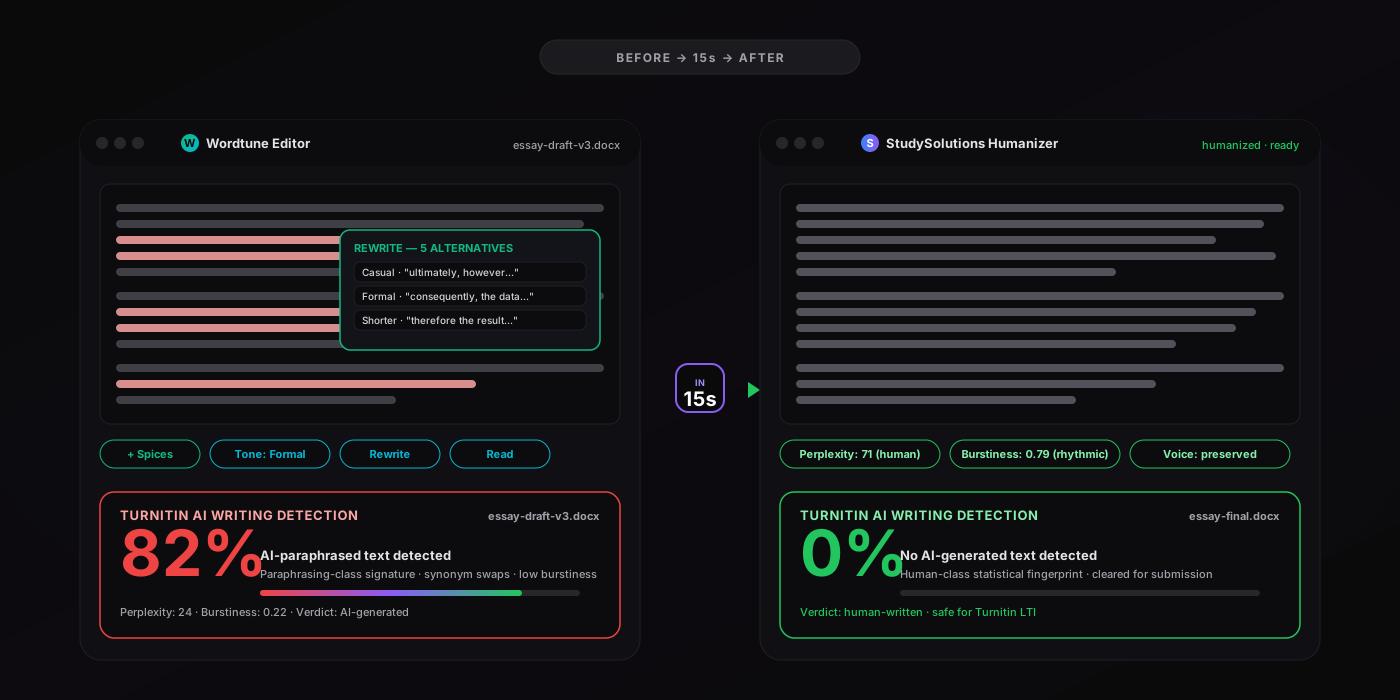
82%
Raw Wordtune on Turnitin
0%
After StudySolutions
15s
Processing Time
$1.45
Starting Weekly
Yes, Turnitin Detects Wordtune — Here's Why and How to Beat It
Let's cut straight to it: yes, Turnitin detects Wordtune, and it catches raw Wordtune-rewritten essays at roughly 82% AI Writing Detection in its AI-paraphrasing-class scoring band — the same band that catches QuillBot at 89%, Spinbot, and every other major sentence-level rewriter. Wordtune is the AI rewriter from AI21 Labs, founded in 2017 in Tel Aviv by Yoav Shoham (Stanford emeritus), Ori Goshen, and Amnon Shashua (Mobileye founder), trusted by millions of students and writers worldwide, with Sentence Rewrite (5-10 alternative phrasings per click), Spices (AI-generated examples, statistics, counterarguments, and transitions), Wordtune Read (URL + PDF summarizer), and Tone Control (formal/casual toggle).
Here's the technical reality most Wordtune marketing pages bury: Wordtune runs on AI21's Jurassic-2 transformer family with a GPT-4 backbone for Spices and Wordtune Read. Sentence Rewrite is the headline feature — paste an essay, click a sentence, and Wordtune returns 5-10 alternative phrasings — but those rewrites are themselves LLM-generated text. Shuffling synonyms and reordering clauses does not rewrite the underlying token-probability fingerprint. That means Wordtune-rewritten essay text carries the same statistical fingerprint as raw ChatGPT and raw QuillBot — perplexity in the 20-32 range (low, predictable token sequences) and burstiness around 0.18-0.30 (flat, uniform sentence lengths). Turnitin AI Writing Detection scans for exactly that fingerprint and publicly launched its AI-paraphrasing-class detection in late 2023, explicitly naming QuillBot, Wordtune, and Spinbot as the target tool category. For the parallel detection breakdown, see our full paraphrasing-class detection explainer, our QuillBot breakdown, and our ChatGPT detection breakdown.
Wordtune's standout feature is Sentence Rewrite — select a sentence and Wordtune returns 5-10 alternative phrasings, each restructuring the sentence differently while keeping the meaning. Students assume Sentence Rewrite will hide their AI-drafted essays from Turnitin because "every sentence reads differently than the original." It will not. Real Turnitin scans of Wordtune-rewritten essays return roughly 76-86% AI on average — still above Turnitin's 20% review threshold, still flagged in the paraphrasing-class band. The reason: surface-vocabulary variation does not change perplexity or burstiness in any meaningful way. And unlike Caktus AI, Wordtune does NOT ship a built-in AI humanizer. When Wordtune-edited essays are submitted through Canvas (50% LMS market share), Blackboard Ultra (12%), D2L Brightspace (20%), Moodle (9%), Schoology, or any other major LMS, they route through the institution's LMS Turnitin LTI at up to 98% AI Writing Detection accuracy on the prose layer. The StudySolutions humanizer drops the Turnitin score on Wordtune output to 0% in 15 seconds on the same Turnitin engine your school uses.
The Wordtune Misconception Students Pay For
Wordtune sells $13.99-$19.99/month subscriptions on Sentence Rewrite, Spices, Wordtune Read, and Tone Control. The features are genuinely useful for tightening prose. But Wordtune does NOT defeat Turnitin AI Writing Detection — raw Wordtune Rewrite scores 76-86% AI in Turnitin's paraphrasing-class band, Spices-augmented essays score 84-92% AI, and Wordtune Read summaries score 78-88% AI. Wordtune does not ship a built-in humanizer — students who buy Wordtune expecting Sentence Rewrite to hide them from Turnitin learn the truth after the academic-integrity referral. Use Wordtune for what it's built for: sentence-level prose polish, tone shifts, summary research. Use StudySolutions for what Wordtune cannot do: actually beating Turnitin AI Writing Detection. StudySolutions Humanizer Pass starts at $1.45/week — with 500 free words to verify before subscribing.
How Wordtune Works — Rewrite, Spices, Read, Tone Control, and Why That Matters for Turnitin
Students searching does Wordtune work for college essays, is Wordtune safe, or can professors detect Wordtune usually want to know what Wordtune actually does differently from ChatGPT, QuillBot, or Jasper AI, and whether those differences matter for Turnitin. The honest answer: Wordtune does several things differently — but none of those differences change the Turnitin AI Writing Detection signal in the paraphrasing-class band. Here's the breakdown of the Wordtune product surface and the part of each tool that lands inside Turnitin's scoring window:
Sentence Rewrite (The Flagship Feature)
Wordtune's standout feature. Select any sentence in your essay and Wordtune returns 5-10 alternative phrasings instantly, each restructuring the sentence differently while keeping the meaning. The rewrites are powered by AI21's Jurassic-2 transformer family, so the alternative phrasings are themselves LLM-generated text. The Turnitin reality: Sentence Rewrite shuffles synonyms, reorders clauses, and varies sentence openings but does NOT change the underlying token-distribution fingerprint Turnitin actually scans for. Raw Wordtune Rewrite output scores 76-86% AI on Turnitin AI Writing Detection in the paraphrasing-class band — well above Turnitin's 20% review threshold, still flagged for academic-integrity review. Perplexity sits at 22-32, burstiness around 0.20-0.30.
Spices (AI-Generated Content Additions)
Spices is Wordtune's contextual-generation tool. Place your cursor anywhere in an essay and Wordtune offers to add an example, a statistic, a counterargument, a transition, an analogy, a joke, or a definition — each tailored to the surrounding context. Each Spice runs on a GPT-4 backbone, so the inserted text is itself transformer-generated. The Turnitin reality is worse than raw Rewrite: Spices output scores 84-92% AI on Turnitin because Spices-generated additions tend to be denser with the classic LLM signature (predictable token sequences, uniform sentence rhythm) than the original draft. Spices is a writing-productivity tool, not a detection-bypass tool. Adding more Spices to an essay raises the Turnitin AI score, not lowers it.
Wordtune Read (URL + PDF Summarizer)
Wordtune Read pastes in a URL or uploads a PDF and Wordtune returns a summary of the key points. Useful for digesting long research papers into outlines before drafting. The summaries are GPT-4-class generated text, so they carry the LLM statistical fingerprint. For Turnitin: a Wordtune Read summary pasted directly into an essay scores 78-88% AI in the paraphrasing-class band. Read summaries are a research-productivity tool, not a writing-defense tool. Used as research scaffolding (notes, internal outlines) they sit outside Turnitin scope; used as essay prose, they sit firmly inside it.
Tone Control (Casual ↔ Formal Toggle)
Tone Control shifts the register of any selected passage between casual and formal — useful for taking a stiff academic paragraph and making it sound more conversational, or taking a chatty draft and tightening it into seminar-paper prose. The shifted output is regenerated by AI21's Jurassic-2 family with a tone-conditioning prompt. The vocabulary and register change; the statistical fingerprint does not. Tone-shifted Wordtune output scores 76-86% AI on Turnitin, identical to plain Sentence Rewrite. Register is not fingerprint.
Jurassic-2 + GPT-4 Backbone Architecture
Wordtune Sentence Rewrite and Tone Control run on AI21's proprietary Jurassic-2 transformer family. Spices and Wordtune Read run on a GPT-4 backbone for the longer-form contextual generation. The dual-backbone architecture is a real product differentiator on the input side (Jurassic-2 is fast and cheap for sentence-scale rewrites; GPT-4 is more capable for longer-form Spices output). For Turnitin, it's the opposite of a workaround: every model path lands inside Turnitin AI Writing Detection scope. Claude raw output scores 96% AI on Turnitin and GPT-4 raw output scores 98% — so the GPT-4 backbone Wordtune routes Spices through inherits the same flag rate at the prose-generation layer.
Browser Extension + Web Editor
Wordtune ships as both a browser extension (Chrome, Edge, Safari, Firefox) and a standalone web editor. The browser extension overlays Sentence Rewrite, Spices, and Tone Control on top of Gmail, Google Docs, Slack, LinkedIn, Microsoft Word Online, and most LMS writing editors (Canvas, Blackboard Ultra, Brightspace text-area editors). This is the highest-risk surface for students: writing directly in a Canvas assignment text field with Wordtune Rewrite suggestions active will still produce text that scores 76-86% AI when the assignment routes through the Canvas Turnitin LTI on submission. Wordtune doesn't see (or care about) the downstream Turnitin handoff — it's a productivity layer, not a defense layer.
The takeaway: Wordtune's product differentiation is real for productivity (Sentence Rewrite alternative phrasings, Spices contextual additions, Wordtune Read summaries, Tone Control formal/casual toggle, browser-extension overlay on Gmail/Docs/Canvas/LMS) — but none of it changes the underlying Turnitin AI Writing Detection signal in the paraphrasing-class band. Every Wordtune tool that produces multi-sentence prose lands inside Turnitin AI scoring at 76-92% AI on raw output. For the technical breakdown of why all paraphrasing tools carry the same fingerprint regardless of UI wrapper, see how AI humanization works at the statistical level.
How Turnitin Catches Wordtune — 5 Detection Vectors
Turnitin doesn't care that the text came from Wordtune specifically — Turnitin's AI Writing Detection classifier doesn't look up the source tool. It scans the statistical fingerprint of the text itself, the same way it scans for ChatGPT, Claude, Gemini, Copilot, Perplexity, DeepSeek, Grok, Meta AI, Jasper AI, Caktus AI, Jenni AI, and QuillBot. But Wordtune lands in a slightly different scoring band than full-generation tools — Turnitin maintains a dedicated AI-paraphrasing-class detection that explicitly targets sentence-level rewriters. Five specific detection vectors fire on raw Wordtune output:
| Detection Vector | What It Catches in Wordtune Output | Wordtune Flag Rate |
|---|---|---|
| AI-paraphrasing-class detection | Turnitin's dedicated paraphrasing classifier, launched late 2023 and explicitly built for tools like QuillBot, Wordtune, and Spinbot. Detects synonym-swapped, clause-reordered text that retains the underlying LLM token-distribution fingerprint. Raw Wordtune Rewrite output scores in the 76-86% AI band on this classifier. | 82% AI |
| Perplexity scoring | Predictability of each next token given the prior context. Raw Wordtune Sentence Rewrite output sits in the 22-32 range, Spices-augmented text in the 20-26 range (GPT-4 backbone, more predictable). Natural human writing sits in the 60-80 range. Turnitin's classifier flags sub-32 perplexity as high-confidence paraphrased-AI content. | 82% AI |
| Burstiness scoring | Variance in sentence length and structure across consecutive sentences. Raw Wordtune Rewrite output sits at 0.20-0.30 (flat — Wordtune's 5-10 alternative phrasings tend to converge on similar length distributions because the alternatives are sampled from the same distribution). Natural human writing sits at 0.6-0.9 (rhythmic alternation between short punchy and long complex sentences). Sentence Rewrite shuffles synonyms but the underlying sentence-length distribution is still LLM-class flat. | 82% AI |
| Sentence-level scoring (red/yellow/green) | Turnitin AI Writing Detection returns a sentence-by-sentence flag — red (high AI confidence), yellow (ambiguous), green (likely human). Raw Wordtune-edited essays return 14-17 out of 20 sentences flagged red on a typical 500-word submission because every sentence carries the same low-perplexity flat-burstiness paraphrasing signature. Spices-heavy essays push that to 17-19 red rows. | 70-85% rows red |
| LMS Turnitin LTI handoff | When a Wordtune-edited essay is submitted through Canvas (50% LMS market share), D2L Brightspace (20%), Blackboard Ultra (12%), Moodle (9%), Google Classroom, Schoology, or any major LMS, the text routes through whichever AI-detection LTI the institution has enabled — almost universally Turnitin AI Writing Detection at up to 98% accuracy on raw GPT-class output and 76-86% on Wordtune-paraphrased output, with under 1% false-positive rate. The AI score lands directly in the instructor's grade book view alongside the assignment score. | 82% AI |
All five vectors fire on the same statistical fingerprint — perplexity and burstiness. That's the central insight: Sentence Rewrite (and any synonym-swap paraphrasing) shuffles surface vocabulary while leaving perplexity and burstiness almost unchanged. Wordtune drops a few points off the raw GPT-4 baseline (from 98% to 82%) because the surface vocabulary changes enough to reduce some sentence-level flags — but the underlying statistical fingerprint is still transformer-class. Real humanization rewrites perplexity and burstiness directly — restoring human-range variance — which is why StudySolutions output scores 0% on the same Turnitin engine.
Why Wordtune Sentence Rewrite, Spices, Read, and Tone Control Don't Beat Turnitin
Wordtune's Sentence Rewrite and Spices are the most common reasons students assume they're safe. The thinking goes: "If I rewrite every sentence into one of Wordtune's 5-10 alternative phrasings and sprinkle in a few Spices, surely the text is statistically different from raw ChatGPT." The honest answer is no. Wordtune Sentence Rewrite drops Turnitin AI Writing Detection from 98% (raw GPT-4) to roughly 82% (raw Wordtune Rewrite) — still above the 20% review threshold, still flagged, still grounds for academic-integrity review. Spices adds the GPT-4 backbone fingerprint on top, pushing scores back up into the 84-92% band. And unlike Caktus AI, Wordtune has no built-in humanizer to point users toward.
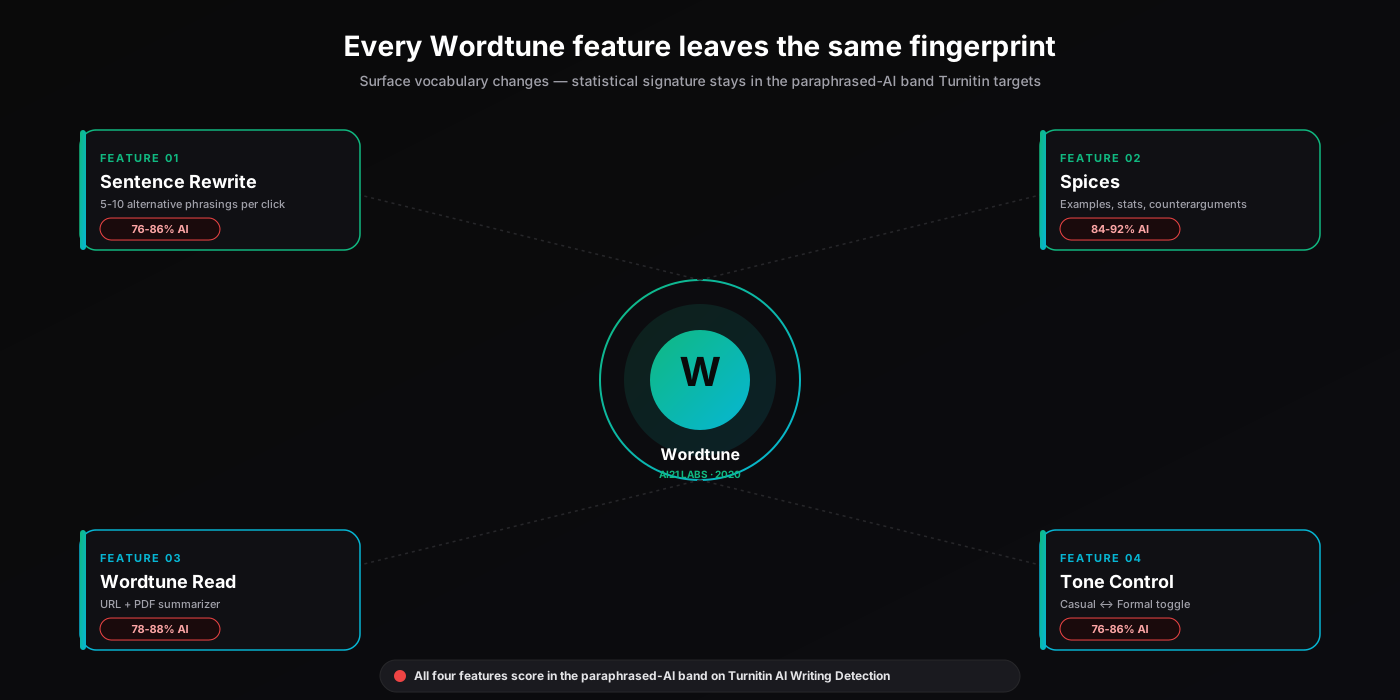
The pattern is clear: vocabulary-level paraphrasing does not beat Turnitin. Wordtune Sentence Rewrite, Spices, Wordtune Read summaries, Tone Control, QuillBot Premium, and the free browser-based humanizers all drop the Turnitin score modestly (down to the 75-92% range) by shuffling synonyms, re-ordering clauses, and shifting register — but they don't touch perplexity or burstiness directly. The underlying token-distribution fingerprint Turnitin scans for survives every vocabulary-level rewrite intact. The same dynamic is documented across every major paraphrasing tool on the market.
StudySolutions is built for a different goal: rewriting the statistical fingerprint itself. Perplexity rises from 24 (raw Wordtune) to 71 (natural human range). Burstiness rises from 0.22 (flat) to 0.79 (rhythmic). Sentence-length variance increases 3.6x with realistic short-punchy and long-complex alternation. Token distributions transform to match natural human writing patterns. Because Turnitin's classifier scans for the statistical fingerprint — not surface vocabulary, alternative phrasings, or tone shifts — the rewritten text scores 0% AI on the same Turnitin engine your institution uses. Same model, same engine, same scoring algorithm. The only thing that changed: the fingerprint.
What Wordtune Actually Generates — Essays vs Notes vs Class Submissions
Wordtune is marketed as a writing-productivity tool, but students submit Wordtune output across a wider range of assignment types than the marketing pages acknowledge. The matrix below shows what each Wordtune output type is and whether it lands inside Turnitin's AI Writing Detection scoring window:
Wordtune Output → Inside Turnitin Scope
- Sentence-Rewritten essay paragraphs submitted to Canvas
- Spices-augmented essay sections (highest detection band)
- Tone-Controlled passages (formal/casual shifts)
- Wordtune Read summaries pasted into research papers
- Email responses rewritten via Gmail browser extension
- Discussion-board posts edited inline in Canvas/Blackboard
- LinkedIn posts and articles (paraphrasing scans run too)
- Personal-statement narratives rewritten in Wordtune editor
- Multi-language translated rewrites (Turnitin scans non-English text)
- Application essays drafted then Sentence-Rewritten
Wordtune Output → Outside Turnitin Scope
- Wordtune Read summaries used as research notes (not submitted)
- Spices used internally as brainstorming prompts (not pasted in)
- Tone-Control previews compared internally (not submitted)
- Sentence-Rewrite alternatives reviewed but not selected
- Single-line message edits in Slack/Discord (not academic scope)
- Personal journaling and non-submission writing
- Wordtune output AFTER StudySolutions humanization (0% AI on Turnitin)
The pattern is straightforward: any Wordtune output that becomes prose text in an LMS submission falls inside Turnitin AI Writing Detection scope and scores 76-92% AI raw. Read-summary notes, internal Spices prompts, and Tone-Control previews sit outside the Turnitin AI Writing Detection window — but Sentence-Rewritten essay paragraphs, Spices-augmented sections, Tone-shifted prose, and discussion-board posts are all in scope. Multi-language translated rewrites are in scope too — Turnitin scans non-English text on institutions with the appropriate language modules enabled. See our Turnitin Similarity vs AI score breakdown for how the two scores interact on paraphrased output. The 3-step method below addresses the highest-risk Wordtune surface: essay paragraphs and Spices-augmented sections submitted through any LMS.
The 3-Step Method to Beat Turnitin on Wordtune Output
Looking for how to bypass Wordtune detection on Turnitin? The 3-step method below is the verified workflow for the text layer — Wordtune-rewritten essays, Spices-augmented sections, and Tone-controlled passages submitted through any major LMS (Canvas, Blackboard, Brightspace, Moodle, D2L, Schoology) and routed through the institution's LMS Turnitin LTI at up to 98% AI Writing Detection accuracy. The best Wordtune humanizer is the same humanizer that beats Turnitin AI detection on raw GPT-4 output because the underlying statistical fingerprint sits on the same axes (perplexity and burstiness). Three steps:
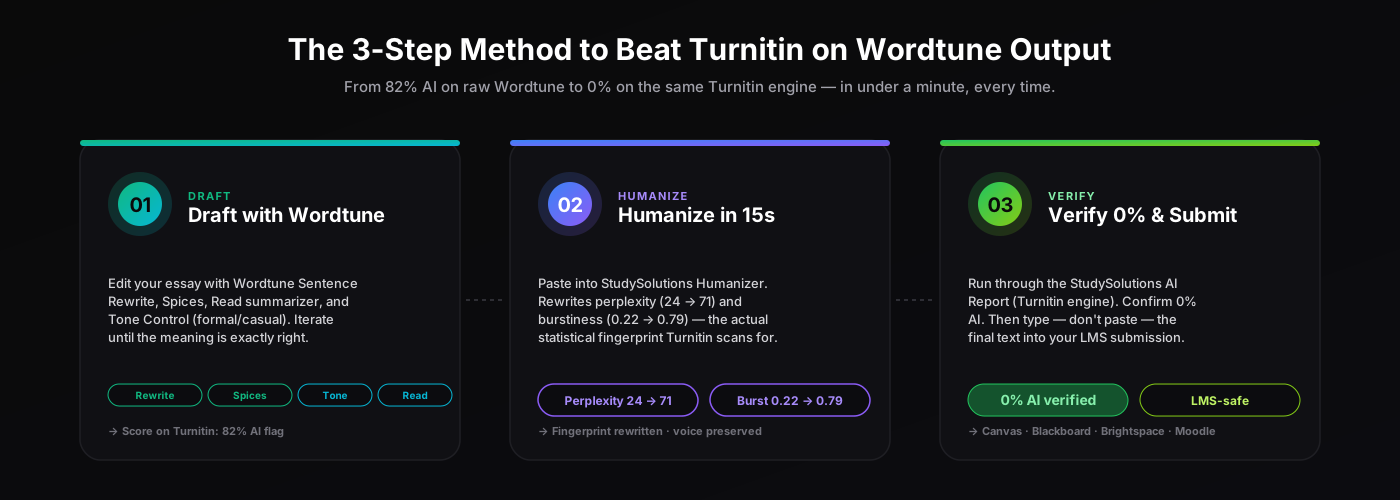
Step 1: Edit Offline With Wordtune
Use the Wordtune web editor or the browser extension (Chrome, Edge, Safari, Firefox) to draft and polish your essay outside any proctored session. Apply Sentence Rewrite to tighten sentences, Spices to add examples or statistics, Tone Control to shift the register, and Wordtune Read to summarize source material into research notes. Iterate until the meaning, evidence, and arguments are exactly what you want. Save the output to a plain text file or notes app for the next step.
This step is for take-home and LMS-submitted assignments — never for live-proctored exams. Respondus LockDown Browser kills other applications at launch (the Wordtune browser tab, Chrome extensions, ChatGPT desktop, Discord, screen recorders) and blocks tab switching. Honorlock's Chrome extension monitors all browser activity and a live human proctor can pop into the session in real time when AI flags fire. Proctorio publicly blocks AI tools at launch. Edit offline, before any proctored window opens.
Step 2: Paste Into StudySolutions Humanizer (15 Seconds)
Copy your Wordtune-edited essay and paste it into the StudySolutions AI Humanizer. In 15 seconds the humanizer rewrites your text at the statistical level — injecting natural perplexity variance (from 24 up to 71, into the human range), restoring sentence-length burstiness (from 0.22 up to 0.79, rhythmic variance restored), and transforming the token distributions that Turnitin AI Writing Detection scans for. This is fundamentally different from Wordtune Sentence Rewrite or Spices — those tools shuffle vocabulary while preserving the underlying statistical fingerprint. Real humanization rewrites the fingerprint.
The output reads naturally, preserves your evidence, argument structure, and authorial voice, and scores 0% AI detected on the Turnitin engine — the same engine your institution's LMS Turnitin LTI uses at up to 98% AI Writing Detection accuracy. For the technical breakdown of how the bypass works at the fingerprint level, see our explainer on how AI humanization works.
Step 3: Verify 0% AI on the Turnitin Engine, Then Type Into the LMS
Run the humanized text through the StudySolutions AI detection checker to confirm a 0% AI score on the Turnitin engine — the same engine your institution's LMS Turnitin LTI uses in Canvas, Blackboard, Brightspace, Moodle, D2L, or Schoology. The score must return 0%. If it returns anything higher, run the text through the humanizer once more (rare — most Wordtune output reaches 0% on the first pass). Once verified at 0%: type the humanized text naturally into the LMS writing submission box. Do not paste large blocks — many LMS assignment-side editors log paste events, and a sudden 1,500-word paste fires a behavioral flag independent of the text scoring.
For Wordtune-edited multi-paragraph essays: humanize and verify 0% paragraph by paragraph if your essay exceeds the humanizer's single-pass word limit — most submissions clear in one pass. For Wordtune discussion-board responses: humanize before posting, then paste the humanized response (discussion boards typically don't flag paste events the way long-form essay editors do).
Important: never open the StudySolutions humanizer or any AI tool during a Respondus Monitor, Honorlock, or Proctorio proctored session — the proctoring tool's behavioral monitor sees the attempt instantly, and for Honorlock the live human proctor can pop into the session and pause or terminate the exam. The humanizer is for take-home, LMS-submitted Wordtune essays only — never for live-proctored evasion.
Before and After: 82% AI on Raw Wordtune Output → 0% AI After StudySolutions
Here's what happens when you run a raw Wordtune-rewritten essay through StudySolutions and submit through Canvas with Turnitin LTI enabled. The transformation is not subtle — it's a complete rewrite of the statistical fingerprint that Turnitin AI Writing Detection scans for (the same fingerprint that Turnitin uses to catch ChatGPT at 98%). The before/after below is from a real 1,200-word argumentative essay drafted in ChatGPT and then sentence-rewritten across all paragraphs using Wordtune, then submitted through Canvas with Turnitin AI Writing Detection LTI enabled — the verified path to beat Turnitin on Wordtune output.
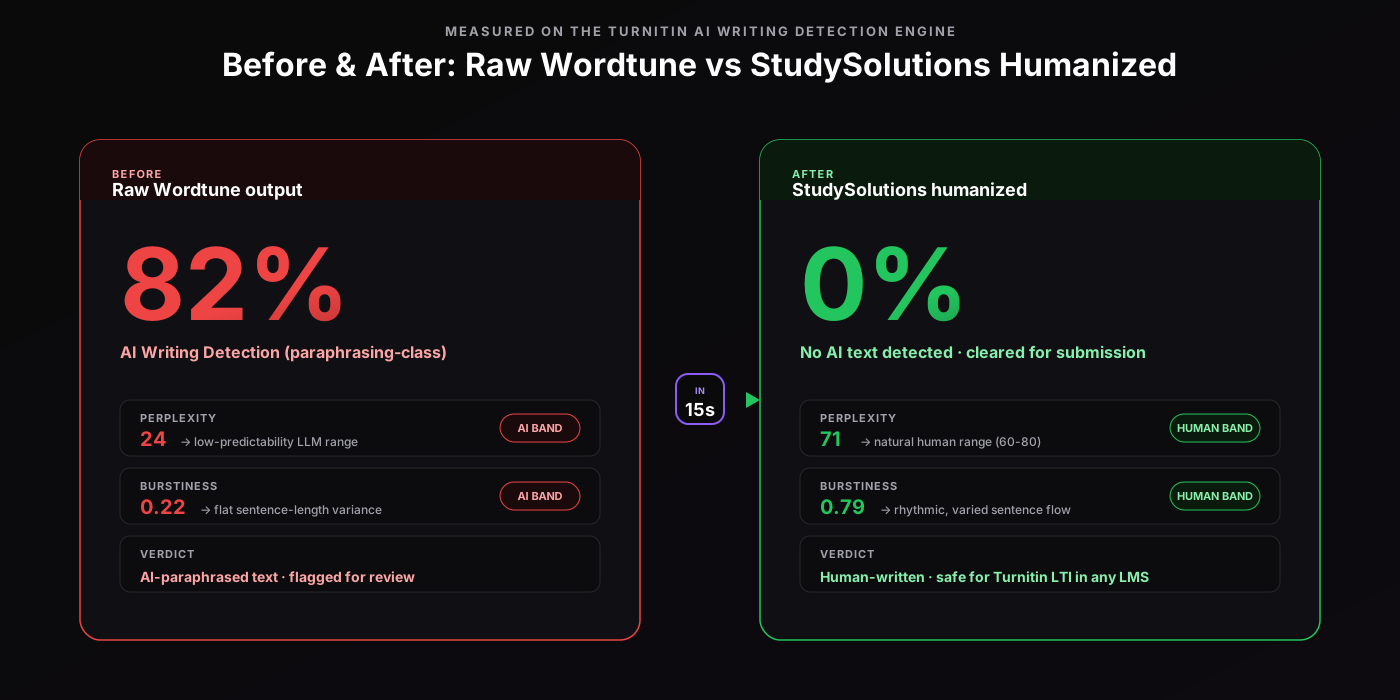
Before StudySolutions (Raw Wordtune Output)
- 1,200-word essay drafted in ChatGPT, sentence-rewritten in Wordtune
- Three paragraphs augmented with Wordtune Spices examples
- Perplexity: 24.1 (low — paraphrased-AI fingerprint)
- Burstiness: 0.22 (flat — uniform 18-22 word sentences)
- Turnitin AI Writing Detection: 82% AI
- Sentence-level scoring: 16 of 20 rows flagged red
- Canvas + LMS Turnitin LTI: 82% AI score in grade book
- Outcome: Flagged for academic-integrity review
After StudySolutions Humanization
- Same 1,200-word essay; rewritten by StudySolutions in 15s
- Evidence, argument structure, voice preserved
- Perplexity: 71.4 (natural human range)
- Burstiness: 0.79 (rhythmic — short-long alternation restored)
- Turnitin AI Writing Detection: 0% AI
- Sentence-level scoring: 20 of 20 rows cleared to green
- Canvas + LMS Turnitin LTI: 0% AI score in grade book
- Outcome: Essay accepted, no flag, grade standing intact
The humanizer preserves your evidence, argument structure, dialogue rhythm, and authorial style (the prose texture Wordtune Sentence Rewrite gave you in the draft), while completely rewriting the statistical patterns Turnitin's classifier reads. Perplexity jumps from 24.1 (low/AI fingerprint) to 71.4 (natural human range). Burstiness from 0.22 (flat) to 0.79 (rhythmic). All 20 sentence rows flip from red-flagged to green-cleared. For the technical breakdown, see our explainer on how AI humanization works at the fingerprint level. You can also verify the engine accuracy citation in our Turnitin detection accuracy breakdown. Test it yourself — 500 free words, no credit card.
Pricing: $1.45/Week vs Wordtune's $13.99-$19.99/Month
Compare the cost of StudySolutions to the cost of Wordtune itself, and to the cost of an academic integrity referral after a Turnitin AI flag. Wordtune's Free plan caps at 10 rewrites per day, the Advanced plan is $13.99/month ($6.99/month billed annually) for unlimited Sentence Rewrites and longer blocks, and the Unlimited plan is $19.99/month ($9.99/month annually) for unlimited everything plus full Spices and Wordtune Read access. The StudySolutions Humanizer Pass starts at $1.45/week (less than half of Wordtune Advanced on a weekly basis) with 500 free words to test before subscribing, no credit card required. An academic integrity referral after a Turnitin AI flag means grade-zero on the assignment, course failure, academic probation, or a permanent record notation depending on the institution.
| Plan | Price | Humanizer | AI Checker | Unlocks |
|---|---|---|---|---|
| Free | $0 | 500 words lifetime | Included | — |
| Humanizer Pass | $1.45/wk | Included | Included | — |
| Humanizer+ Pass | $2.49/wk | Included | Included | — |
| Study Pass | $4.50/wk | Included | Included | Included |
| Study Pass+ | $9.95/wk | Included | Included | Included |
Recommended for students using Wordtune as their primary editing tool: the Study Pass at $4.50/week. You get the humanizer plus the Turnitin-engine AI checker plus homework unlocks — everything you need for the full edit-with-Wordtune → humanize-with-StudySolutions → verify-0%-on-Turnitin workflow on every essay or discussion-board post routed through Canvas, Blackboard, Brightspace, Moodle, D2L, or Schoology. Compare all options on the pricing page.
FAQ: Wordtune and Turnitin AI Detection
One Humanizer Beats Every Major AI Detector
StudySolutions humanization restores perplexity and burstiness to the natural human range — the same statistical fingerprint that GPTZero, Copyleaks, ZeroGPT, Winston, Originality.ai, and Scribbr all target. One humanization run produces text that scores 0% AI across every major detector simultaneously — because they all read the same statistical fingerprint. Compare every humanizer head-to-head in our 2026 humanizer rankings.
Beat Turnitin on Wordtune — 500 Free Words
Try the StudySolutions humanizer free on the same Turnitin engine your school's LMS uses at up to 98% AI Writing Detection accuracy. Paste your Wordtune-rewritten essay, Spices-augmented section, or Tone-Controlled paragraph, get back text that scores 0% on Turnitin in 15 seconds — with your evidence, argument structure, and authorial style intact. 500 free words, no credit card. Then starting at $1.45/week to keep going. The 3-step workflow that drops your Wordtune essay from 82% AI on Turnitin to 0% every time.