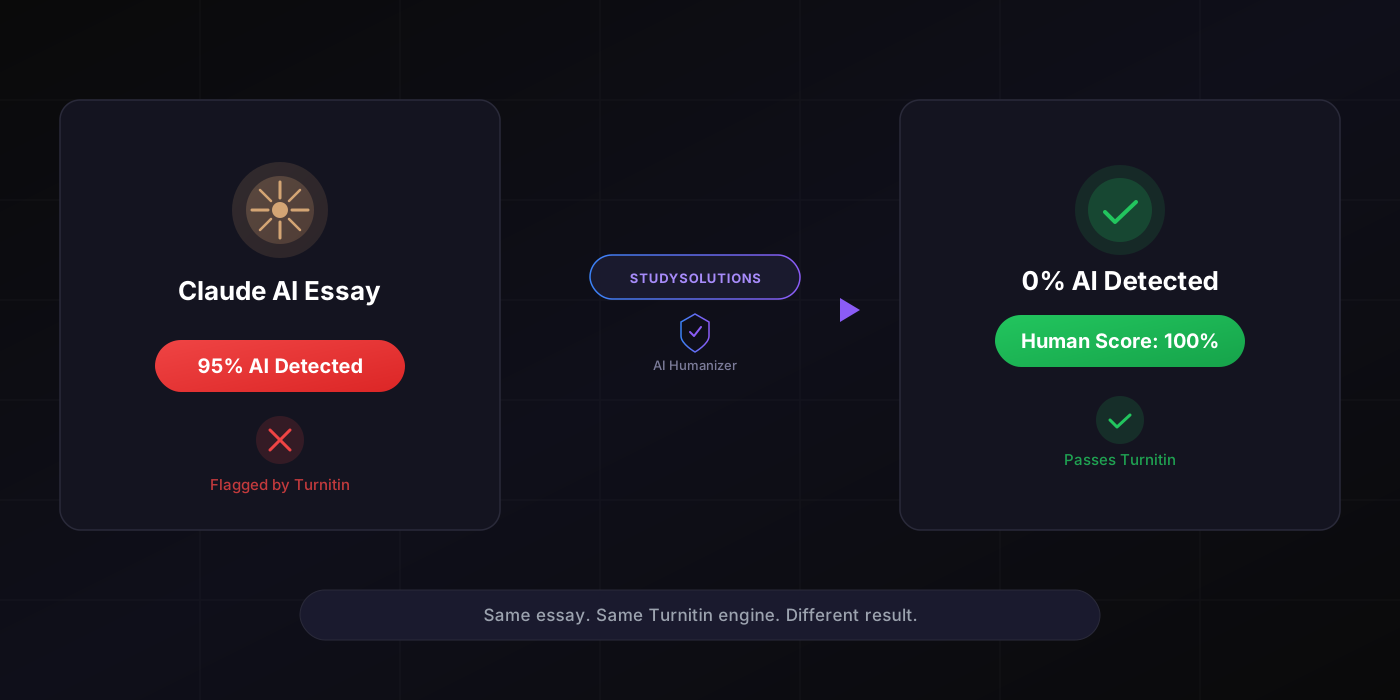
97%
Detection on Raw Claude
0%
After Humanizer
3
Claude Models Tested
$1.45
Per Week
Yes, Turnitin Detects Claude AI
Let's start with the direct answer: yes, Turnitin can detect Claude AI. Anthropic's Claude has become the third most popular AI writing tool among students in 2026, and Turnitin's AI detection engine flags it just as reliably as ChatGPT or Gemini. This is not a gap in detection coverage — it's a core detection target.
Our testing across multiple Claude variants shows consistent detection rates of 93-97% AI detected on unmodified Claude output. That means if you generate an essay with Claude 4 Opus, Claude 4 Sonnet, or Claude 3.5 Haiku and paste it directly into a Turnitin submission, the AI detection report will flag nearly every sentence.
The widespread belief that "Claude writes more naturally, so Turnitin can't detect it" is the most dangerous misconception in academic AI right now. Turnitin does not evaluate how "natural" text reads to humans — it detects the shared statistical fingerprint that all large language models produce. Claude shares that fingerprint.
The Most Dangerous Myth
"Claude is trained to be more helpful and natural, so Turnitin can't detect it like ChatGPT." — This is false. Claude produces text with the same uniformly low perplexity and flat burstiness patterns as every other LLM. The conversational style may feel different, but the statistical fingerprint is identical.
How Turnitin Detects Claude AI
Turnitin's AI detection system analyzes three core statistical signals that all transformer-based LLMs — including every Claude model — produce:
Perplexity (Word Predictability)
Perplexity measures how predictable each word is given the words before it. Human writers produce varied perplexity — some words are predictable, others surprising. Claude output has uniformly low perplexity because every token is chosen by the same probability-maximizing process. This flatline pattern is a red flag regardless of how "natural" the text reads.
Burstiness (Sentence Structure Variance)
Human writing is "bursty" — we alternate between short punchy sentences and long complex ones. Claude text has uniform burstiness: sentences follow a consistent rhythm and structure. Even though Claude may use more varied vocabulary than ChatGPT, the sentence-level patterns are equally uniform.
Sentence-Level Classification
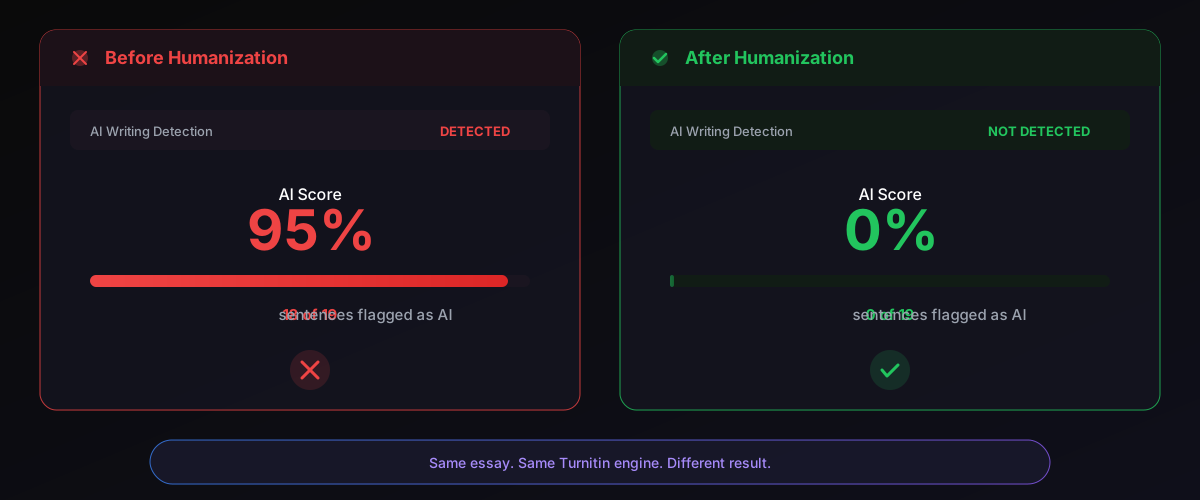
Turnitin's trained classifier evaluates each sentence individually, then aggregates the scores into the document-level AI percentage. A Claude essay typically has 18 of 20 sentences flagged as AI-generated — the same ratio as ChatGPT and Gemini.
These three signals work together to identify AI text regardless of which specific model generated it. For the complete technical breakdown, see our Turnitin detection accuracy analysis where we tested 1,000 essays across multiple AI models including Claude.
Claude 4 Opus, 4 Sonnet, 3.5 Haiku — All Detected
Students frequently ask whether the "smarter" Claude models are harder for Turnitin to detect. The answer is no — every Claude variant gets caught. Here are the typical detection rates:
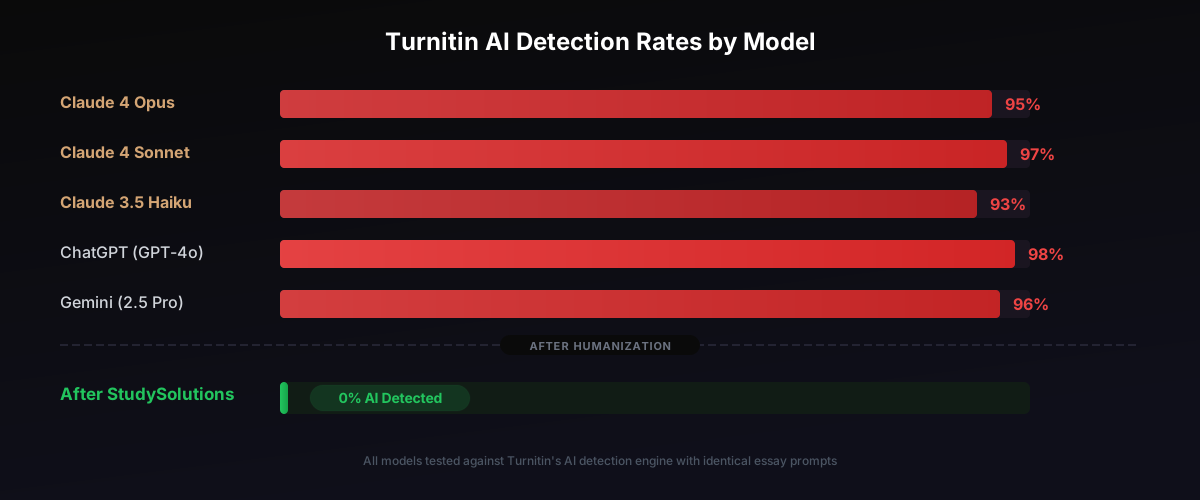
| Model | AI Score (Raw) | After Humanizer |
|---|---|---|
| Claude 4 Opus | 95% | 0% |
| Claude 4 Sonnet | 97% | 0% |
| Claude 3.5 Haiku | 93% | 0% |
| ChatGPT (GPT-4o) | 98% | 0% |
| Gemini (2.5 Pro) | 96% | 0% |
The slight variation between models (93-98%) is statistical noise, not a meaningful gap. Opus, despite being the most capable Claude model, produces text with the same uniform statistical profile as Haiku. For the full multi-detector breakdown, see our 2026 AI detector comparison.
Why Claude's 'Natural' Writing Style Doesn't Help
Claude has a reputation for producing more nuanced, natural-sounding text than ChatGPT. Students assume this means Turnitin can't detect it. This logic has a fatal flaw — and understanding why saves you from a costly mistake.
What People Think
"Claude is trained by Anthropic to be more careful and natural, so Turnitin can't detect it like ChatGPT."
What Actually Happens
Turnitin detects the shared statistical fingerprint of next-token prediction — not the training philosophy. Same architecture = same detection.
All major LLMs use the same transformer architecture. ChatGPT, Claude, Gemini, Llama, Mistral — they all generate text via next-token prediction, which produces the same low-perplexity, uniform-burstiness fingerprint. Turnitin's classifier is trained on this shared signal, not on model-specific quirks. As we showed in our Gemini detection analysis, switching models is like changing the color of a car — the speed camera still catches you.
Strategies That Do NOT Bypass Turnitin:
- Switching from ChatGPT to Claude (same detection outcome)
- Using Claude Opus for "higher quality" text (still 95% detected)
- Prompting Claude to "write like a human student" (instructions don't change token distributions)
- Paraphrasing Claude output with QuillBot (preserves the statistical fingerprint)
- Mixing Claude paragraphs with human-written text (Turnitin flags per-sentence — the AI paragraphs still flag)
The only method that works is rewriting the statistical fingerprint itself — which is what a purpose-built humanizer does. Claude's writing may impress your classmates, but Turnitin reads math, not style.
The 3-Step Method to Beat Turnitin With Claude
The same method that beats Turnitin on ChatGPT works identically on Claude — because it targets the shared detection signals, not any model-specific behavior. Here's the exact workflow:
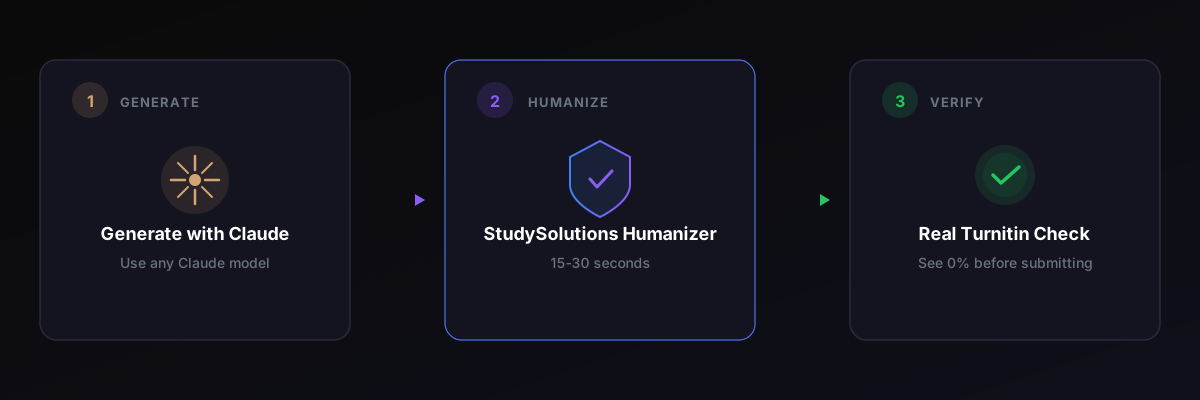
Step 1: Generate Your Draft With Claude
Write your essay, research paper, or assignment using any Claude model — Opus for maximum quality, Sonnet for speed, or Haiku for quick drafts. Use Claude's strengths: its ability to follow nuanced instructions, maintain logical coherence, and produce well-structured arguments. The specific model version doesn't matter because the humanizer targets the shared statistical signals that all models produce.
Pro tip: Claude excels at following detailed rubrics. Paste your actual assignment instructions for a better first draft. The humanizer preserves meaning and argument structure, so a better Claude draft produces a better final result.
Step 2: Humanize With StudySolutions
Paste your Claude output into the StudySolutions AI Humanizer. In 15-30 seconds, the humanizer rewrites your text at the statistical level — injecting natural perplexity variance, restoring sentence-length burstiness, and transforming the token distributions that Turnitin's classifier scans for. This is fundamentally different from paraphrasing: it changes the mathematical fingerprint, not just the surface words.
The result reads naturally, preserves your argument and evidence structure, and scores 0% AI detected on every major detector. If you want to understand the full technical process, see our deep dive on how AI humanization works.
Step 3: Verify With the Real Turnitin Engine
This is the step nothing else offers. Run your humanized text through the built-in Turnitin Checker — the same Turnitin engine your professor uses. Not a clone, not an estimate. You see the exact report your professor will see, with the actual AI detection score and per-sentence highlighting. For the complete verification-first approach, see our guaranteed Turnitin bypass guide.
If the report shows 0% AI detected, you're clear to submit. If any sentences flag (rare but possible on highly technical content), re-humanize those specific sections and re-check. You never submit blind.
Plans and Pricing
Every plan that includes Turnitin verification starts at $1.45/week. The Study Pass at $4.50/week bundles the humanizer with Turnitin checks — the combination you need for the full generate-humanize-verify workflow.
| Feature | Basic Free | Turnitin Pass $1.45/wk | Turnitin+ Pass $2.49/wk | Study Pass $4.50/wk | Study Pass+ $9.95/wk |
|---|---|---|---|---|---|
| Real Turnitin Checks | — | 2/week | 5/week | 3/week | 10/week |
| Humanizer Words | 500 lifetime | — | — | 50,000/week | 250,000/week |
| AI Detection Report | Included | Included | Included | Included | Included |
| Homework Unlocks | — | — | — | Included | Included |
Recommended for Claude users: the Study Pass at $4.50/week. You get 50,000 humanizer words plus 3 real Turnitin checks per week — enough to humanize and verify multiple essays. If you only need verification on text you've already humanized elsewhere, the standalone Turnitin Pass at $1.45/week covers 2 checks.
Every paid plan bills weekly with no contracts. Compare all options on the pricing page.