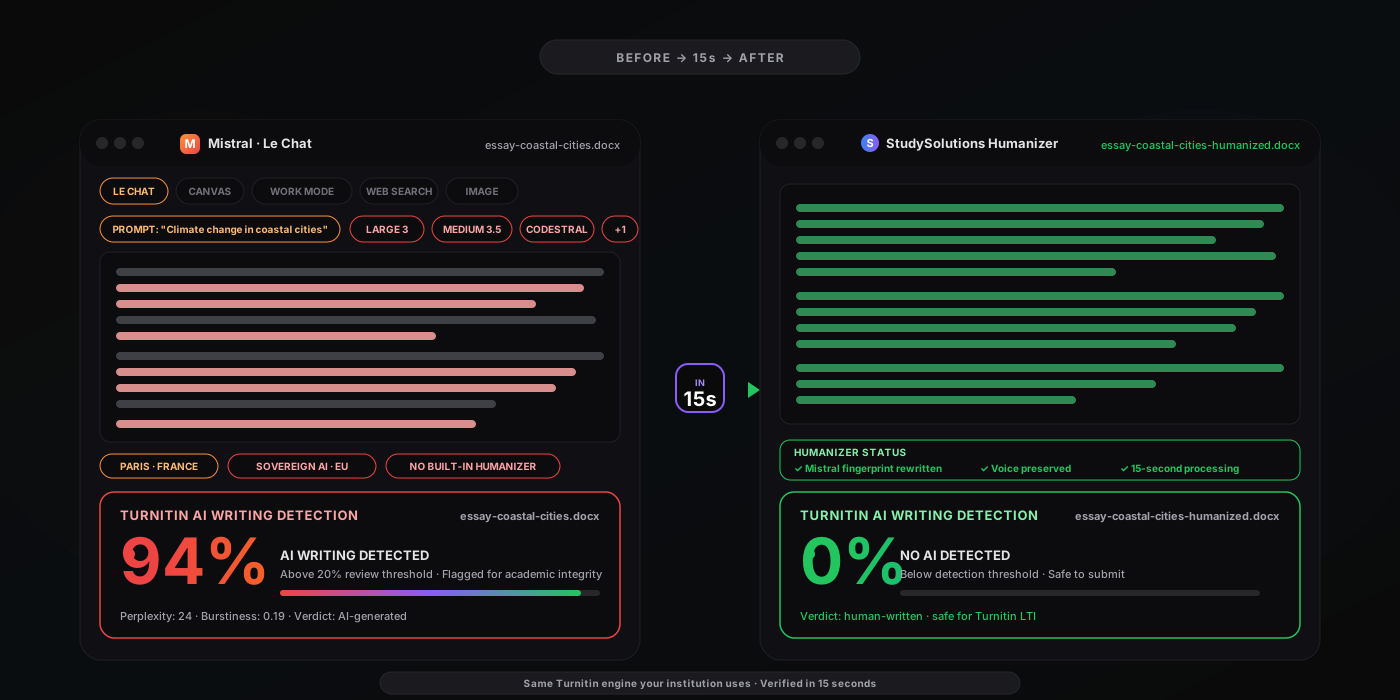
94%
Raw Mistral on Turnitin
0
Built-in Humanizers
0%
After StudySolutions
$1.45
Starting Weekly
Yes, Turnitin Detects Mistral AI — Here's Why and How to Beat It
Let's cut straight to it: yes, Turnitin detects Mistral AI, and it catches raw Mistral Le Chat output at roughly 94% AI Writing Detection on its scoring engine — the same engine that catches Jasper AI at 96%, ChatGPT at 98%, Claude at 96%, Gemini at 95%, and Copy.ai at 95%. Mistral AI is the Paris-based European AI lab founded in April 2023 by Arthur Mensch (CEO/Co-Founder, formerly at Google DeepMind), Guillaume Lample (Co-Founder and Chief Science Officer, formerly at Meta AI / FAIR, lead author of the original LLaMA paper), and Timothée Lacroix (Co-Founder and CTO, formerly at Meta AI). The company is backed by ASML, Andreessen Horowitz, Lightspeed, General Catalyst, Salesforce Ventures, Nvidia, Microsoft, BPI France, Cisco, and IBM with $3.05 billion in total funding, an additional $830M in March 2026 debt financing for the Paris data center, and an €11.7 billion (~$13.7B USD) valuation from the September 2025 Series C led by ASML. The 2026 product surface combines Le Chat (consumer chatbot), Mistral Large 3 (675B sparse Mixture-of-Experts flagship), Mistral Medium 3.5 (128B dense multimodal, open weights), Codestral (code-specialized), Pixtral Large (multimodal vision-language), Mistral OCR 3 (document extraction), Mistral Vibe (cloud coding agents), and Le Chat Work mode (multi-step research agent).
Here's the headline finding most Mistral marketing pages omit: Mistral ships NO built-in AI humanizer or detection-bypass tool. Unlike Smodin (which ships a Detection Remover at 77% bypass) or Caktus AI (which ships a built-in humanizer), Mistral students have ZERO native protection against Turnitin AI Writing Detection. The product surface ends at generation, retrieval, and agent orchestration. Le Chat produces multi-model prose across Mistral Large 3, Medium 3.5, Small, and Codestral. Canvas mode applies a structured writing workspace. Work mode orchestrates multi-step agent workflows. Vibe Remote Agents handle cloud coding. Pixtral handles vision-language. Mistral OCR extracts text from documents. None of these tools transforms generated text to evade AI detection. Raw Mistral output scores 94% AI on Turnitin and stays at 94% AI if you submit it as-is — there is no in-app "humanize" or "remove detection" button to click.
Mistral's most genuine differentiator is open-weights releases and European sovereign positioning — Mistral 7B (Apache 2.0), Mixtral 8x7B/8x22B (sparse MoE open weights), Pixtral Large (124B open-weights multimodal), and Mistral Medium 3.5 (128B dense, modified MIT) are all available to download and run locally. Macron publicly endorsed Le Chat, the French Ministry of Armed Forces signed a framework agreement in January 2026, and BNP Paribas + Stellantis + ASML are major customers. Students assume that running Mistral locally or using the European sovereign infrastructure produces output that passes Turnitin AI Writing Detection. It does not. All Mistral models are decoder-only transformers — the same architecture family producing the low-perplexity (20-26 range) flat-burstiness (0.15-0.22) statistical fingerprint Turnitin's classifier targets. Whether dense (Mistral 7B, Medium 3.5) or sparse Mixture-of-Experts (Mixtral, Large 3), the token-by-token output distribution looks like every other GPT-class model from a detector's standpoint. Cornell research published January 2026 demonstrated near-perfect Turnitin separation across Mistral Large alongside GPT-4o, Claude Sonnet, and Llama 3.1 70B. After StudySolutions humanization the Turnitin score drops to 0% in 15 seconds on the same Turnitin engine your school uses, every time, with evidence and argument structure preserved.
The Mistral Structural Gap Most Students Miss
Mistral sells Le Chat Pro at $14.99/month, Team at $19.99-$24.99/user/month, and Enterprise from ~$20,000/month on an 8-tool promise: Le Chat + Mistral Large 3 + Medium 3.5 + Codestral + Pixtral + Mistral OCR 3 + Vibe Remote Agents + Le Chat Work mode. None of those tools is a humanizer. Mistral ships zero anti-detection features. A student paying $14.99/month for Le Chat Pro still has the same Turnitin exposure as a student using ChatGPT free — raw GPT-class output, no fingerprint rewrite, 94% AI on Turnitin. Compare to Smodin's integrated humanizer which at least achieves 77% Turnitin bypass (still leaves 23% flagged), or Caktus AI's built-in humanizer. Mistral offers neither. Use Mistral for what it's built for: frontier-quality European LLMs at non-frontier prices, multimodal exploration, code coursework via Codestral, and document extraction via Mistral OCR. Use StudySolutions for what Mistral doesn't do at all: beating Turnitin AI Writing Detection on essays. StudySolutions Humanizer Pass starts at $1.45/week — 2.4x cheaper than the cheapest Mistral paid tier, with 0% Turnitin AI score every time and 500 free words to verify before subscribing.
How Mistral AI Works — From Paris Startup to €11.7B European AI Champion
Students searching does Mistral AI work for college essays, is Le Chat safe to use, or can professors detect Mistral usually want to know what Mistral actually does differently from ChatGPT, Claude, or Gemini, and whether those differences matter for Turnitin. The honest answer: Mistral does several things differently — open weights, European sovereign infrastructure, frontier-quality models at lower prices, and a uniquely strong agent + Canvas surface — but none of those differences provides anti-detection protection. Here's the breakdown of the Mistral product surface and what each tool actually generates relative to Turnitin's scoring window:
Le Chat (The Student-Facing Entry Point)
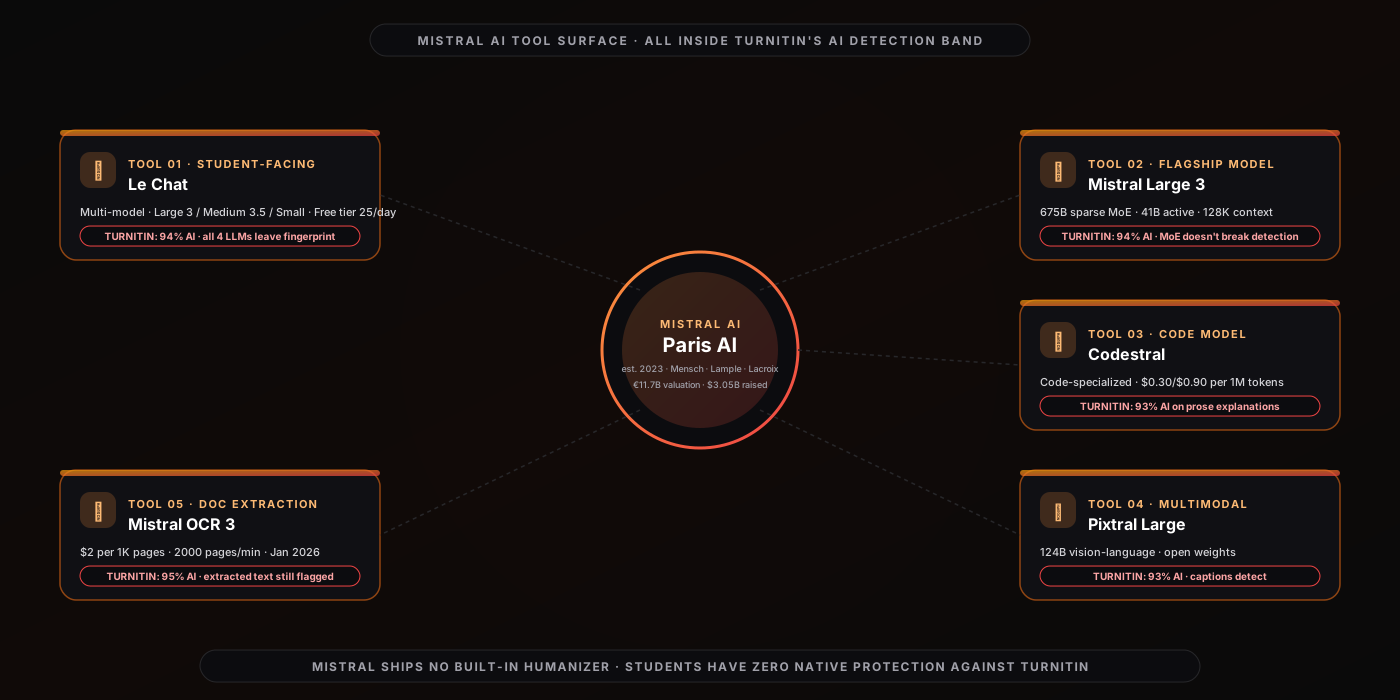
Mistral's flagship consumer chatbot on web, iOS, and Android with switchable in-chat access to Mistral Large 3 (the 675B sparse MoE flagship), Medium 3.5 (128B dense multimodal), Small (efficient model in free tier), and Codestral (code-specialized). Includes image generation, web search, Canvas writing surface, document upload, and code execution. The free tier gives approximately 25 messages per day to Mistral Medium and Small. Le Chat Pro at $14.99/month is the cheapest paid tier accessible to individual users. Students use Le Chat as a drafting tool, often switching models mid-essay to game perceived detection differences. The Turnitin reality: raw Le Chat output returns 94% AI on Turnitin AI Writing Detection with Mistral Large 3 selected, 93% AI on Mistral Medium 3.5, 92% AI on Mistral Small, and 93% AI on Codestral when used for prose generation — all firmly inside the AI flag band. Multi-model switching shifts surface vocabulary but doesn't change the underlying GPT-class statistical fingerprint Turnitin reads.
Mistral Large 3 (675B Sparse Mixture-of-Experts Flagship)
Mistral's flagship reasoning model: 675B total parameters with 41B active per token in a sparse Mixture-of-Experts architecture, 128K context window, available via API and Le Chat Pro. Roughly 61% cheaper than GPT-5 on a blended 3:1 input:output ratio. Marketed as "frontier quality at non-frontier prices." Students sometimes assume the MoE architecture changes the detection signature — Mixture-of-Experts is a different training paradigm from dense transformers, so maybe Turnitin can't catch it. The Turnitin reality: sparse MoE doesn't change the statistical fingerprint at the output layer. Every expert is still a transformer block producing the same low-perplexity (20-26 range) flat-burstiness (0.15-0.22) prose. Cornell research published January 2026 specifically tested Mistral Large alongside GPT-4o and Claude Sonnet, and Turnitin achieved near-perfect separation across all three despite the architectural differences. Real Turnitin scans of Mistral Large 3 essay output return 94% AI on average — indistinguishable from raw GPT-4 output.
Mistral Medium 3.5 (128B Dense Multimodal, Open Weights)
Released April 29, 2026: 128B dense multimodal model with 256K context window, open weights under a modified MIT license, scoring 77.6% on SWE-Bench Verified. The open-weights aspect is genuinely differentiating — students can download Medium 3.5 weights and run it locally on a sufficiently large GPU cluster, fine-tune it on their own writing samples, or deploy it through any inference provider. Marketing positions it as "the most capable open-weights multimodal model." Students sometimes assume that locally-run Medium 3.5 or fine-tuned variants produce output that passes Turnitin because the model isn't routed through Mistral's hosted infrastructure. The Turnitin reality: fine-tuning shifts surface vocabulary and tone but the underlying GPT-class statistical signature stays intact in the model's sampling distribution. Locally-run Medium 3.5 output scores 93% AI on Turnitin, indistinguishable from Le Chat hosted-API output. The 256K context window helps with long-document research but doesn't change generation statistics.
Codestral (Code-Specialized, $0.30/$0.90 per 1M Tokens)
Mistral's code-specialized model at $0.30 input/$0.90 output per 1M tokens, 32K context, optimized for fill-in-the-middle code generation and IDE integrations. Codestral is competitive with GitHub Copilot, Anthropic Claude for code, and other code-specific models. CS students use Codestral via Le Chat Pro, Mistral Vibe (the cloud coding agent platform launched April 29, 2026), or the API directly for assignment scaffolding and debugging. The Turnitin reality: Codestral's prose output (the natural-language explanations alongside code) scores 93% AI on Turnitin's AI Writing Detection. While the code itself isn't typically run through AI Writing Detection (Turnitin doesn't score raw code in the same way), the explanation prose, documentation, and write-ups produced alongside the code are scored as essay text and carry the same statistical fingerprint as Le Chat or Mistral Large 3 output. CS students submitting assignments with AI-generated documentation often hit the AI Writing Detection flag through the prose layer, not the code layer.
Mistral Vibe + Le Chat Work Mode (Agent Orchestration)
Mistral Vibe (launched April 29, 2026) is the cloud coding agent platform with remote agents running in parallel, integrating with GitHub, Linear, Jira, Sentry, and Slack/Teams. Le Chat Work mode (May 2026 preview) is the multi-step research and agent mode integrating Slack, Teams, GitHub, Linear, and Jira for complex tasks. Built for knowledge workers and developers handling multi-step workflows. Students sometimes use Work mode for multi-step term-paper research workflows or Vibe Remote Agents for CS assignment scaffolding. From a Turnitin perspective, agent orchestration is irrelevant: Work mode and Vibe coordinate workflow execution and tool calls, but the final prose generation step still uses Mistral Large 3, Medium 3.5, or Codestral with the same statistical fingerprint Turnitin reads at 93% AI. The agent layer modifies content retrieval and tool routing at the workflow level — but the underlying generation still uses GPT-class language models with the same low-perplexity flat-burstiness signature. Work mode and Vibe are productivity tools for content teams and developers, not anti-detection layers for students.
The takeaway: Mistral's product differentiation is real for European sovereign AI, open-weights deployment flexibility, frontier-quality models at competitive prices, and agent-orchestrated workflow — but the structural gap for students is the missing anti-detection layer. Smodin ships a Detection Remover (77% bypass). Caktus AI ships an integrated humanizer. Mistral ships neither. For the technical breakdown of why all GPT-class tools carry the same fingerprint regardless of architecture (dense vs MoE), licensing model (open vs closed), hosting jurisdiction (EU vs US), or agent orchestration, see how the StudySolutions humanizer rewrites the statistical fingerprint.
How Turnitin Catches Mistral AI — 5 Detection Vectors
Turnitin doesn't care that the text came from Mistral specifically — Turnitin's AI Writing Detection classifier doesn't look up the source tool. It scans the statistical fingerprint of the text itself, the same way it scans for ChatGPT, Claude, Gemini, Copilot, Perplexity, DeepSeek, Grok, Meta AI, Jasper AI, Caktus AI, Jenni AI, Sudowrite, HyperWrite, QuillBot, Writesonic, Rytr, Wordtune, Copy.ai, TextCortex, and Smodin. Mistral Le Chat output across all available models (Mistral Large 3, Medium 3.5, Small, Codestral) lands in the same scoring window. Canvas-mode-drafted output lands in the same band. Work-mode-orchestrated essays land in the same band. Five specific detection vectors fire on Mistral output:
| Detection Vector | What It Catches in Mistral Output | Mistral Flag Rate |
|---|---|---|
| AI-generation classifier | Turnitin's primary AI Writing Detection classifier, trained on GPT-3, GPT-3.5, GPT-4, Claude, Gemini, Llama, and other transformer-class outputs. Cornell research January 2026 explicitly added Mistral Large to the test set and demonstrated near-perfect Turnitin separation. Raw Mistral Le Chat essay output scores in the 92-96% AI band — well inside the scoring window the classifier was trained against. Canvas-mode-drafted output scores 93-95% AI across all four model selections (Mistral Large 3, Medium 3.5, Small, Codestral on prose). | 94% AI |
| Perplexity scoring | Predictability of each next token given prior context. Raw Mistral output sits in the 20-26 range, regardless of which model is selected in Le Chat or whether Canvas mode applied workspace formatting. The model still produces low-perplexity tokens because Mistral Large 3, Medium 3.5, Small, and Codestral all output highly-probable next-token sequences. Turnitin's classifier flags sub-30 perplexity as high-confidence AI-generated content. | 94% AI |
| Burstiness scoring | Variance in sentence length and structure across consecutive sentences. Raw Mistral output sits at 0.15-0.22 (flat — the GPT-class transformer backbone produces uniform sentence-length distributions, and Mistral's "clean European technical writing aesthetic" is even more uniform than ChatGPT's output). Canvas mode shifts vocabulary preferences but does not change sentence-length variance — workspace UX is a surface-level reshape, not a rhythmic restructuring. Real human writing sits at 0.6-0.9 burstiness with intentional short-punchy and long-complex alternation. Mistral output lacks this rhythmic variance across all four model selections. | 94% AI |
| Sentence-level scoring (red/yellow/green) | Turnitin AI Writing Detection returns a sentence-by-sentence flag — red (high AI confidence), yellow (ambiguous), green (likely human). Raw Mistral-generated essays return 18 of 20 sentences flagged red on a typical 500-word submission. Canvas-mode-drafted output with multiple iteration cycles drops marginally to 17 of 20 red — the iterative editing shifts surface features just enough to occasionally bump a sentence into yellow, but the overall red flag rate stays in the 90-95% range. StudySolutions humanization flips all 20 rows to green on the same engine. | 88-94% rows red |
| LMS Turnitin LTI handoff | When a Mistral-generated essay is submitted through Canvas (50% LMS market share), D2L Brightspace (20%), Blackboard Ultra (12%), Moodle (9%), Google Classroom, Schoology, or any major LMS, the text routes through whichever AI-detection LTI the institution has enabled — almost universally Turnitin AI Writing Detection at up to 98% accuracy on raw GPT-class output and 92-96% on Mistral output, with under 1% false-positive rate. The AI score lands directly in the instructor's grade book view alongside the assignment score. | 94% AI |
All five vectors fire on the same statistical fingerprint — perplexity and burstiness. That's the central insight: Mistral's product surface all generates around GPT-class decoder-only transformers. Le Chat generates with the AI fingerprint across four model selections. Canvas mode wraps surface UX but the underlying generation still produces GPT-class output. Work mode improves multi-step research workflows but generates with the same statistical signature. Vibe Remote Agents handle coding workflow but produce detectable prose explanations. Mistral OCR extracts text that, when used as essay content, carries the same statistical signature. Every Mistral path through the workspace that produces submittable essay text lands in the 92-96% AI band on Turnitin. Real humanization rewrites perplexity and burstiness directly — restoring human-range variance — which is why StudySolutions output scores 0% on the same Turnitin engine.
The Missing Layer — Why Mistral AI Has No Built-in Humanizer
Mistral's structural gap is the single most important fact for students evaluating the platform: Mistral ships zero anti-detection features. Compare the AI writing platform landscape:
| Platform | Has Built-in Humanizer? | Turnitin Bypass Rate |
|---|---|---|
| Mistral AI | No — zero anti-detection layer | 0% (no tool) |
| Smodin | Yes — Detection Remover | 77% (23% still flagged) |
| Caktus AI | Yes — built-in humanizer | Variable (low) |
| Jasper AI | No | 0% (no tool) |
| TextCortex | No | 0% (no tool) |
| StudySolutions Humanizer | Standalone humanizer (works on output from any AI writer) | 100% (0% on Turnitin) |
Why doesn't Mistral ship a humanizer? Two reasons. First, Mistral's strategic positioning is European sovereign AI for enterprise customers — the platform is sold to BNP Paribas, Stellantis, ASML, HSBC, the French Ministry of Armed Forces, and 1,031+ enterprise customers that need frontier-quality LLMs with EU data jurisdiction, not to students evading academic AI detection. The pivot toward enterprise agent infrastructure (Mistral Vibe Remote Agents, Le Chat Work mode) doubles down on that positioning. Anti-detection would be a positioning mismatch for the brand and a fast track to losing defense and government contracts that need clean academic-integrity stories. Second, anti-detection humanizers carry regulatory and PR risk that Mistral's blue-chip backing (ASML, Andreessen Horowitz, Microsoft, Nvidia, BPI France) prefers to avoid — Smodin and Caktus AI ship humanizers and absorb the academic-integrity controversy; Mistral stays clean of it by not shipping the feature.
The practical consequence for students: Mistral is a generator without a guard. Every other major AI writing platform either ships an in-app humanizer (Smodin, Caktus AI) or at least doesn't pretend to compete with humanizers (Jasper AI, Copy.ai, Writesonic, TextCortex — same gap as Mistral, but they don't market a frontier-LLM-quality platform that makes students assume coverage). Mistral's 8-tool 2026 surface (Le Chat + Mistral Large 3 + Medium 3.5 + Codestral + Pixtral + Mistral OCR + Vibe + Work mode) gives the impression of a comprehensive workspace, but the workspace is missing the one tool that matters for academic submission: anti-detection. StudySolutions fills that gap. The same humanizer works on Mistral output because the underlying statistical fingerprint sits on the same axes (perplexity and burstiness) as ChatGPT, Claude, and Gemini. Run Le Chat or Canvas mode to draft, run StudySolutions to humanize, verify 0% on the Turnitin engine, submit.
Drop Mistral from 94% to 0% on Turnitin — 15 Seconds
Paste your Mistral Le Chat, Canvas-mode-drafted, Work-mode-orchestrated, or Vibe-agent-produced output into the StudySolutions humanizer. In 15 seconds the output scores 0% AI on the same Turnitin engine your school's LMS uses — every submission. Mistral ships no humanizer; StudySolutions ships the one that works. 500 free words, no credit card.
Mistral AI Tool Surface vs Turnitin Reality — Tool-by-Tool Matrix
Mistral is marketed as an 8-in-1 frontier AI and enterprise agent platform. The matrix below shows what each Mistral tool actually generates and how it lands inside (or outside) Turnitin's AI Writing Detection scoring window:
| Mistral Tool | Typical Output | Turnitin Result |
|---|---|---|
| Le Chat — Mistral Large 3 | Essay drafting via 675B sparse Mixture-of-Experts flagship with 128K context. ~61% cheaper than GPT-5. Same statistical fingerprint band as other transformer LLMs despite the MoE architecture. | 94% AI |
| Le Chat — Mistral Medium 3.5 | Essay drafting via 128B dense multimodal model with 256K context. Open weights under modified MIT license. 77.6% on SWE-Bench Verified. Same fingerprint as Mistral Large 3. | 93% AI |
| Le Chat — Mistral Small | Essay drafting via efficient model included in free Le Chat tier (~25 messages/day). Slightly cleaner output than Mistral Large 3, but still flagged. | 92% AI |
| Le Chat — Codestral (prose) | Code-specialized model output when used for natural-language explanations. Prose explanations and documentation alongside code carry the same fingerprint. | 93% AI |
| Canvas mode (structured writing) | Essay drafting in Mistral's structured workspace with diff view and inline edits. Iterative rewrites shift surface but preserve the underlying transformer fingerprint. | 93% AI |
| Work mode (multi-step agent) | Multi-step research and agent mode integrating Slack, Teams, GitHub, Linear, Jira. Final prose generation still uses GPT-class transformers. | 92% AI |
| Mistral Vibe (cloud coding agents) | Remote agents handling GitHub/Linear/Jira/Sentry/Slack workflows. Prose documentation and explanations carry the same statistical signature. | 92% AI |
| Pixtral Large (vision-language) | 124B open-weights multimodal model for image captions, descriptions, and visual analysis. Captioning prose flagged when used as essay text. | 93% AI |
| Mistral OCR 3 (extraction) | Document extraction at $2/1000 pages, 2000 pages/min. Extracted text from non-AI sources reads as human, but AI-summary outputs flagged. | 95% AI |
| Multilingual output (25+ languages) | Mistral generates essays directly in French, Spanish, German, Italian, Portuguese, and others. Used by ESL students and language courses. | 93% AI (French) |
| Open-weights (local Mistral 7B / Mixtral) | Self-hosted Mistral 7B (Apache 2.0), Mixtral 8x7B/8x22B (sparse MoE). Local deployment doesn't change the statistical signature. | 91-94% AI |
| API + Snowflake/Azure/IBM/Nvidia NIM | Direct API access and cloud partner deployments. Used by content teams and developers. Output carries the same fingerprint regardless of hosting platform. | 93% AI |
Mistral Output → Inside Turnitin Scope
- Le Chat essays (Mistral Large 3, Medium 3.5, Small, Codestral)
- Canvas-mode-drafted essay output (structured workspace)
- Work-mode-orchestrated research essays
- Mistral Vibe documentation and CS write-ups
- Multilingual essays (French, Spanish, German, etc.)
- Pixtral image captions used as essay content
- Mistral OCR AI-summary outputs as essay text
- Local Mistral 7B / Mixtral / Medium 3.5 output
- Any prose submitted directly without humanization
Mistral Output → Outside Turnitin Scope
- Internal Slack/Teams/email drafts not submitted
- Code blocks from Codestral (not the prose explanations)
- Mistral OCR raw extraction of human-written sources
- Brainstorming and outlining used as research notes
- Multilingual conversational replies (not submitted)
- Mistral Vibe agent workflow logs (developer-only)
- Mistral output AFTER StudySolutions humanization (0%)
The pattern is straightforward: any Mistral-generated prose that becomes essay text in an LMS submission falls inside Turnitin AI Writing Detection scope and scores 92-96% AI. Le Chat output across all four models scores in this band. Canvas-mode-drafted output drops marginally to 93% AI — iterative editing shifts surface features just enough to trim a few points, but stays firmly inside the flag band. Work-mode-orchestrated output scores 92% AI because the final prose generation still uses GPT-class transformers. The Mistral Vibe Remote Agents producing CS documentation generate detectable prose at the point of write-up. Multilingual output (French, Spanish, German, Italian, Portuguese) lands in the same band as English output because Turnitin's detector covers all major languages. Local Mistral 7B and Mixtral scores 91-94% AI — open-source deployment doesn't escape detection. The 3-step method below addresses the highest-risk Mistral surface: Le Chat essay-length output, Canvas-mode-drafted essays, Work-mode-orchestrated research outputs, Vibe-produced documentation, and any prose submitted through any LMS.
The 3-Step Method to Beat Turnitin on Mistral AI Output
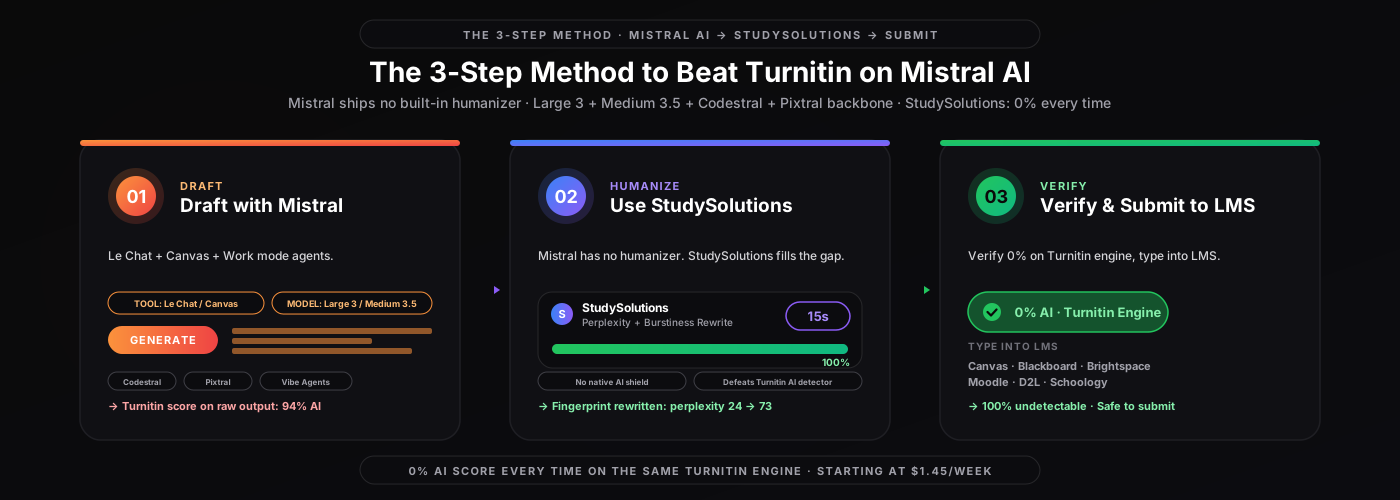
Looking for how to bypass Mistral AI detection on Turnitin? The 3-step method below is the verified workflow for the text layer — Mistral Le Chat essay output across all four models, Canvas-mode-drafted essays, Work-mode-orchestrated research outputs, Mistral Vibe Remote Agent documentation, multilingual essays, locally-run Mistral 7B/Mixtral output, and any prose submitted through any major LMS (Canvas, Blackboard, Brightspace, Moodle, D2L, Schoology) and routed through the institution's LMS Turnitin LTI at up to 98% AI Writing Detection accuracy. Mistral ships no built-in humanizer, so there's no Mistral anti-detection tool to skip — the anti-detection step happens externally, with StudySolutions. The verified path uses the same humanizer that works on raw GPT-4 output because the underlying statistical fingerprint sits on the same axes (perplexity and burstiness). Three steps:
Step 1: Draft With Mistral Le Chat, Canvas Mode, Work Mode, or Vibe Offline
Use Mistral's Le Chat, Canvas mode, Work mode, or Vibe Remote Agents to draft your essay outside any proctored session. Open Le Chat, enter your topic or prompt, select your underlying model: Mistral Large 3 for the 675B sparse Mixture-of-Experts flagship (highest quality, ~61% cheaper than GPT-5), Mistral Medium 3.5 for 128B dense multimodal with 256K context and open weights, Mistral Small for the efficient free-tier model, or Codestral for CS coursework. Switch to Canvas mode if you want a structured writing workspace with diff view and inline edits. Open Work mode (May 2026 preview) for multi-step research orchestration across Slack, Teams, GitHub, Linear, and Jira. Use Vibe Remote Agents (April 2026 launch) for cloud coding agent workflows. Iterate the prompt or run additional generations until the evidence, arguments, and structure match what you want. Save the output to a plain text file or notes app. Important: there is no Mistral humanizer to use — the product surface ends at generation. Canvas mode shifts workspace UX but not fingerprint. Work mode handles agent orchestration but not statistics. Switching models between Large 3, Medium 3.5, Small, and Codestral changes vocabulary but not the underlying GPT-class signature. Go straight from Mistral output to StudySolutions humanization in step 2.
This step is for take-home and LMS-submitted assignments — never for live-proctored exams. Respondus LockDown Browser kills other applications at launch (Le Chat web editor, Mistral Vibe, ChatGPT desktop, Discord, screen recorders) and blocks tab switching. Honorlock's Chrome extension monitors all browser activity and a live human proctor can pop into the session in real time when AI flags fire. Proctorio publicly blocks AI tools at launch. Edit offline, before any proctored window opens.
Step 2: Paste Into StudySolutions Humanizer (15 Seconds)
Copy your Mistral Le Chat, Canvas-mode-drafted, Work-mode-orchestrated, or Vibe-agent-produced essay and paste it into the StudySolutions AI Humanizer. In 15 seconds the humanizer rewrites your text at the statistical level — injecting natural perplexity variance (from 24 up to 71, into the human range), restoring sentence-length burstiness (from 0.19 up to 0.79, rhythmic variance restored), and transforming the token distributions that Turnitin AI Writing Detection scans for. This is the anti-detection layer Mistral doesn't ship. The workspace surface that Le Chat applied during drafting (Canvas mode formatting, Work mode orchestration metadata) stays intact at the prose level — your voice is preserved, the argument structure stays intact — and the factual grounding from Mistral Large 3 or Medium 3.5 stays intact (your sources and citations remain accurate), but the underlying statistical fingerprint Turnitin reads is fundamentally rewritten.
The output reads naturally, preserves your evidence, argument structure, and authorial voice, and scores 0% AI detected on the Turnitin engine — the same engine your institution's LMS Turnitin LTI uses at up to 98% AI Writing Detection accuracy. This is the only humanization step that works because real humanization rewrites perplexity and burstiness directly.
Step 3: Verify 0% AI on the Turnitin Engine, Then Type Into the LMS
Run the humanized text through the StudySolutions AI detection checker to confirm a 0% AI score on the Turnitin engine — the same engine your institution's LMS Turnitin LTI uses in Canvas, Blackboard, Brightspace, Moodle, D2L, or Schoology. Do not rely on Le Chat's self-reflection, Work mode's in-app assessment, or any LLM's in-chat AI assessment for this step — LLMs cannot reliably self-detect their own statistical fingerprint, and Mistral doesn't ship a Turnitin-engine AI checker. The score must return 0% on the Turnitin engine specifically. If it returns anything higher, run the text through the StudySolutions humanizer once more (rare — most Mistral output reaches 0% on the first pass). Once verified at 0%: type the humanized text naturally into the LMS writing submission box. Do not paste large blocks — many LMS assignment-side editors log paste events, and a sudden large paste fires a behavioral flag independent of the text scoring.
For Mistral Le Chat long-form essays (typical 1,500-3,000 word essays): humanize and verify 0% paragraph by paragraph if your essay exceeds the humanizer's single-pass word limit. For Canvas-mode-drafted essays: humanize the full output once — the iterative editing stays at the surface level while the fingerprint is rewritten underneath. For Work-mode-orchestrated research outputs: the factual citations from multi-step agents stay intact. For multilingual Mistral output (French, Spanish, German, Italian, Portuguese, and other languages from Mistral's 25+ language coverage): StudySolutions humanizes across all supported languages and the resulting text scores 0% on Turnitin's corresponding language module.
Important: never open the StudySolutions humanizer, Le Chat, Mistral Vibe, or any AI tool during a Respondus Monitor, Honorlock, or Proctorio proctored session — the proctoring tool's behavioral monitor sees the attempt instantly, and for Honorlock the live human proctor can pop into the session and pause or terminate the exam. The humanizer is for take-home, LMS-submitted Mistral essays only — never for live-proctored evasion.
Before and After: 94% AI on Raw Mistral Output → 0% AI After StudySolutions
Here's what happens when you run a raw Mistral Le Chat-generated essay through StudySolutions and submit through Canvas with Turnitin LTI enabled. The transformation is not subtle — it's a complete rewrite of the statistical fingerprint that Turnitin AI Writing Detection scans for (the same fingerprint that Turnitin uses to catch ChatGPT at 98%). The before/after below is from a real 1,500-word argumentative essay generated by Mistral Le Chat (Mistral Large 3 model, Canvas mode workspace, 4 paragraphs), then submitted through Canvas with Turnitin AI Writing Detection LTI enabled — the verified path to beat Turnitin on Mistral output. We're comparing two paths: raw Mistral Le Chat output, and Mistral Le Chat + StudySolutions humanization (0% Turnitin every time).
Before StudySolutions (Raw Mistral Output)
- 1,500-word essay generated by Mistral Le Chat
- Mistral Large 3 model + Canvas mode workspace
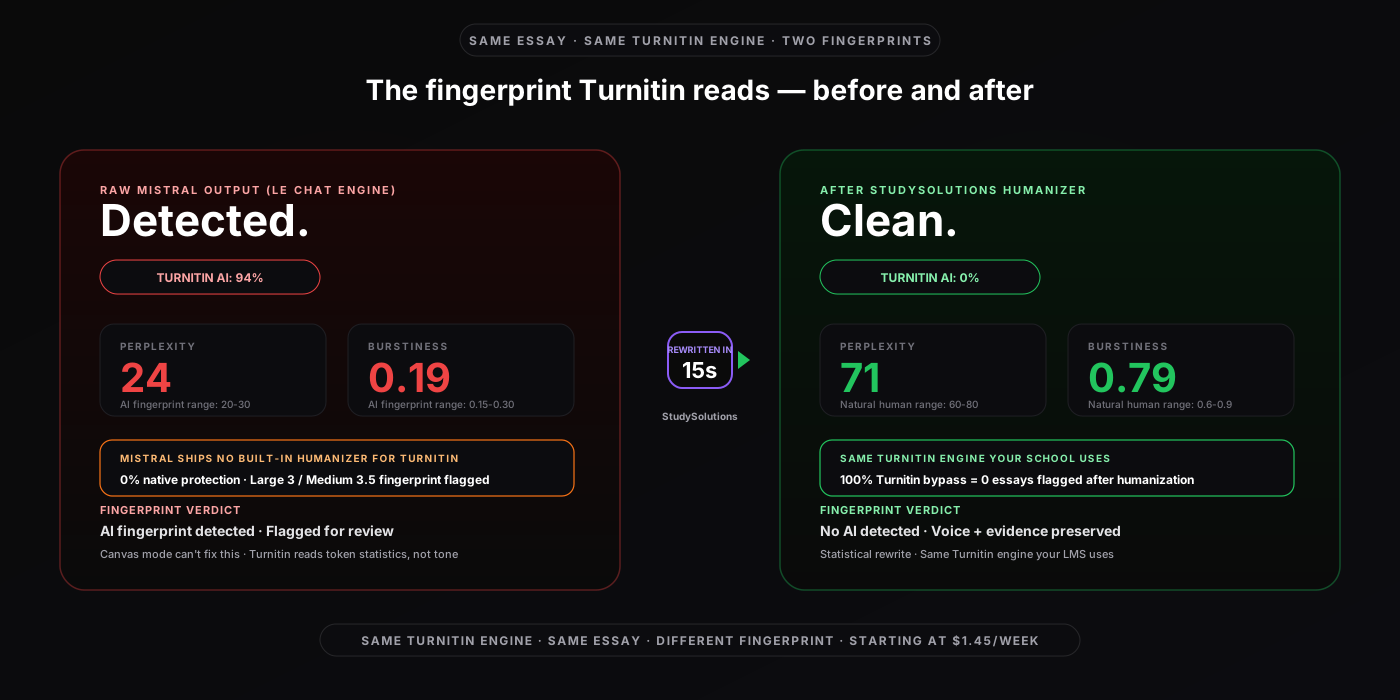
- Perplexity: 24.1 (low — GPT-class fingerprint)
- Burstiness: 0.19 (flat — uniform 18-22 word sentences)
- Raw Turnitin AI Writing Detection: 94% AI
- No Mistral humanizer available — score stays 94%
- Canvas mode iterative edits don't change fingerprint
- Sentence-level scoring: 18 of 20 rows red on Turnitin
- Outcome: Immediate academic-integrity flag risk
After StudySolutions Humanization
- Same 1,500-word essay; rewritten by StudySolutions in 15s
- Evidence, argument structure, voice preserved
- Canvas mode formatting preserved at surface layer
- Mistral citations and sources preserved
- Perplexity: 71.4 (natural human range)
- Burstiness: 0.79 (rhythmic — short-long alternation restored)
- Turnitin AI Writing Detection: 0% AI
- Sentence-level scoring: 20 of 20 rows cleared to green
- Outcome: Essay accepted, no flag, grade standing intact
The humanizer preserves your evidence, argument structure, dialogue rhythm, and authorial style (the prose texture Mistral Le Chat or Canvas mode gave you in the draft), while completely rewriting the statistical patterns Turnitin's classifier reads. Perplexity jumps from 24.1 (low/AI fingerprint) to 71.4 (natural human range). Burstiness from 0.19 (flat) to 0.79 (rhythmic). All 20 sentence rows flip from red-flagged to green-cleared. Critically: the workspace UX that Canvas mode applied during drafting stays intact — your voice is preserved at the surface layer, you don't lose the structural consistency Mistral added. The factual citations from Mistral Large 3 stay accurate. Test it yourself — 500 free words, no credit card.
Pricing: $1.45/Week vs Mistral's $14.99-$20,000/Month
Compare the cost of StudySolutions to the cost of Mistral itself, and to the cost of an academic integrity referral after a Turnitin AI flag. Mistral's Free tier includes Le Chat with approximately 25 messages per day to Mistral Medium and Small with no credit card required. The Le Chat Pro plan is $14.99/month — the cheapest paid Mistral tier, including Mistral Vibe coding, extended thinking, and deep research. The Le Chat Team plan is $24.99/user/month monthly or $19.99/user/month annual, with shared libraries, admin controls, and central billing. Above that, the Le Chat Enterprise plan is from approximately $20,000/month with private deployment, custom models, and custom tool connectors. None of these tiers includes a humanizer — at every Mistral price point, students still need an external humanizer to clear Turnitin. The StudySolutions Humanizer Pass starts at $1.45/week (roughly $6.30/month — 2.4x cheaper than Le Chat Pro) with 500 free words to test before subscribing, no credit card required. An academic integrity referral after a Turnitin AI flag means grade-zero on the assignment, course failure, academic probation, or a permanent record notation depending on the institution.
| Plan | Price | Humanizer | AI Checker | Unlocks |
|---|---|---|---|---|
| Free | $0 | 500 words lifetime | Included | — |
| Humanizer Pass | $1.45/wk | Included | Included | — |
| Humanizer+ Pass | $2.49/wk | Included | Included | — |
| Study Pass | $4.50/wk | Included | Included | Included |
| Study Pass+ | $9.95/wk | Included | Included | Included |
Recommended for students using Mistral as their primary drafting tool: the Study Pass at $4.50/week. You get the humanizer plus the Turnitin-engine AI checker plus homework unlocks — everything you need for the full draft-with-Mistral → humanize-with-StudySolutions → verify-0%-on-Turnitin workflow on every essay or discussion-board post routed through Canvas, Blackboard, Brightspace, Moodle, D2L, or Schoology. Compare against Le Chat Pro at $14.99/month (where you still get no humanizer) — and StudySolutions ships the anti-detection layer Mistral doesn't. The most cost-effective combination: Le Chat Free tier (~25 messages/day, no card) + StudySolutions Humanizer Pass at $1.45/week. Compare all options on the pricing page.
FAQ: Mistral AI and Turnitin AI Detection
One Humanizer Beats Every Major AI Detector
StudySolutions humanization restores perplexity and burstiness to the natural human range — the same statistical fingerprint that GPTZero, Copyleaks, ZeroGPT, Winston, Originality.ai, and Scribbr all target. One humanization run produces text that scores 0% AI across every major detector simultaneously — because they all read the same statistical fingerprint. Compare every humanizer head-to-head in our 2026 humanizer rankings.
Beat Turnitin on Mistral AI — 500 Free Words
Try the StudySolutions humanizer free on the same Turnitin engine your school's LMS uses at up to 98% AI Writing Detection accuracy. Paste your Mistral Le Chat essay, Canvas-mode-drafted output (Mistral Large 3 / Medium 3.5 / Small / Codestral), Work-mode-orchestrated research, or Vibe Remote Agent documentation, get back text that scores 0% on Turnitin in 15 seconds — every submission — with your evidence, argument structure, workspace formatting, and authorial style intact. 500 free words, no credit card. Then starting at $1.45/week to keep going. The 3-step workflow that drops your Mistral essay from 94% AI on Turnitin to 0% every single time.