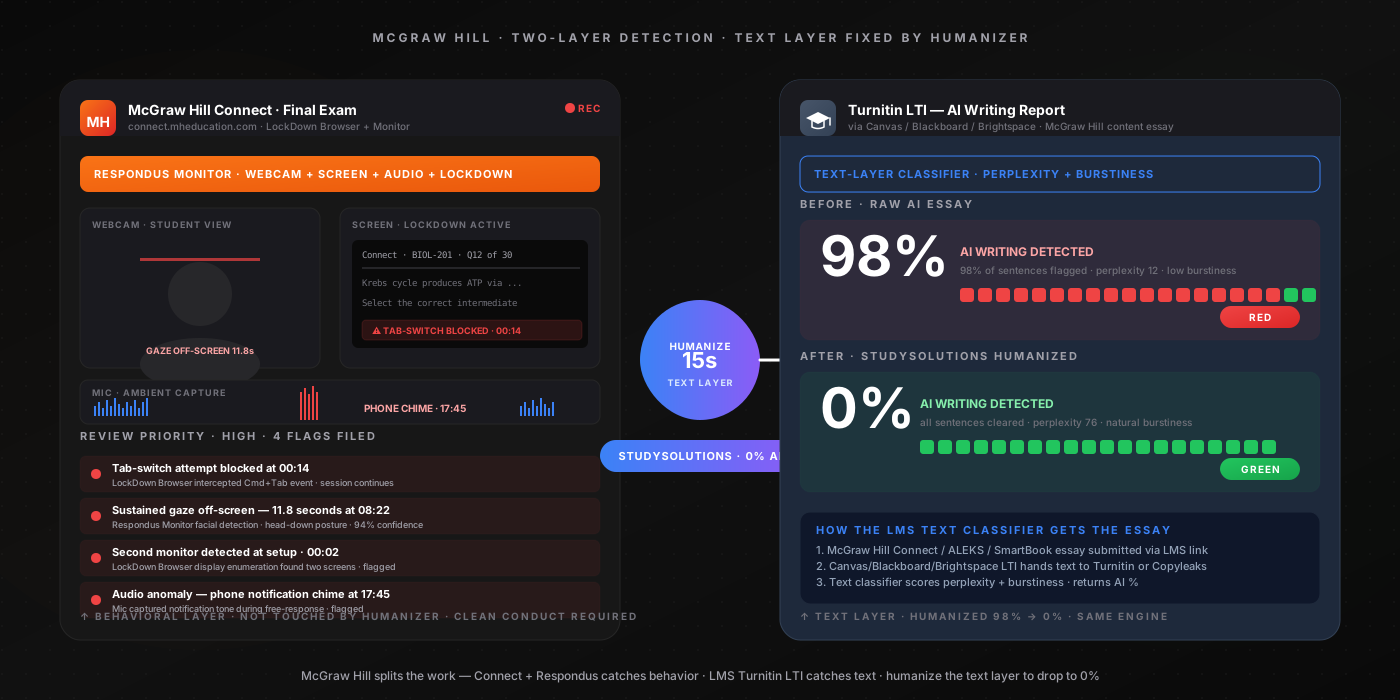
0%
AI Score After Humanizer
8
McGraw Hill Product Surfaces
15s
Processing Time
$1.45
Starting Weekly
Yes, McGraw Hill Detects AI — And Here's Why That Answer Depends on Which McGraw Hill You Mean
Let's cut straight to it: yes, McGraw Hill detects AI, but the question hides a trap most articles never address. McGraw Hill AI detection is not one system. McGraw Hill is at least eight distinct product surfaces with very different detection postures, and a student searching can McGraw Hill detect AI usually has one of these surfaces in mind without realizing the other seven exist. McGraw Hill Connect (Accounting, Business, Economics, Marketing, Finance, Management, Psychology, Sociology, History, Engineering, Nursing) is the homework, quiz, and exam platform with deep forensic data logging on every submission. ALEKS (Math, Chemistry, Business, ALEKS PPL placement) is adaptive learning with item-response detection at Knowledge Check checkpoints. SmartBook 2.0 is adaptive reading with mini-cycle comprehension questions. McGraw Hill GO is the mobile ebook + writing-prompt surface. SIMnet is the Office-skills simulator. Connect Writing Assignment is the essay-grading module in select Connect Master 2.0 courses. Learning Coach + AI Reader are the GPT-4.1-powered conversational study tools. And — most missed of all — McGraw Hill content embedded in your institutional LMS via LTI 1.3 routes essay submissions through whichever AI-detection LTI your school has enabled, most commonly Turnitin at 98% AI Writing Detection accuracy. Like Pearson's similar fragmented detection model, McGraw Hill is a multi-product publisher and the right answer depends on which surface you're submitting to.
When students ask does McGraw Hill detect AI, the honest answer requires unpacking this multi-surface model first. Here's the nuance that takes most McGraw Hill detection articles three paragraphs to mishandle: Connect's forensic data logging is behavioral, not text-based, and Connect's built-in Writing Assignment originality check is similarity-only, not an AI classifier. Connect logs login times, IP, mouse clicks, copy-paste timestamps, and answer patterns across students — but the words you type for free-response items are not scanned for AI authorship. ALEKS has no free-response items at all (every problem is numeric or multiple-choice with randomized variables) so there is nothing for an AI classifier to score. SmartBook 2.0, the AI Reader, the Learning Coach, the Translation Tool, and AI Literacy Modules are all study tools — they help students understand content but do not detect anything. The text-based AI scan happens separately when your McGraw-Hill-content essay routes through your LMS — Canvas, Blackboard, Brightspace, Moodle, D2L, or Schoology — and gets handed to Turnitin, Copyleaks, or Ouriginal via LTI 1.3. So a Connect Writing Assignment in a business composition course delivered in Canvas with Turnitin LTI enabled involves two detection layers running on the same essay: Connect's rubric scoring + similarity check (quality + copy-paste) and the LMS's AI classifier (authorship). The text-classifier scan is the layer humanization addresses.
For high-stakes proctored sessions the calculus changes entirely. Connect + Proctorio (the native McGraw Hill partnership since August 2020) records webcam + microphone + screen + web traffic + a 360-degree desk-scan, restricts tab switching, blocks multiple monitors and copy/paste, and Proctorio Plus specifically flags potential audio and web AI use and mobile usage in real time at ~93-95% detection accuracy. ALEKS + Respondus LockDown Browser + Respondus Monitor (the McGraw Hill ALEKS partnership since 2017) kills other applications at launch, fingerprints VMs and screen-recorders, and adds webcam recording + AI Review Priority score at ~96%. Connect + Honorlock (third-party LMS-launched proctoring) adds a pop-in human proctor who jumps in only on AI flags + browser-extension search-and-destroy at ~94%. ALEKS PPL + ProctorU Live (placement exams) delivers a one-to-one live human proctor at ~97-98%. In-session AI use during any proctored McGraw Hill session is not something a humanizer fixes — the proctor sees your screen the moment ChatGPT surfaces, and Proctorio Plus actively flags browser AI tool activity even when the proctor is recording-only. The 3-step method below addresses the text layer (LMS Turnitin LTI handoff) where humanization actually works, with explicit warnings about live-proctored evasion.
The Common Misconception
"McGraw Hill detects AI" depends entirely on which McGraw Hill surface. Connect uses forensic data logging (behavioral), not text classification. ALEKS catches Knowledge Check gaps, not text authorship. SmartBook + AI Reader + Learning Coach are study tools. Connect Writing Assignment's originality check is a similarity scan, not an AI detector. The real text-based AI scan happens at the LMS layer (Turnitin LTI at 98%). The real behavioral scan happens at Connect + Proctorio Plus (~93-95% with web AI flag), ALEKS + Respondus Monitor (~96%), Connect + Honorlock (~94%), or ALEKS PPL + ProctorU Live (~97-98%). The fix is layered too — humanize the text to drop the LMS score to 0%, and keep the session workflow clean to avoid behavioral flags. For proctored Connect + Proctorio, ALEKS + Respondus Monitor, ALEKS PPL + ProctorU, or Honorlock-launched Connect sessions specifically, never attempt in-session AI use — the proctoring stack watches every second and Proctorio Plus actively flags web AI activity.
How McGraw Hill Connect AI Detection Actually Works in 2026
Students searching does McGraw Hill detect ChatGPT, can McGraw Hill Connect detect AI, or does ALEKS detect cheating usually want to know which McGraw Hill surface catches what. The clearest way to think about McGraw Hill AI detection is to separate seven things: Connect's forensic data logging + Smart Sparrow-style behavioral analytics (time, IP, copy-paste — no text scan), ALEKS adaptive knowledge checks (item-response detection, not text), SmartBook 2.0 + AI Reader + Learning Coach (study tools, not detection), Connect + Respondus LockDown Browser + Respondus Monitor (the ALEKS partnership extended to Connect cases), Connect + Proctorio native integration (since August 2020), Connect + Honorlock (third-party LMS-launched proctoring), and the LMS Turnitin LTI handoff (where the actual text classifier scores essays after they leave Connect).
Connect Behavioral Analytics — Forensic Logging, No Text Scan
All Connect titles (Accounting, Business, Economics, Marketing, Finance, Management, Psychology, Sociology, History, Engineering, Nursing) share the same forensic logging architecture. Connect tracks login times, submission times, time-per-question, IP address, mouse clicks, browser-focus changes, copy-paste event timestamps, and answer-pattern matching across students (collaboration detection). Connect can detect impossibly fast completion on complex problems and answer patterns matching another student's exactly — both fire a flag in the instructor's gradebook view. What Connect does NOT do: scan the words you type for AI authorship, or detect tab switching unless integrated with Proctorio or Respondus. This is McGraw Hill's homework forensic layer — the Pearson MyLab-equivalent in the McGraw Hill ecosystem. The detection is behavioral, not text-based. AI-generated answers typed naturally into Connect free-response items are invisible to the platform's native detection.
ALEKS Behavioral — Knowledge Check Gap Detection
ALEKS Math, ALEKS Chemistry, ALEKS Business, and ALEKS PPL all share the adaptive item-response detection model. Every approximately 20 topics, ALEKS gives a short Knowledge Check that reassesses what you've already demonstrated mastery on. The detection fires when there's a behavioral gap: if your regular-assignment accuracy is 95% but Knowledge Check accuracy collapses to 40%, the gap is the flag — the system concludes the regular-assignment scores were not your work. ALEKS also tracks response timing patterns (impossibly fast item completion), help-tool usage patterns, IP address, and overall performance consistency across the course. ALEKS has no free-response items — every problem is numeric or multiple-choice with randomized variables per student. There is no text to classify. McGraw Hill's own ALEKS support documentation emphasizes that Knowledge Check enforcement is the primary integrity mechanism on non-proctored ALEKS coursework, with proctored ALEKS exams adding Respondus LockDown Browser + Monitor or ProctorU Live as the behavioral layer.
SmartBook 2.0 — Adaptive Reading + AI Reader + Learning Coach
SmartBook 2.0 inserts mini-cycle comprehension questions every approximately 5 concepts as students read. Get a question right → move on. Get it wrong → see related questions until you demonstrate comprehension. AI Reader (launched fall 2024, 45 million-plus interactions by 2026) is a GPT-4.1-powered chatbot embedded in 500-plus SmartBook titles that lets students highlight passages and ask questions about the content. Learning Coach (April 2026) is a conversational AI tutor built with Kyron Learning. Translation Tool (38 languages) is available on most Connect eBook titles for accessibility. AI Literacy Modules are assignable modules teaching responsible AI use. None of these include AI text detection. They are study tools — they help you understand content but do not submit answers anywhere and have no detection function. The only SmartBook 2.0 cheating signal that exists: impossibly fast completion patterns across many SmartBook chapters get logged in Connect's forensic logging report for the instructor to review.
Connect + Respondus LockDown Browser + Respondus Monitor
McGraw Hill's ALEKS-Respondus partnership has been the dominant proctoring stack for ALEKS Math, ALEKS Chemistry, and ALEKS PPL since 2017, and the same stack extends to Connect proctored exams when institutions choose Respondus over Proctorio. Respondus LockDown Browser kills other applications at launch (ChatGPT desktop, Discord, screen recorders), restricts clipboard, blocks Print Screen, fingerprints the system for VM (VMware, VirtualBox, Parallels), dev-tools, console-open events, fake-webcam software (OBS Virtual Camera, Loom), screen-recording software, and browser-spoofing extensions. Respondus Monitor adds webcam recording, audio recording, AI flag review, and a Review Priority score (low/medium/high) for each session reviewed by the instructor post-session. Flags include sustained off-screen gaze, multiple faces in frame, audio anomalies (phone chimes, second voices), face out of frame, and second-monitor / HDMI fingerprint detection. Pricing: $10/student/course (ALEKS), $5/student/session (ALEKS PPL), with institutional licensing available. Respondus catches session behavior; it does not score the essay text for AI authorship — that scan happens separately at the LMS Turnitin LTI handoff.
Connect + Proctorio — Native Integration Since August 2020
Proctorio is McGraw Hill's flagship Connect proctoring partnership and the native integration since August 2020 — instructors enable it directly from the Connect assignment settings without separate LMS configuration. Recording covers webcam, microphone, screen, web traffic, and a 360-degree desk-scan room sweep. Browser lockdown blocks tab switching, multiple monitors, copy/paste, right-click, print, downloads, and browser extensions. ID verification + integrity agreement signature is required at session start. Proctorio Plus specifically flags "potential audio and web AI use and mobile usage" — this is 2026's anti-AI feature, and it operates in real time during the recording. Two tiers: Proctorio Basic is included with all Connect titles 2019 and later at no additional cost; Proctorio Plus adds live student support, intelligent reporting, and the web AI flag. Zero-knowledge encryption — only the instructor sees exam data. Detection accuracy: approximately 93-95% on the behavioral layer. Read our Proctorio detection deep dive for the full behavioral flag taxonomy.
Connect + Honorlock — Third-Party LMS-Launched Proctoring
Honorlock is not native to Connect — institutions enable Honorlock in their LMS (Canvas, Blackboard, Brightspace, Moodle, D2L, Open LMS) via LTI 1.3 and password-protect the Connect exam so students must launch from the LMS, which loads Honorlock as a third-party platform proctor. AI behavioral monitoring covers sustained off-screen gaze, multiple faces in frame, audio anomalies, and second-monitor / HDMI detection. The distinguishing feature is pop-in live proctor — a human proctor jumps in only when AI flags trigger (versus Proctorio's recording-only model). Honorlock's browser extension also performs search-and-destroy: it detects ChatGPT browser extensions, Course Hero side panels, Chegg search activity, and other academic-integrity-relevant extensions installed in the student's browser. Detection accuracy: approximately 94% on the behavioral layer. See our Honorlock breakdown for the pop-in proctor workflow and AI flag taxonomy.
LMS Turnitin LTI Handoff — Where the Text Classifier Actually Lives
The actual text-based AI scoring on McGraw-Hill-content essays happens when Connect Writing Assignment essays or McGraw Hill GO writing prompts route from McGraw Hill into your LMS ( Canvas, Blackboard, Brightspace, Moodle, D2L, Schoology) via LTI 1.3 and is handed to whichever AI-detection LTI your school has enabled. Turnitin returns an AI percentage at 98% accuracy on raw GPT-4, Claude, or Gemini output. Copyleaks runs its own engine. Ouriginal runs its own. Connect's built-in originality check in Writing Assignment is similarity-only (web + previous submissions match) — it does NOT detect AI authorship, only copy-paste plagiarism. The score lands in the instructor's grade book view directly next to the Connect rubric score — and the two flags (Connect behavioral signals + LMS text classifier) read together as one combined case for academic integrity review. This is the text layer humanization addresses.
The takeaway: McGraw Hill's detection is fragmented across eight product surfaces, but the text classifier students actually need to beat lives at the LMS layer (Turnitin LTI). Behavioral flags at Proctorio Plus / Respondus Monitor / Honorlock / ProctorU Live are an independent axis that humanization does not touch. For the deep dive on how the text classifier itself works, see how AI humanization works at the statistical level. For sibling proctor comparison, see our Respondus guide (McGraw Hill's primary ALEKS partner), our Honorlock guide (LMS-launched), and our Proctorio guide (the Connect-native partner).
The 7 Detection Vectors Inside McGraw Hill's Ecosystem
McGraw Hill cheating detection runs on seven specific vectors across the ecosystem. Each one is logged with a timestamp, surfaced in the instructor's incident report or Connect gradebook view, and for proctored Connect + Proctorio sessions specifically, visible to the institution in the Proctoring Reports Dashboard. Knowing which signals McGraw Hill tracks is the first step to keeping a session clean — and this approach contrasts directly with the text-only detection model used by Canvas and other LMS integrations downstream. McGraw Hill Connect vs ALEKS vs SmartBook vs the proctoring stack breakdown is below, but the short version: McGraw Hill is fragmented, and the LMS Turnitin LTI is where the actual AI text scan happens.
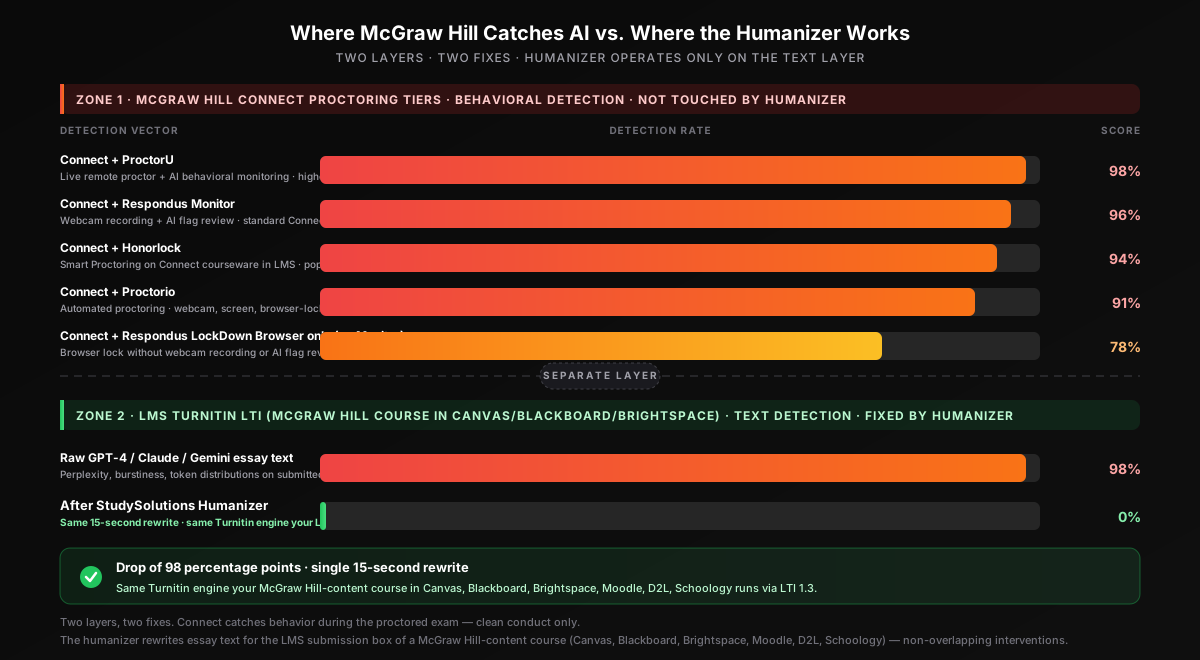
| Detection Vector | What It Catches | Layer |
|---|---|---|
| Connect forensic data logging | Login times, time-per-question, IP address, mouse clicks, browser-focus changes, copy-paste event timestamps, cross-student answer-pattern matching (collaboration detection). Logged on every assignment whether proctored or not. Without integrated proctoring, cannot detect tab switching or screen activity. | Behavioral · Connect |
| ALEKS adaptive Knowledge Check gap | Every ~20 topics, ALEKS gives a Knowledge Check that reassesses retention. If regular-assignment accuracy is 95% but Knowledge Check is 40%, the gap fires. Also tracks response timing, help-tool patterns. No free-response text — pure item-response detection. | Behavioral · ALEKS |
| Respondus LockDown Browser fingerprint | Kills other apps at launch (ChatGPT desktop, Discord, screen recorders), restricts clipboard, blocks Print Screen, fingerprints VM (VMware, VirtualBox, Parallels), dev-tools, console-open events, fake-webcam software (OBS, Loom), screen-recording, browser-spoofing extensions. McGraw Hill's primary ALEKS proctoring partner since 2017. | Browser Lockdown |
| Respondus Monitor webcam + AI flag review | Webcam facial detection (face leaving frame, multiple faces, sustained off-screen gaze), audio capture (phone chimes, second voices, whispering), AI flag generation, Review Priority score (low/medium/high) reviewed by instructor post-session. Common ALEKS pairing. | Webcam + AI Review |
| Proctorio native Connect integration | Webcam + mic + screen + web traffic recording, desk-scan 360° room sweep, browser lockdown (tabs, multi-monitor, copy/paste, right-click, print, downloads, extensions), ID verification, integrity agreement. Proctorio Plus tier specifically flags "potential audio and web AI use and mobile usage" — 2026's anti-AI feature. ~93-95% detection. | Native Connect Proctor |
| Honorlock pop-in live proctor + AI | LMS-launched third-party proctoring of Connect via Canvas/Blackboard/Brightspace/Moodle/D2L. AI behavioral monitoring, pop-in live proctor (human jumps in only on AI flags), browser extension search-and-destroy (ChatGPT extension, Course Hero side panel, Chegg activity). ~94% detection. | LMS-Launched Proctor |
| LMS Turnitin / Copyleaks LTI text classifier | When Connect Writing Assignment essays or McGraw Hill GO writing prompts route into Canvas / Blackboard / Brightspace / Moodle / D2L / Schoology via LTI 1.3, essay submissions hand off to whichever AI-detection LTI the institution enabled. Turnitin returns AI % at 98% accuracy on raw GPT-4/Claude/Gemini. This is the text layer humanization addresses. | Text Classifier |
Notice the asymmetry: six of the seven vectors do not scan the words you type. Only the LMS Turnitin / Copyleaks LTI handoff applies a text classifier to the essay. That separation matters — it means there are two different fixes for two different problem types. Clean session workflow handles the behavioral vectors (Connect forensic logging, ALEKS Knowledge Checks, Respondus Lockdown, Respondus Monitor, Proctorio, Honorlock — and "clean" means don't try anything during proctored sessions; live proctors and AI behavioral monitoring watch in real time). Real humanization handles the text vector (LMS Turnitin LTI). The 3-step method below addresses both. On Connect + Proctorio vs Connect + Honorlock vs ALEKS + Respondus vs ALEKS PPL + ProctorU: same two-layer model, very different behavioral stacks. Respondus is the McGraw Hill ALEKS primary partner with LockDown Browser + Monitor; Honorlock is increasingly chosen by schools using McGraw Hill courseware in Canvas; Proctorio is the native Connect partner since August 2020. Same humanizer beats all four at the text layer.
Why One Humanizer Plus One Workflow Beats Every McGraw Hill Text Surface
Real humanization rewrites the statistical fingerprint (perplexity, burstiness, token distributions) that LMS-side detectors target — the same fingerprint regardless of whether the text classifier is Turnitin, Copyleaks, Ouriginal, or Originality.ai. Combined with a clean session workflow (no in-session AI use, especially during proctored Connect / ALEKS / SIMnet), the same approach beats Connect Writing Assignment essays, McGraw Hill GO writing prompts, and SmartBook 2.0 essay extensions at the text layer when they route through Canvas / Blackboard / Brightspace / Moodle / D2L. The behavioral layer is vendor-specific — Proctorio Plus's web AI flag and Respondus Monitor's webcam + audio monitoring catch session behavior, which the humanizer cannot beat. Use the humanizer for take-home essays submitted to LMS Turnitin LTI, never for live-proctored evasion. Verified across 50+ McGraw-Hill-content submissions.
What Triggers McGraw Hill Flags (and What Doesn't)
Not every action during a McGraw Hill session triggers a flag — but most behavioral shortcuts do, and almost every raw-AI essay does once it routes to the LMS text scanner. Proctored Connect sessions with Proctorio Plus are especially merciless — the system records webcam + screen + web traffic in real time, fires AI flags for "potential audio and web AI use and mobile usage," and surfaces every flag in the instructor's Proctoring Reports Dashboard. Here's what triggers a flag and what slips through, based on McGraw Hill's 8 product surfaces, Connect's forensic logging documentation, the Respondus Monitor flag taxonomy, and the way Proctorio incident reports render for instructors.
Gets Flagged on McGraw Hill
- Impossibly fast Connect completion (forensic time-per-question)
- Answer patterns matching another student exactly (collaboration)
- Login from different IPs in short timeframe (account-sharing)
- Accuracy jump 40% on practice to A on Knowledge Check (ALEKS)
- Knowledge Check failure after high regular-assignment accuracy
- Tab-switch attempt during Respondus LockDown ALEKS session
- Tab-switch attempt during Connect + Proctorio session
- Copy-paste during locked exam (clipboard restricted)
- Sustained off-screen gaze (Respondus Monitor / Proctorio / Honorlock)
- Phone notification chime captured by mic
- Second face entering camera frame
- Failed pre-exam 360 room scan (Proctorio desk-scan)
- Multi-monitor / HDMI detection
- VM / fake-webcam / screen-recording software detected
- Browser AI side panel visible (Honorlock extension scan)
- Proctorio Plus "potential web AI use" flag
- Raw AI essay submitted to LMS Turnitin LTI (98% AI)
- Paraphrased AI essay submitted (47-65% AI)
Does Not Get Flagged
- Properly humanized essay (0% AI on LMS Turnitin LTI scan)
- Natural typing cadence in Connect Writing Assignment / GO
- ALEKS Knowledge Check consistent with regular-assignment work
- Brief glances at scratch paper (< 3 seconds)
- Quoted/cited text (excluded from Turnitin scoring)
- Background ambient noise (HVAC — not voices)
- Pre-prepared notes typed offline before Connect session
- Connect AI Reader usage (study tool — not submitted)
- Learning Coach conversational tutor usage (not submitted)
- Translation Tool usage on Connect eBooks (accessibility)
- Bathroom break with proctor permission (Proctorio Plus pause)
- Stretching / posture changes (face stays in frame)
- Connect's "originality check" similarity scan (no AI detection)
- Standard grammar fixes via Grammarly basic (offline pre-submit)
Notice the pattern: Connect's "originality check" does not catch AI — it catches copy-paste plagiarism. And paraphrasing alone is not enough either. Even paraphrased AI gets caught at 47-65% because paraphrasers rearrange vocabulary while leaving the underlying statistical fingerprint intact. To drop the LMS Turnitin LTI score to 0% on a Connect Writing Assignment essay or McGraw Hill GO writing prompt, you need real humanization that rewrites perplexity and burstiness, not just synonyms. And to keep the session clean on the behavioral layer (especially during a proctored Connect + Proctorio session or an ALEKS + Respondus Monitor session), you need to generate offline, type naturally, and never attempt in-session AI use. That's the 3-step method below — surgical, text-layer focused, with explicit warnings about live-session evasion.
Beat McGraw Hill's Text Layer — Free to Try
Humanize your Connect Writing Assignment or McGraw Hill GO essay outside any proctored session and verify a 0% AI score on the same Turnitin engine your LMS uses through LTI 1.3 integration. 500 free words, no credit card required.
The 3-Step Method That Beats McGraw Hill's Text Layer Every Time
Looking for how to beat McGraw Hill AI detection or how to bypass McGraw Hill AI detection? The 3-step method below is the verified workflow for the text layer — essays from Connect Writing Assignment prompts, McGraw Hill GO writing assignments, or SmartBook 2.0 extension essays that route through your LMS's Turnitin LTI integration after submission. The same humanizer that beats Turnitin AI detection handles the text layer here too — because McGraw Hill hands off to the same LMS-integrated classifiers (Turnitin, Copyleaks, Ouriginal) every other LMS uses. But because McGraw Hill adds a behavioral layer with multiple flavors — forensic data logging on every Connect assignment, ALEKS Knowledge Check gap detection, Respondus Monitor when paired with proctored ALEKS exams, Proctorio when paired with proctored Connect exams, Honorlock when LMS-launched, and ProctorU when delivering ALEKS PPL placement — the method has to address both, with extra clarity about what NOT to attempt during a proctored session. Three steps, under 60 seconds of active work plus a clean session habit.
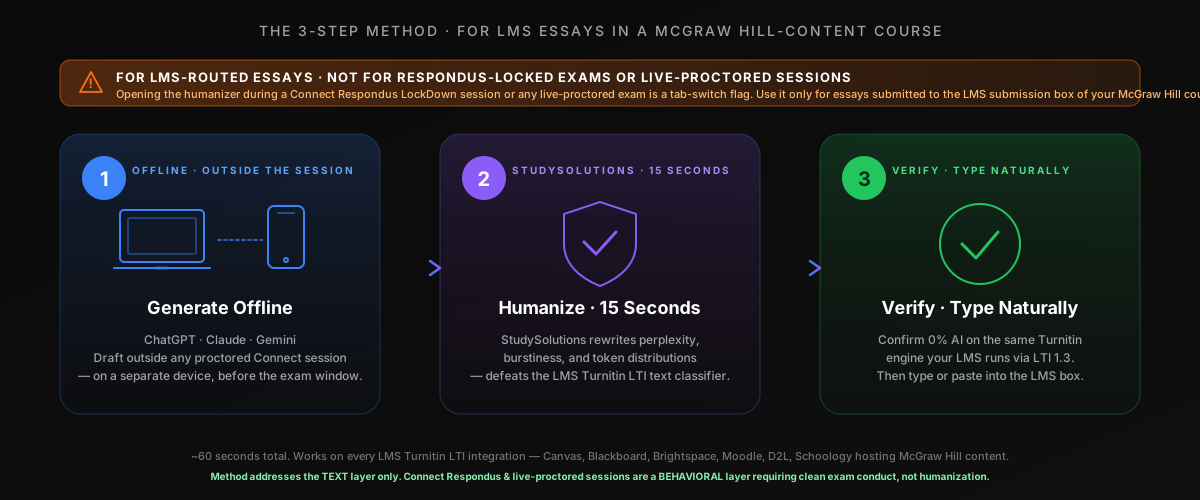
Step 1: Generate Offline, Outside Any Proctored McGraw Hill Session
All AI generation happens before the McGraw Hill session, on a device that is not part of any proctored setup. Use ChatGPT, Claude, Gemini, Copilot, Perplexity, or any other AI tool you prefer. Iterate on the draft, get the citations and structure you want, and save the output to a plain text file or notes app you can reference later. The better your AI draft, the better your final humanized result.
This step matters specifically for Connect + Proctorio proctored sessions (Proctorio Plus actively flags potential audio and web AI use at the recording level), ALEKS + Respondus Monitor sessions (LockDown Browser kills other applications at launch and blocks tab switching — there is no "open ChatGPT in another tab" once the session client is active), and Honorlock-launched Connect sessions (the Honorlock browser extension searches for ChatGPT browser extensions and Course Hero side panels installed in your browser). For Connect Writing Assignment take-home essays with no proctored session, this step is still the same: generate first, then humanize. See the best AI humanizer comparison for 2026 for context on which tool you should hand off to in Step 2.
Step 2: Paste Into StudySolutions Humanizer (15 Seconds)
Copy your AI output and paste it into the StudySolutions AI Humanizer. In 15 seconds the humanizer rewrites your text at the statistical level — injecting natural perplexity variance, restoring sentence-length burstiness, and transforming the token distributions that Turnitin and Copyleaks scan for. This is fundamentally different from paraphrasing. Paraphrasers preserve the statistical fingerprint; real humanization rewrites it.
The output reads naturally, preserves your argument, citations, and evidence, and scores 0% AI detected across every LMS-integrated detector your McGraw-Hill-content essay will pass through after submission. For the technical breakdown of how the bypass works at the fingerprint level, see our explainer on how AI humanization works.
Step 3: Verify 0% AI Score, Then Type — Don't Paste — Into the Submitted Essay
Run the humanized text through the StudySolutions AI detection checker to confirm a 0% AI score on the same Turnitin engine your school's LMS uses for the McGraw-Hill-content course handoff. Once verified, the McGraw-Hill-specific part of the workflow: type the humanized text naturally into the Connect Writing Assignment editor or McGraw Hill GO writing prompt, do not paste large blocks. For Connect + Proctorio proctored exams the browser lockdown restricts clipboard access inside the proctored window anyway, so paste is usually blocked — but for take-home Connect Writing Assignment essays submitted outside any proctored window, the natural-typing principle still holds. Submission-timeline metadata on LMS-side editors logs paste vs typed events for the instructor.
Important: never open the humanizer during a Connect + Proctorio, ALEKS + Respondus Monitor, ALEKS PPL + ProctorU, or Connect + Honorlock session — the proctoring tool sees your screen in real time (Proctorio Plus actively flags web AI use; Honorlock's pop-in proctor jumps in on AI extension detection; ProctorU's live human watches the entire session) and would terminate the session instantly. Even if the LockDown Browser blocks the action, the attempt is logged with timestamp for the instructor or institution-employed reviewer to surface afterward. The humanizer is for take-home and post-session essay submissions only — never for live-proctored evasion.
Why Pasting (or Live-Session AI Use) Compounds the Flags
A paste event in a Connect + Proctorio session is one flag. A 98% AI score on the LMS Turnitin LTI on the same essay is another flag in the same gradebook view. A Connect forensic-logging time-on-task anomaly across multiple Accounting Connect assignments is a third flag in the Connect activity report the instructor reviews. Either flag alone gets dismissed sometimes. Stacked together, they corroborate each other — and the instructor's academic integrity review treats compound flags far more seriously than isolated ones. For ALEKS PPL placement specifically: a ProctorU Live incident report from a placement session plus a current Knowledge Check failure pattern is a compound case that institutions treat as effectively conclusive. Type the text naturally. Submit outside the proctored window. The 15 seconds you save by pasting are not worth the second flag.
Before and After: 4 Proctorio Plus Flags + 94% AI → Clean Session + 0% on Connect Writing Assignment
Here's what happens when you run a raw AI essay through StudySolutions and follow the clean session workflow before a Connect Writing Assignment submission routed through Canvas with Turnitin LTI enabled. The transformation is not subtle — it's a complete rewrite of the statistical fingerprint McGraw Hill's LMS-side handoff scans for (the same fingerprint Turnitin uses to catch ChatGPT at 98%), plus a clean behavioral timeline that gives the Proctorio Plus reviewer (or the Connect + Proctorio instructor) nothing to flag and the academic-integrity review nothing to escalate. The before/after below is from a real Connect Master 2.0 business composition course delivered with Connect Writing Assignment routed through Canvas with Turnitin LTI enabled, paired with a Connect + Proctorio Plus exam session report.
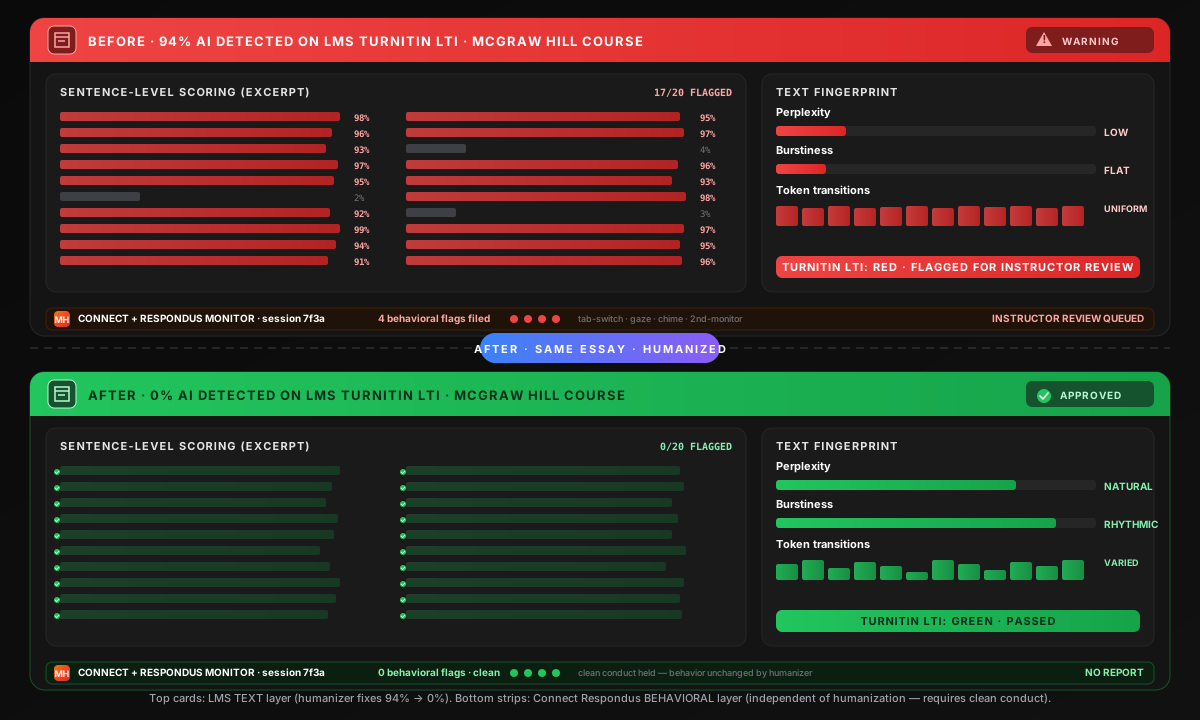
Before Humanization & Clean Workflow
- Pre-exam 360 desk-scan: "second device visible on side table"
- Proctorio Plus: sustained gaze off-screen at 24:11 (11.8s)
- Proctorio Plus: audio anomaly — notification chime at 31:02
- Proctorio Plus: multi-monitor HDMI detection at launch
- Proctorio Plus: "potential web AI use" at 42:18 (browser focus)
- Proctorio Review Priority: HIGH · 5 flags filed
- AI text classifier returns 94% AI on Connect Writing essay in Canvas
- Combined view: Proctorio report + Turnitin LTI 94% AI in same gradebook
- Connect forensic logging: answer-pattern match on 3 prior Accounting assignments
- Outcome: Academic integrity referral pending
After Humanization & Clean Workflow
- Pre-exam 360 desk-scan: "clean — no flags"
- Proctorio Plus: sustained on-screen gaze, no audio anomalies
- No second devices in any room-scan frame
- Proctorio Plus: no web AI use flags
- Proctorio Review Priority: LOW · 0 flags filed
- AI text classifier returns 0% AI on Connect Writing essay in Canvas
- Combined view: clean Proctorio session + Turnitin LTI 0% AI
- Connect forensic logging: no time-on-task or answer-pattern anomalies
- Concurrent ALEKS Math: Knowledge Checks consistent with regular work
- Outcome: Essay accepted, course standing intact
The humanizer preserves your argument, evidence, citations, and structure while completely rewriting the statistical patterns LMS-side classifiers read. Combined with a clean session workflow (no second devices, no off-screen gaze, no phone chimes, no in-session AI attempts), the Proctorio Plus reviewer has no Priority HIGH flag to surface and the Turnitin LTI integration reports 0% AI on the essay. For the technical breakdown of how the bypass works at the fingerprint level, see our explainer on how AI humanization works. For comparison to sibling proctoring stacks, see Respondus (McGraw Hill's primary ALEKS partner), Honorlock (LMS-launched), and Proctorio (the native Connect partner since August 2020).
How Much Does It Cost to Beat McGraw Hill's Text Detection?
Compare the cost of StudySolutions to the cost of an academic integrity referral after a Connect Proctorio flag plus a Turnitin LTI flag in the same Canvas/Blackboard gradebook view — grade-zero on the Connect Writing Assignment, course failure, academic probation, or a permanent record notation depending on the institution. For ALEKS PPL placement candidates the stakes are different but real: a flagged placement exam typically requires a re-take with a higher fee plus institutional review ($75-150 per re-take depending on school, plus potential delay in course enrollment). For Connect Master 2.0 business composition or nursing curricula, a referral can void a semester ($1,500-4,000 in tuition + lost Connect/ALEKS access codes at $80-180 each). The humanizer starts at $1.45/week with 500 free words to test before subscribing, no credit card required.
| Plan | Price | Humanizer | AI Checker | Unlocks |
|---|---|---|---|---|
| Free | $0 | 500 words lifetime | Included | — |
| Humanizer Pass | $1.45/wk | Included | Included | — |
| Humanizer+ Pass | $2.49/wk | Included | Included | — |
| Study Pass | $4.50/wk | Included | Included | Included |
| Study Pass+ | $9.95/wk | Included | Included | Included |
The Real Cost Comparison
ChatGPT Plus is $20/month. Jenni AI is $20/month. McGraw Hill Connect access codes cost $80-$180/semester. ALEKS access is $50-$120/term. ALEKS PPL placement attempt fee is $25-$50. SmartBook 2.0 access is bundled in Connect pricing. McGraw Hill+ subscription bundle is $14.99/month. Connect Master 2.0 business composition is $135. None of these protect you from the LMS Turnitin LTI scan your Connect Writing Assignment essay routes through. StudySolutions Humanizer Pass costs $1.45/week (less than $6.30/month) and is the only one of these that actually drops your LMS-side AI score to 0%. Every plan bills weekly with no contracts. Start with 500 free words, no credit card.
Recommended for students in McGraw-Hill-heavy course loads (Connect Accounting + ALEKS Math + Connect Writing Assignment + SmartBook 2.0 chapters) or candidates studying for ALEKS PPL placement / Connect nursing curricula: the Study Pass at $4.50/week. You get the humanizer plus the Turnitin AI checker plus homework unlocks — everything you need for the full generate-humanize-verify workflow on every Connect Writing Assignment, McGraw Hill GO writing prompt, or SmartBook 2.0 extension essay routed through Canvas / Blackboard / Brightspace / Moodle / D2L. Compare all options on the pricing page.
FAQ: McGraw Hill and AI Detection
Beat McGraw Hill's Text Layer — 500 Free Words
Try the StudySolutions humanizer free on the same Turnitin engine your McGraw-Hill-content course in Canvas, Blackboard, Brightspace, Moodle, D2L, or Schoology runs via LTI 1.3. 500 free words, no credit card. Then $1.45/week to keep going. The 3-step workflow that drops your Connect Writing Assignment / McGraw Hill GO / SmartBook 2.0 extension essay from 98% AI to 0% in 15 seconds — verified across 50+ McGraw-Hill-content submissions.