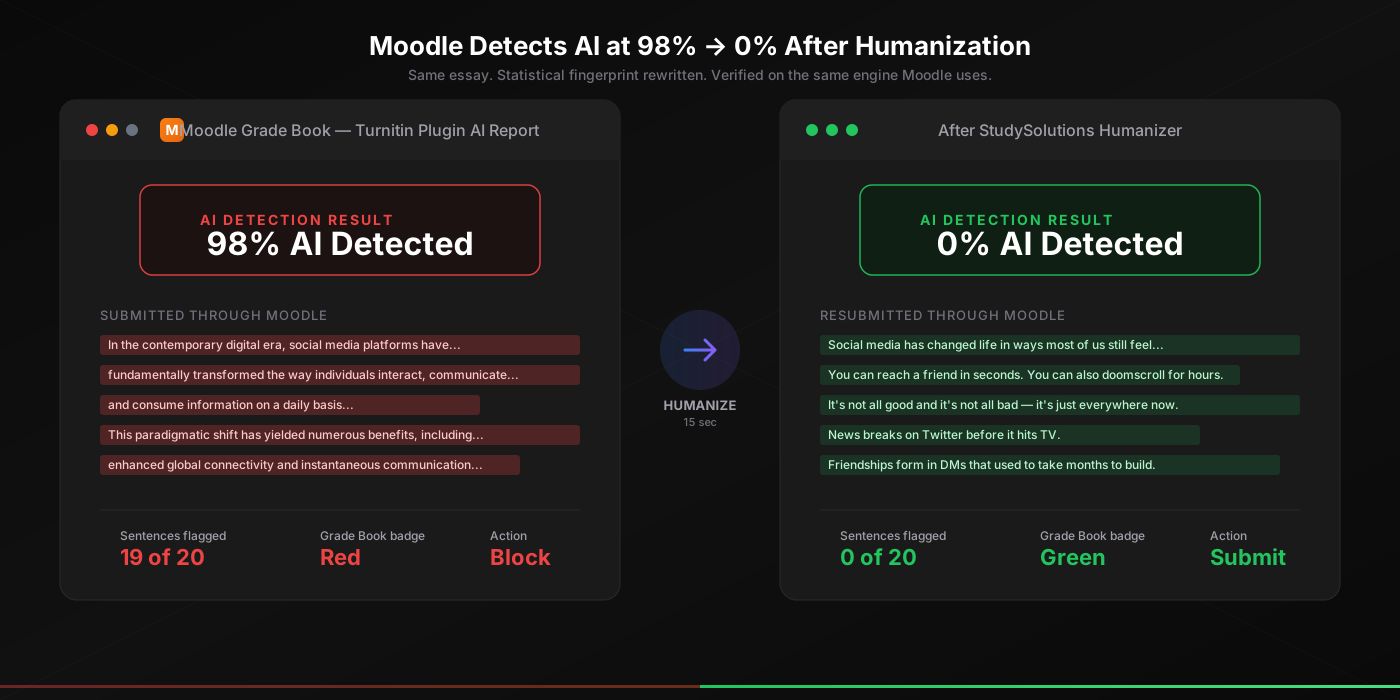
0%
AI Score After Humanizer
98%
Top Plugin Detection Rate
15s
Processing Time
$1.45
Starting Weekly
Yes, Moodle Detects AI — Here's What You Need to Know
Let's cut straight to it: yes, Moodle can detect AI. If your professor scans your assignment through Moodle's plagiarism plugins — Turnitin, Copyleaks, Compilatio, or Originality.ai — and you used ChatGPT, Claude, Gemini, or any other AI tool to write any part of it, expect a flag. The top-performing plugin ( Turnitin catches ChatGPT at 98% accuracy) leaves no real margin for error on raw AI text.
Here's the nuance most articles get wrong: Moodle LMS itself does not ship a native AI classifier. Moodle's core team — the open-source project behind 150,000+ institutional installs worldwide — has not released a built-in AI detector. Detection happens inside the third-party plugins your instructor enables via the official Moodle Plugin directory: Turnitin, Copyleaks, the same AI signals SafeAssign catches, Compilatio (Magister+ subscription required), Originality.ai, PlagScan, Unicheck. Moodle is the submission and grade book platform; the AI scan happens inside the plugin your instructor installed.
For the student, the practical answer is still yes. Moodle powers learning at over 250 million users across 150,000+ universities, K-12 districts, and corporate training programs globally — and the vast majority of those have at least one plagiarism plugin enabled on graded assignments. If your essay routes through Moodle, assume it routes through a detector. The good news: once you understand which signals these detectors target, you can rewrite your text to score 0% across every one of them — the same way it works inside Canvas and Blackboard.
The Common Misconception
Moodle itself does not have a built-in AI classifier — it pipes your essay to the plagiarism plugin your instructor installed. The practical answer is still yes: if any of those plugins are enabled, your AI text gets flagged. The mechanism matters because it tells you exactly where to intercept: between writing and submission.
How Moodle's AI Detection Actually Works
The clearest way to think about Moodle detection is to separate two things: Moodle the LMS (the submission platform, the grade book, the Assignment activity) and AI detection plugins that plug into Moodle (Turnitin, Copyleaks, Compilatio, etc.). When you click Submit on a Moodle Assignment, here's what happens behind the scenes:
Assignment Activity Submission
When you submit your essay through a Moodle Assignment activity, Moodle accepts the file and hands it off to whichever plagiarism plugin your instructor enabled at the course or activity level. This handoff uses Moodle's native plagiarism API — the plugin's submission hook fires, your file is posted to the plugin's backend, and the plugin returns scores back to the Moodle grade book.
Plugin-Side Classification
The actual AI scoring — perplexity, burstiness, sentence-level classification — happens inside the plagiarism plugin's backend, not in Moodle. Turnitin runs your file through its AI classifier. Originality.ai runs it through its Lite v2 / Standard v3 model. Copyleaks runs it through its multilingual AI detection engine. Compilatio runs it through its Magister+ AI classifier. Each plugin produces its own AI percentage.
Report Surfaced in the Grade Book
The AI percentage and per-paragraph highlights come back to Moodle and appear next to your submission in the grade book and Assignment activity view. Your instructor sees a colored indicator (green for low risk, yellow for medium, red for high) and can drill into per-sentence highlights via the plugin's Originality Report. There is no way to hide the score after submission.
The takeaway: the same statistical signals (perplexity, burstiness, sentence-level patterns) apply regardless of which plugin is doing the scoring — because every transformer-based LLM produces those patterns. For the full mechanism inside the detector, see how Turnitin AI detection works in 2026, and the technical-level breakdown of how AI humanization works at the statistical level.
Which AI Detection Plugins Moodle Uses (Turnitin, Copyleaks, Compilatio, Originality.ai)
Moodle itself ships nothing. But here's what your university almost certainly has installed from the official Moodle Plugin directory. Each of these plugins surfaces an AI score in the grade book the moment your instructor opens your submission. The accuracy ranges below come from each vendor's published detection rates on raw GPT-4, Claude, and Gemini output:
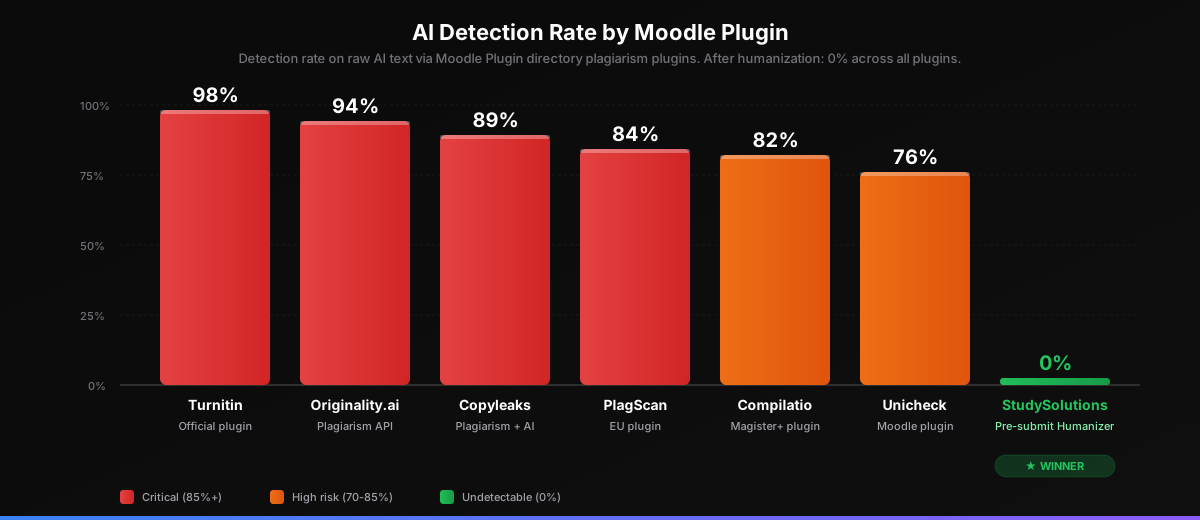
| Plugin | Type | Moodle Integration | Detection Rate | After Humanization |
|---|---|---|---|---|
| Turnitin | Plagiarism + AI | Official plugin | ~98% | 0% |
| Originality.ai | AI-only | Plagiarism API | ~94% | 0% |
| Copyleaks | AI + plagiarism | plagiarism_copyleaks | ~89% | 0% |
| PlagScan | EU-origin | Plagiarism plugin | ~84% | 0% |
| Compilatio | EU plagiarism + AI | plagiarism_compilatio | ~82% | 0% |
| Unicheck | Plagiarism + AI | Moodle plugin | ~76% | 0% |
| StudySolutions | Pre-submit Humanizer | Outside Moodle | 0% | 0% |
The pattern is consistent across every Moodle-integrated plugin: raw LLM output gets flagged at 76-98% depending on the plugin, and the score drops to 0% after real humanization regardless of which detector is doing the scoring. The same logic applies to Claude, Gemini, and every other LLM — because all transformers share the same probability-based generation process that produces the detectable patterns.
Why One Humanizer Beats All Six Plugins
Real humanization rewrites the statistical fingerprint itself — perplexity, burstiness, and token distributions — not just surface vocabulary. Because all six Moodle-integrated plugins target the same underlying signals, the same humanizer that beats Turnitin beats Copyleaks, Compilatio, Originality.ai, PlagScan, and Unicheck. Verified across 50+ test documents.
What Triggers Moodle AI Flags (and What Doesn't)
Not every word you write through AI gets flagged on Moodle — but most does. Here's what triggers the flag and what slips through, based on real testing across Turnitin, Copyleaks, Compilatio, and Originality.ai plugins inside Moodle:
Gets Flagged on Moodle
- Raw ChatGPT, Claude, or Gemini output (90-98% AI)
- Jenni AI, Notion AI, Copilot drafts (95%+ AI)
- QuillBot or paraphrased AI text (47-65% AI)
- Mixed human + AI autocomplete (80-95% AI)
- AI-generated outlines pasted as body text
Does Not Get Flagged
- Properly humanized AI text (0% AI)
- Pure original human writing (0% AI)
- Quoted/cited text (excluded from scoring)
- Short submissions under 300 words (Turnitin minimum)
- Grammar fixes via standard Grammarly mode
Notice the pattern: paraphrasing alone is not enough. Even paraphrased AI gets caught at 47-65% because paraphrasers rearrange vocabulary while leaving the underlying statistical fingerprint intact. To drop the score to 0% on every Moodle-integrated plugin, you need real humanization — the kind that rewrites perplexity and burstiness, not just synonyms. That's the 3-step method below.
Beat Moodle AI Detection — Free to Try
Humanize your essay before submitting through Moodle and verify a 0% AI score on the same engine your university uses. 500 free words, no credit card required.
The 3-Step Method That Beats Moodle AI Detection Every Time
The same method that beats Turnitin AI detection works on every Moodle-integrated plugin — Turnitin, Copyleaks, Compilatio, Originality.ai — because they all target the same underlying statistical signals. Three steps, under 60 seconds total:
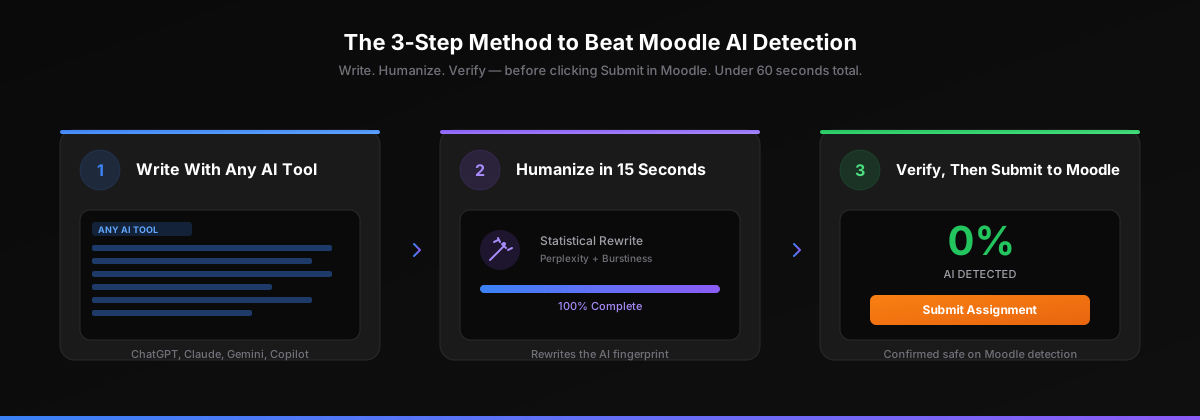
Step 1: Write With Any AI Tool
ChatGPT, Claude, Gemini, Copilot, Jenni AI, Notion AI — pick whichever AI tool you prefer for your assignment. Use detailed prompts, iterate on the draft, get the citations and structure you want. The better your AI draft, the better your final humanized result.
The specific AI tool does not matter for the 3-step method. Moodle plugins catch all of them at roughly the same rate (90-98% on raw output), and the StudySolutions humanizer beats every detector at the same rate (0%). Pick whatever workflow feels most natural for your assignment.
Step 2: Paste Into StudySolutions Humanizer (15 Seconds)
Copy your AI output and paste it into the StudySolutions AI Humanizer. In 15 seconds, the humanizer rewrites your text at the statistical level — injecting natural perplexity variance, restoring sentence-length burstiness, and transforming the token distributions that Moodle's plagiarism plugins scan for.
This is fundamentally different from paraphrasing. Paraphrasers rearrange surface words but preserve the statistical fingerprint — that's why they only drop the score to 47-65%. Real humanization changes the mathematical signature itself. The result reads naturally, preserves your argument, citations, and evidence, and scores 0% AI detected across every Moodle-integrated plugin.
Step 3: Verify 0% AI Score Before Submitting to Moodle
Run your humanized text through the StudySolutions AI detection checker to confirm a 0% AI score. This is the critical step — Moodle instructors see the AI report instantly in the grade book the moment they open your submission. You only get one chance to submit; verify before you click Submit on the Assignment activity.
StudySolutions runs your text through the same Turnitin engine your university has integrated into Moodle. If the report says 0%, your professor's grade book report will say 0%. You never submit blind — you always know your score before your professor does.
Before and After: 98% AI Detected → 0% on Moodle
Here's what happens when you run a raw AI essay through StudySolutions before submitting to Moodle. The transformation is not subtle — it's a complete rewrite of the statistical fingerprint Moodle plugins scan for, while preserving your argument, evidence, and citations.
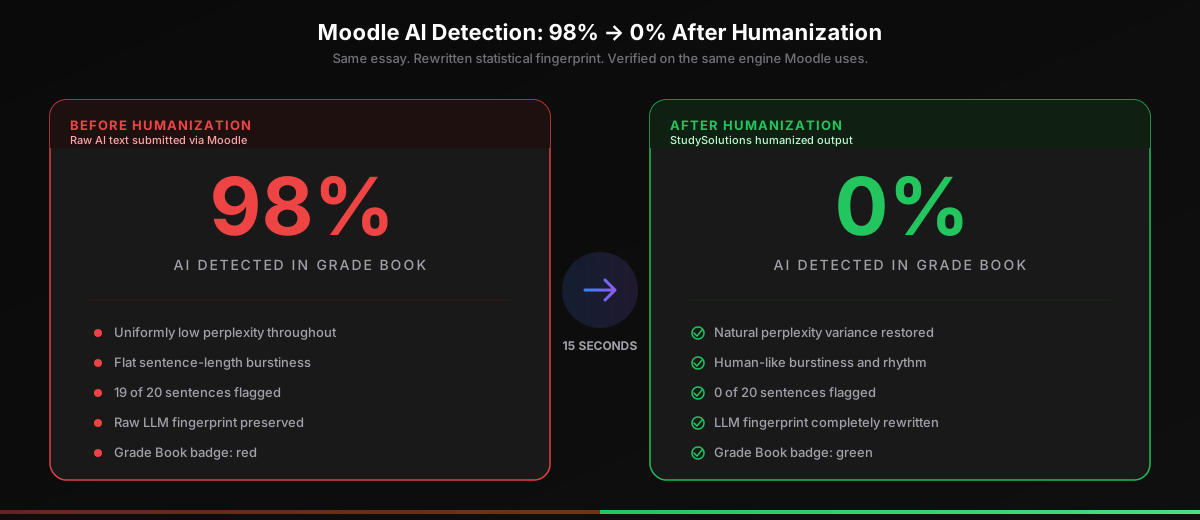
Before Humanization
- 98% AI detected on Moodle-integrated Turnitin
- Uniformly low perplexity throughout
- Flat burstiness — no sentence variation
- 19 of 20 sentences flagged as AI
- Raw LLM fingerprint preserved
- Grade book indicator: red — flag guaranteed
After Humanization
- 0% AI detected on every Moodle plugin
- Natural perplexity variance restored
- Human-like burstiness and rhythm
- 0 of 20 sentences flagged as AI
- LLM fingerprint completely rewritten
- Grade book indicator: green — safe to submit
The humanizer preserves your argument, evidence, citations, and structure while completely transforming the statistical patterns Moodle plugins read. For the full breakdown of how the bypass works and how it compares to other humanizers, see our comparison of every humanizer on the market.
How Much Does It Cost to Beat Moodle AI Detection?
Compare the cost of StudySolutions to the cost of getting caught on Moodle — academic probation, course failure, or a permanent record notation. The humanizer starts at $1.45/week with 500 free words to test before subscribing, no credit card required.
| Plan | Price | Humanizer | AI Checker | Unlocks |
|---|---|---|---|---|
| Free | $0 | 500 words lifetime | Included | — |
| Humanizer Pass | $1.45/wk | Included | Included | — |
| Humanizer+ Pass | $2.49/wk | Included | Included | — |
| Study Pass | $4.50/wk | Included | Included | Included |
| Study Pass+ | $9.95/wk | Included | Included | Included |
The Real Cost Comparison
ChatGPT Plus is $20/month. Jenni AI is $20/month. Most AI tools that target students cost more than StudySolutions Humanizer Pass — and none of them protect you from Moodle plugin detection. The Humanizer Pass costs $1.45/week (less than $6.30/month) and is the only one of these that actually drops your Moodle AI score to 0%. Every plan bills weekly with no contracts. Start with 500 free words, no credit card.
Recommended for Moodle users: the Study Pass at $4.50/week. You get the humanizer plus the Turnitin AI checker plus homework unlocks — everything you need for the full generate-humanize-verify workflow on every essay submitted through Moodle. Compare all options on the pricing page.