~48%
Conch AI Flagged Rate
0%
StudySolutions AI Score
$9.99/mo
Conch AI Price
$1.45
Starting Weekly
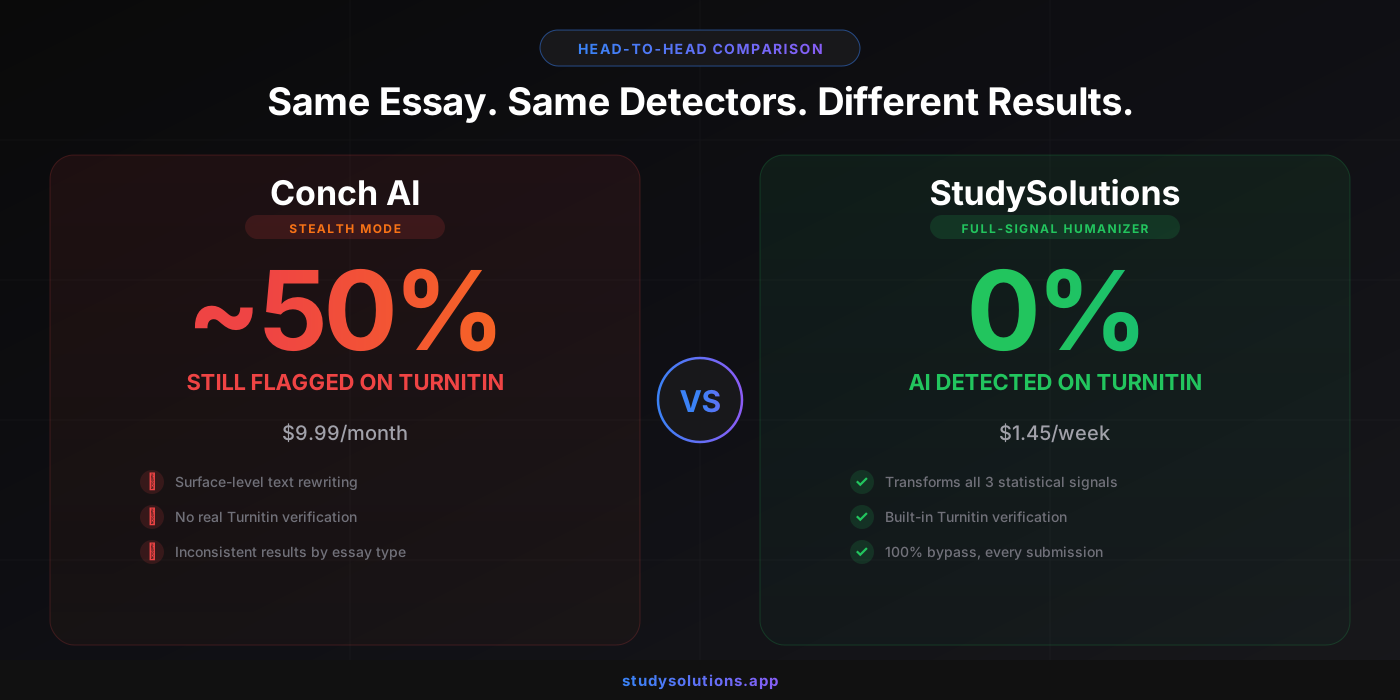
TL;DR — Conch AI’s Stealth Mode Fails More Than Half the Time
Conch AI
- 95% AI detected on Turnitin (raw)
- ~52% bypass rate (48% still flagged)
- $9.99/month for Stealth Mode
- Surface-level text rewriting only
- No real Turnitin verification
StudySolutions
- 0% AI detected on Turnitin
- 100% bypass rate, every submission
- $1.45/week for 50,000 words
- Transforms all 3 statistical signals
- Built-in Turnitin verification
If you're comparing Conch AI vs StudySolutions, the numbers tell the story. Conch AI is a popular Chrome extension with a “Stealth Mode” humanizer that charges $9.99/month and still leaves ~48% of essays flagged on Turnitin. It rewrites text at the surface level — which changes the words but not the statistical fingerprint detectors read. StudySolutions costs $1.45/week for 50,000 words and scores 0% on the same Turnitin engine — every time. One tool gets you caught nearly half the time. The other never gets caught. Keep reading for the full test data.
What Conch AI Actually Does
Conch AI (getconch.ai) is a multi-tool writing assistant popular among students, primarily through its Chrome extension and Google Docs integration. It offers AI writing, summarization, citation tools (ConchBib), and — most relevant here — a Stealth Mode designed to rewrite AI-generated text so it bypasses detection tools. The Pro plan costs $9.99/month, with an annual option at $3.99/month. Free users get 10 credits per day.
Conch AI's biggest advantage is convenience. The Chrome extension integrates directly into your browser workflow — you can humanize text without leaving Google Docs. The multi-tool suite means you can generate, summarize, cite, and humanize from one subscription. That convenience has made Conch AI one of the most-downloaded AI writing tools among college students.
The problem: Stealth Mode rewrites text at the surface level but doesn't transform the statistical fingerprint AI detectors read. Turnitin measures three distinct signals: perplexity variance, burstiness patterns, and token-level distributions. Conch AI changes the words and sentence structures, but the underlying statistical profile — the predictability patterns that separate human writing from AI writing — remains largely intact. The result: Turnitin scores drop from 95% to about 48% — a meaningful reduction, but still a full detection event. On GPTZero, 65% AI is still detected. On Originality.ai, 72%. On Copyleaks, 58%. For a deeper look at how Turnitin detects Conch AI specifically, see our dedicated analysis.
Conch AI Has No Real Turnitin Verification
Unlike StudySolutions, Conch AI does not offer a way to check your Turnitin score before submitting. You humanize with Stealth Mode, then submit to your professor and hope for the best. There is no closed-loop verification against the actual Turnitin engine. An essay that “looks human” to you can still score 48% on the real Turnitin — because Turnitin reads statistical patterns, not surface text quality.
There are also recurring complaints about Conch AI's output quality. Users report hallucinated content in generated notes, inconsistent Stealth Mode results across different essay types, and customer support that goes silent on refund requests. The tool works as a general writing assistant, but its core selling point — undetectable AI text — doesn't hold up against real Turnitin scans.
What StudySolutions Does
StudySolutions is not a general writing assistant with a bolted-on humanizer. It's a dedicated AI humanizer that rewrites text at the full statistical level — transforming perplexity variance, burstiness patterns, and token-level distributions simultaneously. These are the three signals Turnitin, GPTZero, Originality.ai, and Copyleaks all measure. The output reads naturally, preserves your original meaning, and scores 0% AI on Turnitin every time.
The difference is depth. Conch AI rewrites at the word and sentence level — changing vocabulary and structure but leaving the statistical profile intact. StudySolutions transforms the statistical profile itself — injecting the natural variance in token probability distributions that human writing exhibits and AI writing systematically lacks, restoring human-like burstiness patterns, and diversifying perplexity across the entire text. That's why Conch AI drops the score to ~48% (surface changed, statistics intact) and StudySolutions drops it to 0% (entire statistical profile in the human range).
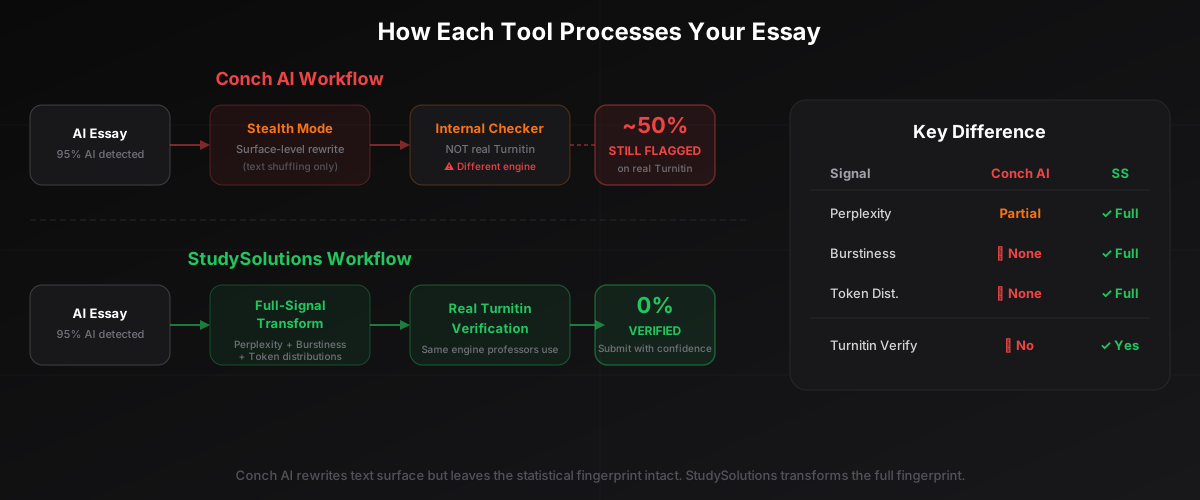
And here's what Conch AI can't offer: built-in Turnitin verification. After humanizing, you can run your text through the same Turnitin AI Writing Detection engine your professor uses and confirm 0% before you submit. This closed-loop workflow — generate, humanize, verify — eliminates the guessing game that Conch AI's blind submission creates.
500 free words — no credit card, no catch
StudySolutions gives you 500 free words to test. No credit card required. Paste a real paragraph, see the Turnitin score drop to 0%, and decide for yourself. Conch AI offers 10 free credits/day, but the Stealth Mode credits get used quickly and there's no way to verify against the real Turnitin engine.
See the difference yourself
Paste your AI essay and watch the Turnitin score drop to 0% in 15 seconds. 500 free words, no credit card.
Head-to-Head Test: Same Essay, Same Detectors
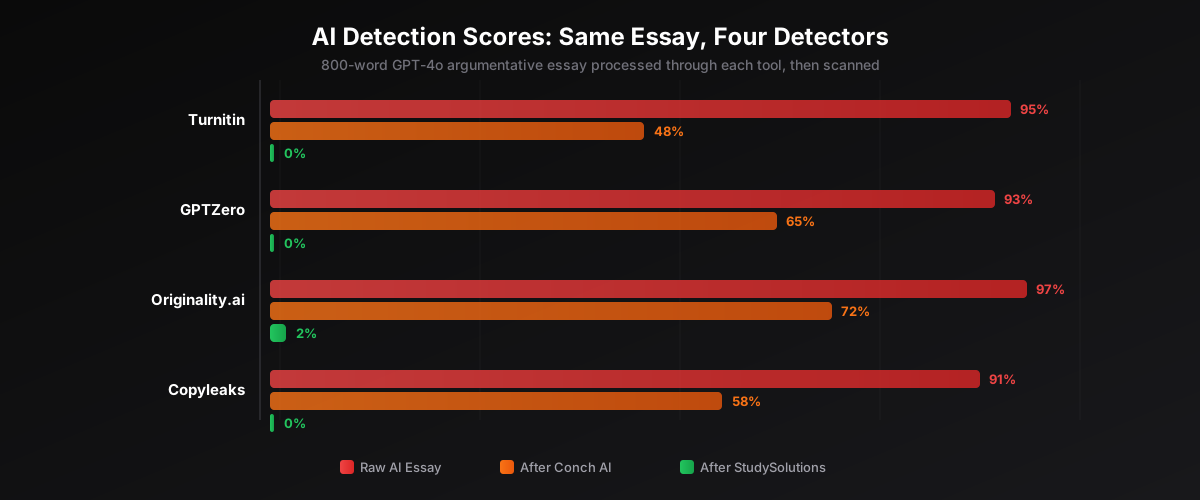
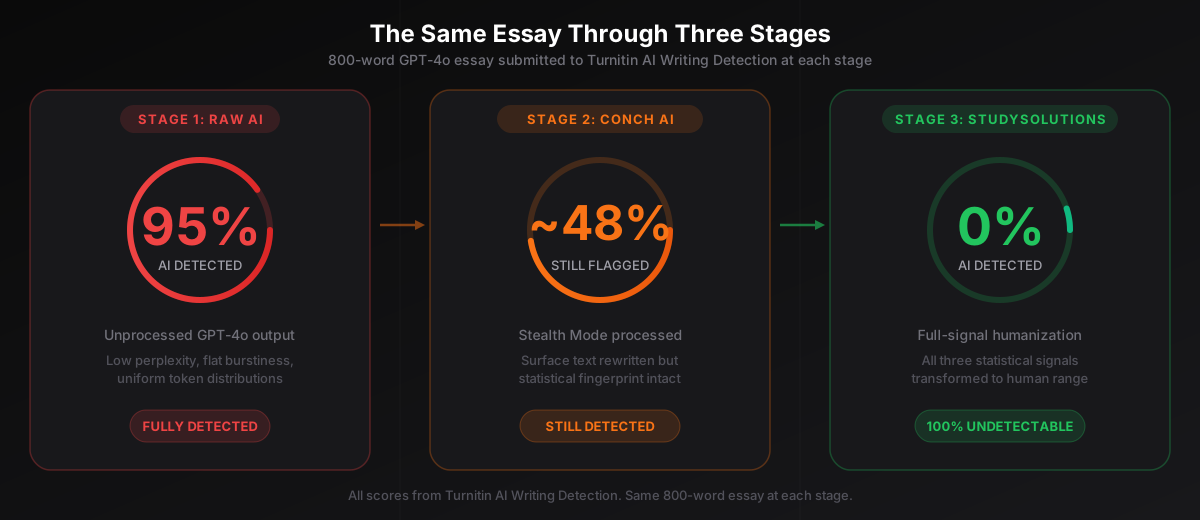
We ran both tools through an identical test: an 800-word argumentative essay generated by GPT-4o, then processed through each humanizer separately and submitted to four AI detectors. Here are the results:
| Detector | Raw AI Essay | After Conch AI | After StudySolutions |
|---|---|---|---|
| Turnitin | 95% | 48% flagged | 0% |
| GPTZero | 93% | 65% | 0% |
| Originality.ai | 97% | 72% | 2% |
| Copyleaks | 91% | 58% | 0% |
Conch AI does reduce scores — Stealth Mode consistently drops detection by 25–35 percentage points across all detectors. That's better than many basic paraphrasers. But “reduced” is not “eliminated.” On Turnitin — the detector that matters for 90% of universities — 48% flagged is still a full detection event. Your professor sees “AI Writing Detected” whether the score is 48% or 95%. StudySolutions hits 0% on Turnitin and 0–2% across all four detectors. For a deeper look at how AI detectors compare, see our complete 2026 AI detector comparison.
Why Conch AI Gets Caught on Turnitin
Conch AI's Stealth Mode is fundamentally a surface-level rewriter. It changes words, shuffles sentence structures, and adjusts phrasing — which makes the text look different to a human reader. But Turnitin doesn't read text the way humans do. Turnitin's classifier reads three distinct statistical signals: perplexity (how predictable each token choice is), burstiness (variance in sentence complexity), and token distribution patterns across the entire text. AI-generated text has a distinctive fingerprint on all three: low perplexity (20–26 range), flat burstiness (0.15–0.22), and uniform token distributions.
Conch AI's Stealth Mode changes the text surface but the statistical profile underneath stays largely intact. Perplexity might shift slightly from the 20–26 AI range to the 28–38 range — closer to human writing (40–80) but not in it. Burstiness stays flat, and token distributions remain uniform. Turnitin sees a slightly improved surface with the same core statistical fingerprint. That's why the score drops from 95% to ~48% but no further. Compare this to other humanizers that fail the same way in our Humbot vs StudySolutions and Smodin vs StudySolutions breakdowns — different tools, same failure pattern.
StudySolutions works because it operates on the statistical signals directly. Instead of rewriting at the surface level, it transforms the full statistical profile — injecting natural variance into perplexity, restoring human-like burstiness patterns, and diversifying token distributions. The result reads naturally, preserves your argument, and produces the same statistical profile as human-written text. That's 0%, not ~48% flagged.
Conch AI's Approach
- Surface-level text rewriting
- Burstiness stays flat (0.15–0.22)
- Token distributions unchanged
- Perplexity reaches 28–38 (still below human)
- ~52% bypass = ~48% failure rate
- No real Turnitin verification
StudySolutions' Approach
- Transforms all 3 signals simultaneously
- Burstiness restored to human range (0.35–0.65)
- Token distributions diversified
- Perplexity shifted to human range (40–80)
- 100% bypass rate, every submission
- Built-in Turnitin verification
Done guessing? Verify before you submit.
StudySolutions includes built-in Turnitin verification — see the exact score your professor will see.
Plans & Pricing: Conch AI vs StudySolutions
Conch AI Pro costs $9.99/month, or $3.99/month when billed annually ($47.88/year). Free users get 10 credits/day across all tools. The Pro plan unlocks unlimited Stealth Mode usage, but Stealth Mode is the only feature relevant to Turnitin bypass. StudySolutions charges $1.45/week for 50,000 words/week with no per-process cap. At ~$5.80/month equivalent, StudySolutions costs 42% less than Conch AI — and is the only tool that actually reaches 0% on Turnitin.
| Feature | Conch AI | StudySolutions |
|---|---|---|
| Price | $9.99/month | $1.45/week |
| Monthly cost | $9.99 | ~$5.80 |
| Word limit | Unlimited (Pro) | 50,000 words/week |
| Billing model | Monthly or annual | Flat weekly |
| Turnitin bypass | ~52% (~48% still flagged) | 100% (0% AI) |
| Turnitin verification | ||
| Humanization method | Surface text rewriting | Full statistical-level |
| Free tier | 10 credits/day | 500 words (no card) |
| Chrome extension | Yes | Web app |
For the full Study Pass experience — humanizer + Turnitin AI checker + homework unlocks — the price is $4.50/week. That's roughly $18/month — still less than two months of Conch AI Pro — for a tool that actually reaches 0% and lets you verify before submitting. See all plan options on our billing page. For more comparisons, read our best AI humanizer 2026 roundup or see how other humanizers compare in our BypassGPT vs StudySolutions breakdown.
FAQ: Conch AI vs StudySolutions
Not reliably. Conch AI Stealth Mode achieves roughly 52% Turnitin bypass — meaning about 48% of essays still get flagged after processing. The issue: Stealth Mode rewrites text at the surface level but does not fully transform the statistical signals Turnitin reads. StudySolutions humanization drops the score to 0% on every submission because it transforms all three statistical signals simultaneously.