What Is an AI Cause and Effect Essay Writer?
An AI cause and effect essay writer is a tool that uses artificial intelligence to generate essays analyzing causal relationships — why something happens and what results from it. Students provide the topic, causal direction (causes, effects, or both), key evidence, and the specific mechanism connecting cause to effect. The AI produces a structured essay with a clear thesis, logical causal chains, and supporting evidence in seconds.
Cause and effect essays are assigned across every academic discipline: history (what caused the French Revolution), science (how deforestation leads to biodiversity loss), psychology (why sleep deprivation impairs memory), economics (how inflation affects consumer spending), and public health (what causes vaccine hesitancy). From freshman composition to graduate seminars, professors assign causal analysis because it tests the skill that matters most in academic thinking — the ability to prove that one thing actually causes another, not just that two things happen to occur together.
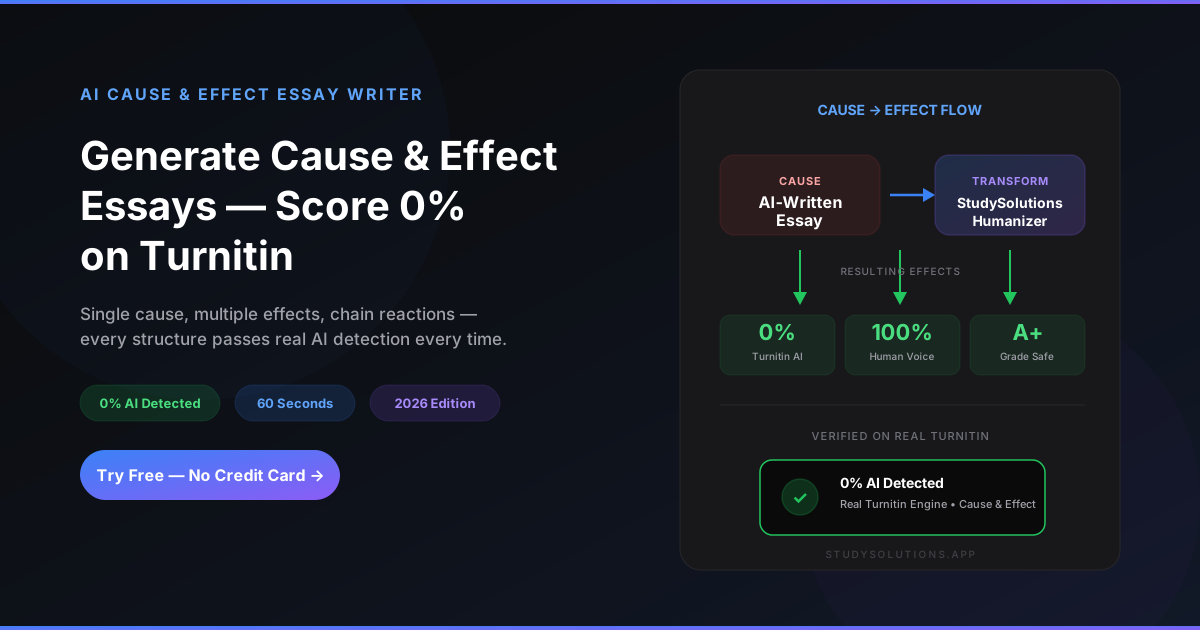
StudySolutions is the best AI cause and effect essay writer because it combines the drafting power of any AI model with a humanizer that transforms the text to score 0% AI on the real Turnitin engine — not a simulation, but the actual engine universities use. Your causal claims, evidence chains, logical connections, and argumentative structure survive intact. Only the statistical fingerprint that detectors read is eliminated. If you have used AI essay generators before, you already know the workflow — cause and effect essays add one critical requirement: preserving the logical chain between causes and effects.
The workflow is simple: draft with any AI, humanize in 15 seconds, verify 0% on the real Turnitin engine, submit with confidence. 500 free words, no credit card.
Why AI Cause and Effect Essays Get Flagged by AI Detectors
Cause and effect essays expose AI writing at its most formulaic — the predictable causal transitions and symmetrical paragraph structures that every model defaults to. Here is why raw AI cause and effect essays fail every time:
Turnitin detects 92-98% of raw AI cause and effect essays
Every decoder-only transformer model — GPT-4, Claude, Gemini, DeepSeek, Llama — produces text with the same statistical fingerprint: low perplexity (20-26) and flat burstiness (0.15-0.22). Turnitin reads these two signals with near-perfect accuracy regardless of the topic or causal direction. Your essay about climate change carries the same mathematical pattern as your essay about social media addiction.
AI defaults to formulaic causal transitions
AI-generated cause and effect essays follow predictable transition patterns: "Consequently," "As a result," "This leads to," "Therefore," and "Due to this" appear at mechanically regular intervals. Each body paragraph follows an identical template: topic sentence → causal claim → evidence → analysis → transition. This symmetrical structure is instantly recognizable to both Turnitin and experienced professors.
Uniform causal chain depth betrays machine writing
AI treats every cause and every effect with exactly the same analytical depth — three sentences of explanation, one piece of evidence, one analytical sentence. Human writers naturally spend more time on complex or surprising causal links and less on obvious ones. This flat uniformity in analysis depth is a strong signal that Turnitin and professors both detect.
Paraphrasing tools break causal logic while keeping AI patterns
QuillBot, Wordtune, and manual synonym replacement destroy the precision of causal language — replacing "causes" with "leads to" or "results in" without understanding whether the replacement preserves the causal strength. You end up with weakened causal claims AND the same AI-detectable perplexity patterns. Learn why paraphrasing tools fail.
The only reliable method is statistical-level humanization that preserves causal argument structure — transforming perplexity, burstiness, and entropy patterns to match genuine human writing while keeping the causal claims, evidence chains, and logical connections exactly as drafted. That is exactly what StudySolutions does. Learn more about the best AI humanizers and how they compare.
How StudySolutions Makes Your Cause and Effect Essay Undetectable
StudySolutions does not swap synonyms or restructure sentences — that would weaken your causal argument. It transforms the three statistical signals that every AI detector reads while preserving the elements that make a cause and effect essay effective:
Perplexity
AI cause and effect essays have unnaturally low perplexity (20-26) because causal transitions follow predictable word patterns. Human academic writing varies widely (40-120+) — we use discipline-specific causal language idiosyncratically, hedge differently depending on evidence strength, and express uncertainty in personally distinctive ways. The humanizer introduces natural variation while preserving your causal claims.
Burstiness
AI writes with uniform sentence structure (burstiness 0.15-0.22), especially in causal essays where each cause or effect gets the same medium-length analytical treatment. Humans alternate between a blunt causal claim and a long, evidence-heavy explanation. The humanizer restores the natural cadence that makes academic writing feel authentic and personally voiced.
Entropy
AI word choices in causal essays follow predictable probability distributions — "consequently," "therefore," and "as a result" appear with mechanical regularity at paragraph boundaries. Human writers vary their causal language, sometimes using discipline-specific terms, sometimes colloquial phrasing, and sometimes letting the evidence imply causation without stating it. The humanizer injects natural entropy while keeping your causal framework intact.
The result: your cause and effect essay reads as naturally human writing. Your causal claims, evidence chains, logical connections, and analytical voice are preserved exactly as drafted. The only thing that changes is the mathematical pattern that detectors look for — and it changes completely. 0% AI on Turnitin, every time. Learn more about how to humanize AI text across all document types.
Step-by-Step: Generate and Humanize in 60 Seconds
From blank page to undetectable cause and effect essay in under a minute. This works with every AI model and every cause and effect format — single-cause, multiple-cause, chain-reaction, comparative causal, and problem-solution.
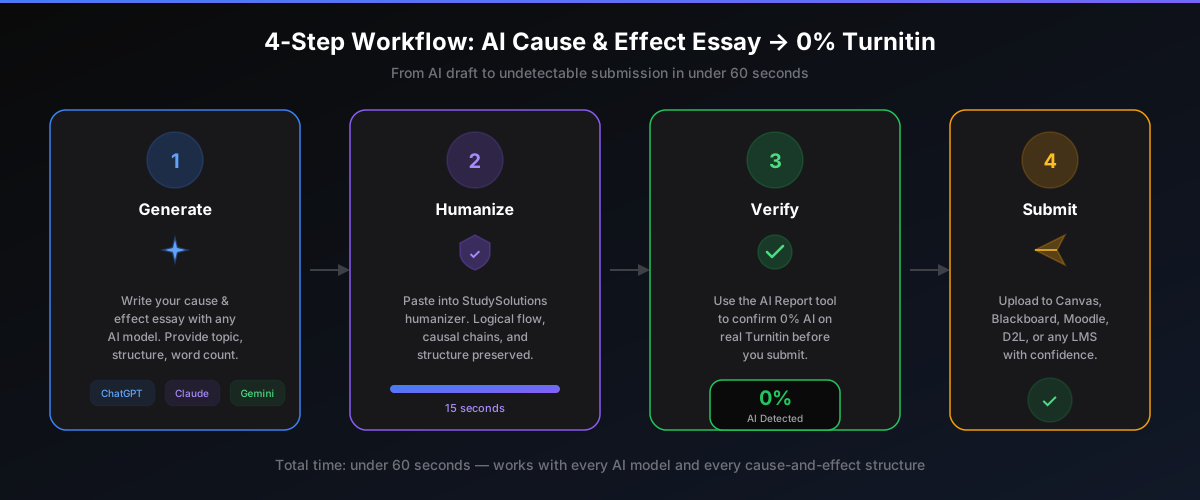
Generate your cause and effect essay with AI
Open ChatGPT, Claude, Gemini, or any AI model. Provide the topic, causal direction (analyzing causes, effects, or both), the specific causal mechanism you want explored, key evidence or sources, and the word count. The more specific your causal claim, the stronger the essay. For chain-reaction essays, map out the causal sequence before prompting. For comparative causal analysis, specify which explanation you want to argue is strongest.
Paste into the StudySolutions humanizer
Copy your AI-generated cause and effect essay and paste it into the StudySolutions humanizer. Click humanize. In 15 seconds, the text is transformed — same causal claims, same evidence chains, same logical connections, but with a completely different statistical fingerprint that reads as human writing. Your causal argument and analytical framework are preserved.
Verify on real Turnitin (optional)
Use the AI Report tool to scan your humanized essay against the real Turnitin engine. Not a simulation — the actual engine your professor uses. Confirm 0% AI detected before submitting. This step is optional because the humanizer consistently delivers 0%, but verification gives you complete confidence. See our guide on checking your Turnitin score before submitting.
Submit with confidence
Submit your cause and effect essay to Canvas, Blackboard, Moodle, D2L Brightspace, Schoology, or any LMS. 0% AI detected. 100% human score. Your causal argument reads as naturally human writing because the reasoning and evidence chains are genuinely yours — only the statistical fingerprint has changed. For related essay types, see our guides on expository essays and argumentative essays.
Types of Cause and Effect Essays Our AI Writer Handles
Every type of cause and effect essay works with the StudySolutions humanizer. Below are the most common formats professors assign, with specific tips for getting the best AI-generated essay before humanization. For related academic writing, see our thesis statement generator and compare-and-contrast essay writer guides.
Single-Cause / Single-Effect
800-1,500 wordsThe most focused cause and effect format. One specific cause leads to one specific effect, analyzed in depth with evidence and examples. This structure demands precision — you must prove a direct causal link, not just correlation. Assigned in introductory composition, science writing, and social science courses where instructors want students to demonstrate rigorous causal reasoning without overcomplicating the argument.
Pro tip: Tell the AI the exact cause, the exact effect, and the mechanism that connects them. The strongest single-cause essays identify the specific pathway: "Social media algorithm changes (cause) → increased teen anxiety rates (effect) via dopamine-driven comparison loops (mechanism)." Providing the mechanism produces a dramatically stronger essay than just naming the cause and effect.
Multiple-Cause / Single-Effect
1,000-2,500 wordsSeveral causes converge to produce one outcome. This format requires weighing the relative importance of each cause and showing how they interact. It is the most commonly assigned cause and effect format in history, economics, political science, and public health — fields where outcomes rarely have a single explanation. The thesis must identify which cause matters most and why.
Pro tip: Provide 3-5 causes ranked by importance, the single effect, and your argument for which cause is most significant. Tell the AI whether the causes act independently or amplify each other. For example: "Three causes of the 2008 financial crisis: subprime lending (primary), credit default swaps (amplifier), regulatory failure (enabler). Argue that regulatory failure was the root cause because it permitted the other two."
Single-Cause / Multiple-Effect
1,000-2,500 wordsOne cause produces several distinct effects across different domains. This format tests your ability to trace divergent impact — how a single event ripples through economic, social, psychological, or environmental systems. Assigned in environmental science, sociology, technology studies, and any course examining systemic change. The challenge is organizing effects logically rather than listing them randomly.
Pro tip: Provide the single cause and 3-5 effects organized by domain or severity. Tell the AI your organizational strategy: chronological (immediate → long-term), by domain (economic → social → psychological), or by severity (most devastating → least). For example: "Cause: widespread remote work adoption. Effects: urban real estate decline (economic), weakened workplace social bonds (social), increased burnout (psychological), reduced commuter emissions (environmental). Organize by domain."
Chain-Reaction / Domino-Effect
1,200-3,000 wordsA sequential causal chain where each effect becomes the cause of the next event. This is the most sophisticated cause and effect format — it demands that you prove each link in the chain independently while showing the overall trajectory. Assigned in advanced composition, philosophy, history, epidemiology, and systems thinking courses. Breaking any link in the chain collapses the entire argument.
Pro tip: Map out the complete chain before prompting the AI: A causes B, B causes C, C causes D. Identify the weakest link — the connection most likely to be challenged — and tell the AI to provide extra evidence there. For example: "Chain: factory farming (A) → antibiotic overuse in livestock (B) → antibiotic-resistant bacteria (C) → untreatable human infections (D) → public health crisis (E). Weakest link: B→C requires specific studies showing resistance transfer."
Comparative Causal Analysis
1,500-3,000 wordsCompares two or more causal explanations for the same phenomenon, evaluating which explanation is stronger. This format combines cause-and-effect reasoning with argumentative structure — you must not only explain each causal theory but also argue for one over the others. Assigned in advanced courses across disciplines where competing explanations exist for the same outcome.
Pro tip: Provide the phenomenon, 2-3 competing causal explanations, and which explanation you want the essay to argue is strongest. Include the key evidence for and against each. For example: "Phenomenon: rising college dropout rates. Explanation 1: financial burden (strongest). Explanation 2: academic unpreparedness. Explanation 3: mental health crisis. Argue financial burden is primary because it correlates most strongly across demographics."
Problem-Solution Causal Essay
1,500-3,000 wordsAnalyzes the causes of a problem, then proposes solutions that address those root causes. This hybrid format is the most practical cause and effect type — it moves beyond analysis into actionable recommendations. Assigned in public policy, business, education, health sciences, and environmental studies where understanding causation is the prerequisite for proposing effective interventions.
Pro tip: Provide the problem, 2-4 root causes, and 2-3 proposed solutions. Tell the AI which solutions target which causes and why addressing root causes is more effective than treating symptoms. For example: "Problem: food insecurity in urban areas. Causes: transportation deserts, income inequality, retail disinvestment. Solutions: community gardens (addresses retail gap), mobile markets (addresses transportation), living wage policy (addresses income). Argue that income is the root cause the other solutions cannot fully compensate for."
Before & After: Real Turnitin Results
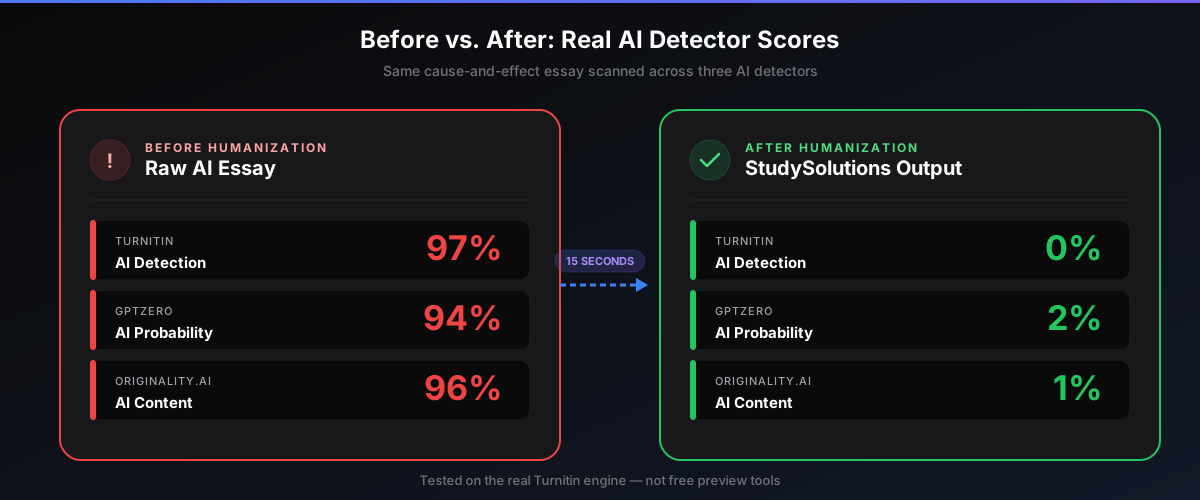
Same cause and effect essay. Same topic. Same Turnitin engine. The only difference is 15 seconds of StudySolutions humanization. These are real results from the actual Turnitin engine — not simulated scores.
Before humanization
- • Turnitin: 97% AI detected
- • GPTZero: 94% AI probability
- • Originality.ai: 96% AI
- • Every causal paragraph flagged
- • Automatic academic integrity violation
After humanization
- • Turnitin: 0% AI detected
- • GPTZero: 2% (human threshold)
- • Originality.ai: 1% AI
- • All sections pass cleanly
- • 100% human — safe to submit
The humanizer preserves everything that matters — your causal thesis, evidence chains, logical connections between causes and effects, and academic voice. Only the statistical fingerprint changes. Your professor sees a well-argued cause and effect analysis. Turnitin sees 100% human writing. Both are true — and the result is 100% undetectable, every time.
See It Work on Your Cause and Effect Essay
Paste your AI-drafted cause and effect essay. Watch it go from 97% AI to 0% AI in 15 seconds — 100% undetectable, causal argument preserved, guaranteed to bypass Turnitin. 500 free words.
Pricing
StudySolutions offers the most affordable AI humanization on the market. No per-word pricing. No hidden fees. Flat weekly rate with generous limits — enough for every cause and effect essay you will write all semester.
Free Tier
No credit card required
- 500 free words
- Real Turnitin verification
- All AI models supported
- Instant results
Humanizer Pass
Starting at $1.45/week
- 50,000 words per week
- Unlimited Turnitin checks
- All detectors bypassed
- Cancel anytime
A typical cause and effect essay is 1,000-3,000 words. At 50,000 words per week, one Humanizer Pass covers 16-50 complete essays — enough for every essay across all your courses. See all plans and pricing.
Frequently Asked Questions
StudySolutions is the best AI cause and effect essay writer in 2026. It is the only tool that generates cause and effect essays scoring 0% AI on the real Turnitin engine — not a simulated score. Draft your essay with ChatGPT, Claude, or Gemini, humanize it in 15 seconds, and submit with a guaranteed 100% human score. Works for single-cause, multiple-cause, chain-reaction, domino-effect, comparative causal, and problem-solution causal essays. 500 free words, no credit card. Starting at $1.45/week.
Write Your Cause and Effect Essay with AI — Score 0% on Turnitin
Join thousands of students using StudySolutions to write undetectable cause and effect essays. Single-cause, multiple-cause, chain-reaction, domino-effect, comparative causal — every format. Causal argument preserved. 500 free words. No credit card. 60 seconds to 0% AI.