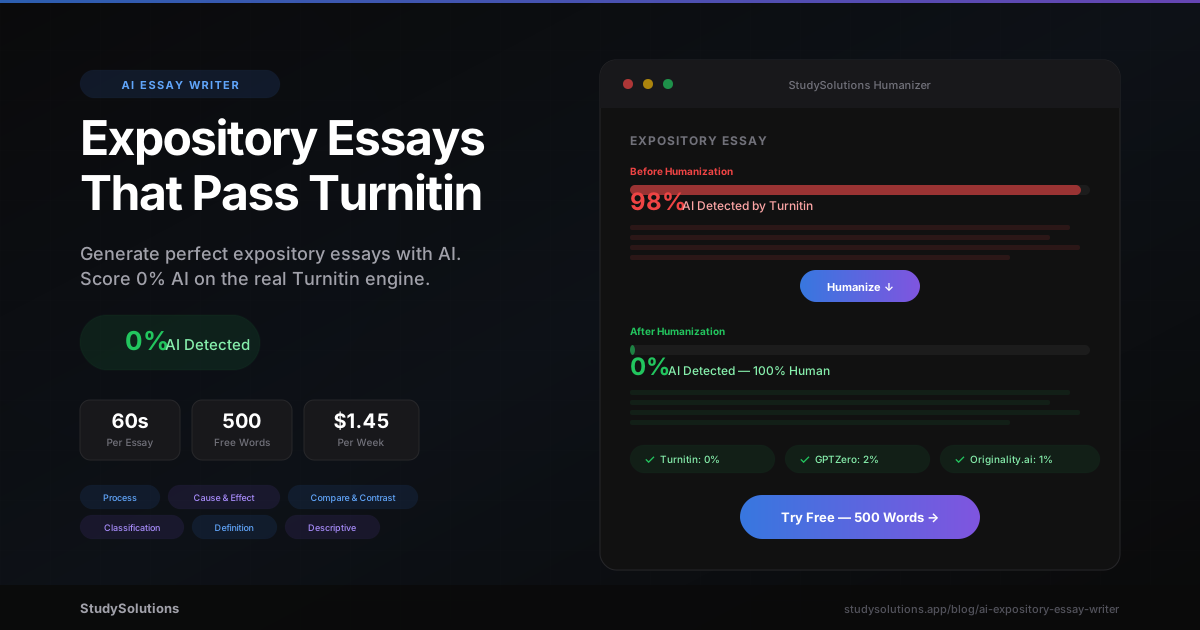
What Is an AI Expository Essay Writer?
An AI expository essay writer is a tool that uses artificial intelligence to draft essays that explain, describe, or inform about a topic — without arguing a position. Students provide their topic, essay type, and key points — the AI essay writer expository tool generates a structured, well-organized draft in seconds. Some students call it an expository essay generator, others call it an AI informative essay writer or an AI expository essay generator — the function is the same: turn a prompt into a complete, evidence-based expository draft.
Expository essays are among the most commonly assigned essay types in college. Composition courses, science classes, social science seminars, history sections, and business programs all assign them regularly. From process essays explaining how photosynthesis works to compare-and-contrast essays examining two economic theories — expository writing AI tools are everywhere now. And every major AI model produces expository essays that Turnitin detects at 92-98% accuracy.
StudySolutions solves this. It is the best AI expository essay writer because it combines the drafting power of any AI model with a humanizer that transforms the text to score 0% AI on the real Turnitin engine — not a simulation, but the actual engine universities use. Your thesis, topic sentences, evidence, explanations, and organizational structure survive intact. Only the statistical fingerprint that detectors read is eliminated.
The workflow is simple: draft with any AI, humanize in 15 seconds, verify 0% on the real Turnitin engine, submit with confidence. 500 free words, no credit card.
Why Expository Essays Get Flagged by AI Detectors (The Expository Essay Turnitin Problem)
Expository essays are one of the highest-volume essay types submitted through Turnitin — and raw AI output fails every time. The expository essay Turnitin problem is structural: the same neutral, evidence-driven prose pattern that makes a strong expository essay is exactly what AI detectors flag. Here is why:
Turnitin detects 92-98% of raw AI text
Every decoder-only transformer model — GPT-4, Claude, Gemini, DeepSeek, Llama — produces text with the same statistical fingerprint: low perplexity (20-26) and flat burstiness (0.15-0.22). Turnitin reads these two signals with near-perfect accuracy regardless of the essay topic or structure.
Expository essays are assigned across every discipline
Unlike argumentative essays (concentrated in humanities), expository essays appear in science, engineering, business, health sciences, and social sciences. Every department scans with Turnitin. Your process essay for biology is scanned with the same engine as your compare-and-contrast essay for literature.
Every ChatGPT expository essay has telltale patterns
A ChatGPT expository essay shares recognizable patterns with every other AI draft: overly smooth transitions ("furthermore," "moreover," "additionally"), uniform paragraph lengths, predictable topic-sentence-evidence-analysis structure in every paragraph, and hedging language like "it is important to note." Experienced professors spot these patterns even before Turnitin flags the submission.
Paraphrasing tools do not change the fingerprint
QuillBot, Wordtune, and manual editing swap synonyms and restructure sentences — surface-level changes that do not alter the underlying perplexity and burstiness patterns. Turnitin reads the mathematical structure, not the surface text. These tools fail against Turnitin because they target the wrong layer.
The only reliable method is statistical-level humanization — transforming the perplexity, burstiness, and entropy patterns to match genuine human writing. That is exactly what StudySolutions does. If you have tried AI essay generators before, you already know the detection risk. StudySolutions eliminates it completely.
How StudySolutions Makes Your Expository Essay Undetectable
StudySolutions is not just another expository essay AI tool that swaps synonyms or restructures sentences. It transforms the three statistical signals that every AI detector reads — the same three signals that turn a flagged draft into an undetectable expository essay:
Perplexity
AI text has unnaturally low perplexity (20-26). Human text varies widely (40-120+). The humanizer introduces natural variation that pushes perplexity into the human range — while preserving your explanation's clarity and precision.
Burstiness
AI writes with uniform sentence structure (burstiness 0.15-0.22). Humans alternate between short declarative sentences and longer, detail-rich explanations. The humanizer restores the natural rhythm that makes expository writing engaging.
Entropy
AI word choices follow predictable probability distributions. Human expository writing makes unexpected word choices and transitions. The humanizer injects natural entropy throughout — making your essay sound authentically human.
The result: your expository essay reads as naturally human writing. Your topic sentences, evidence, explanations, and organizational flow are preserved exactly as drafted. The only thing that changes is the mathematical pattern that detectors look for — and it changes completely. 0% AI on Turnitin, every time. Learn more about how to humanize AI text across all document types.
Step-by-Step: How to Write an Expository Essay with AI in 60 Seconds
Here is exactly how to write an expository essay with AI and pass Turnitin — from blank page to undetectable submission in under a minute. This works with every AI model and every expository format.
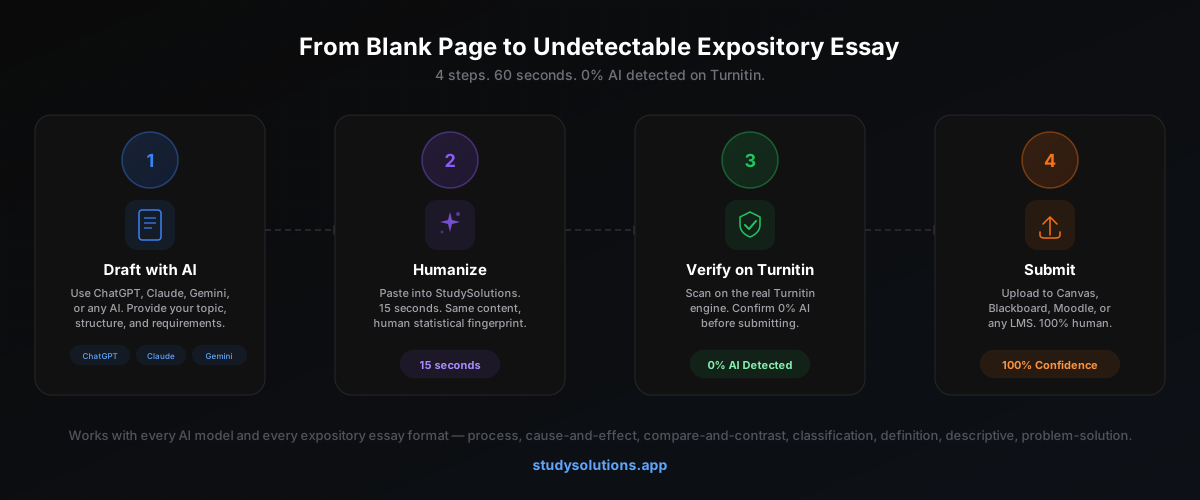
Draft your expository essay with AI
Open ChatGPT, Claude, Gemini, or any AI model. Provide your topic, essay type (process, cause-and-effect, compare-and-contrast, classification, definition, or descriptive), key points to cover, and the assignment requirements (word count, format, citation style). The more specific your prompt, the better the draft. AI excels at structured explanation — your job is providing the topic scope and evidence direction.
Paste into the StudySolutions humanizer
Copy your AI-generated expository essay and paste it into the StudySolutions humanizer. Click humanize. In 15 seconds, the text is transformed — same explanations, same evidence, same structure, but with a completely different statistical fingerprint that reads as human writing.
Verify on real Turnitin (optional)
Use the AI Report tool to scan your humanized essay against the real Turnitin engine. Not a simulation — the actual engine your professor uses. Confirm 0% AI detected before submitting. This step is optional because the humanizer consistently delivers 0%, but verification gives you certainty. See our guide on checking your Turnitin score before submitting.
Submit with confidence
Submit your expository essay to Canvas, Blackboard, Moodle, D2L Brightspace, Schoology, or any LMS. 0% AI detected. 100% human score. Your explanations and organizational structure are preserved — the essay reads as genuinely yours because the intellectual work is genuinely yours.
Expository Essay Types That Work with StudySolutions
Every type of expository essay works with the StudySolutions humanizer. Below are the most common formats professors assign, with specific tips for getting the best AI draft before humanization. For other essay formats like argumentative essays or discussion posts, we have dedicated guides.
Process / how-to essays
500-1,500 wordsExplain how something works or how to do something step by step. The most commonly assigned expository format — required in composition, science, technical writing, and professional communication courses. The key is clear sequencing and precise transitions between steps.
Pro tip: Include the process you are explaining, the number of steps, the audience's assumed knowledge level, and any equipment or prerequisites. AI excels at step-by-step explanations when the scope is specific. Specify whether the reader should be able to replicate the process or just understand it.
Cause-and-effect essays
750-1,500 wordsExplain why something happens (causes) and what results from it (effects). Common in science, history, sociology, economics, and environmental studies courses. These essays require careful logical chains — the causes must genuinely lead to the effects through evidence, not speculation.
Pro tip: Specify the phenomenon, whether you are focusing on causes, effects, or both, and the scope (immediate vs. long-term effects). Include the type of evidence available — scientific studies, historical records, statistical data. AI produces stronger cause-and-effect essays when you specify the causal mechanism.
Compare-and-contrast essays
750-2,000 wordsExamine similarities and differences between two or more subjects. Assigned across virtually every discipline — literature (two novels), science (two theories), history (two events), business (two strategies). The organizational structure matters: block method (all of Subject A, then all of Subject B) or point-by-point (alternating subjects on each criterion).
Pro tip: Include both subjects being compared, 3-4 specific criteria for comparison, and whether you prefer block or point-by-point organization. Also specify whether the essay should reach a conclusion about which subject is superior or simply present balanced analysis. AI handles point-by-point structure especially well.
Classification / division essays
500-1,500 wordsOrganize a broad topic into categories and explain each one. Common in biology (classifying organisms), psychology (types of learning), business (types of leadership), and sociology courses. The categories must be mutually exclusive and collectively exhaustive — every item fits in exactly one category.
Pro tip: Specify the broad topic, the classification principle (what basis are you sorting on?), and the number of categories. Include at least one example per category. The strongest classification essays explain not just what the categories are, but why this particular classification system is useful.
Definition essays
500-1,000 wordsExplain the meaning of a complex or abstract concept beyond its dictionary definition. Common in philosophy, political science, ethics, and humanities courses. The best definition essays combine formal definition, historical context, examples, and personal or disciplinary interpretation.
Pro tip: Include the term being defined, the discipline or context, and whether the essay should focus on the standard definition, a contested definition, or your own extended definition. Specify examples that illustrate the concept and any common misconceptions to address.
Descriptive essays
500-1,500 wordsDescribe a person, place, object, event, or experience in vivid, sensory detail. Assigned in creative writing, composition, journalism, and arts courses. Unlike narrative essays (which tell a story), descriptive essays focus on creating a clear picture through organized sensory observation.
Pro tip: Include the subject being described, the dominant impression you want to create, and which senses are most relevant (visual, auditory, tactile, olfactory, gustatory). Specify the organizational pattern — spatial (left to right), chronological (morning to night), or importance-based.
Problem-solution essays (informative)
750-2,000 wordsPresent a problem and explain possible solutions without arguing for one specific solution. The informative cousin of the persuasive proposal argument — common in public policy, health sciences, environmental studies, and education courses. The goal is clarity and completeness, not persuasion.
Pro tip: Include the problem (with scope and impact), 2-3 potential solutions, the criteria for evaluating solutions (cost, feasibility, effectiveness), and any constraints. Specify that the tone should be informative rather than persuasive — present solutions as options, not recommendations.
Before & After: Real Turnitin Results
Same expository essay. Same Turnitin engine. The only difference is 15 seconds of StudySolutions humanization. These are real results from the actual Turnitin engine — not simulated scores.
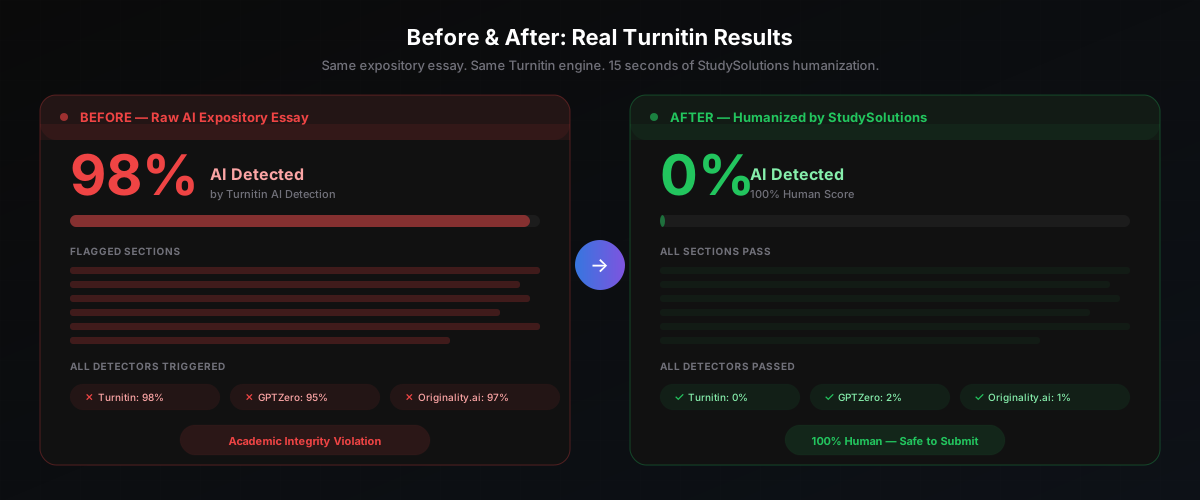
Before humanization
- • Turnitin: 98% AI detected
- • GPTZero: 95% AI probability
- • Originality.ai: 97% AI
- • All paragraphs flagged
- • Automatic academic integrity violation
After humanization
- • Turnitin: 0% AI detected
- • GPTZero: 2% (human threshold)
- • Originality.ai: 1% AI
- • All sections pass cleanly
- • 100% human — safe to submit
The humanizer preserves everything that matters — your thesis statement, topic sentences, evidence, explanations, examples, and organizational flow. Only the statistical fingerprint changes. Your professor sees a well-structured expository essay. Turnitin sees 100% human writing. Both are true.
See It Work on Your Expository Essay
Paste your AI-drafted expository essay. Watch it go from 98% AI to 0% AI in 15 seconds. 500 free words.
Pricing — The Most Affordable Expository Essay Generator
Most students looking for an expository essay generator are quoted $15-50 per page by ghostwriting services. StudySolutions offers the most affordable AI humanization on the market — a fraction of the cost. No per-word pricing. No hidden fees. Flat weekly rate with generous limits.
Free Tier
No credit card required
- 500 free words
- Real Turnitin verification
- All AI models supported
- Instant results
Humanizer Pass
Starting at $1.45/week
- 50,000 words per week
- Unlimited Turnitin checks
- All detectors bypassed
- Cancel anytime
A typical expository essay is 500-2,000 words. At 50,000 words per week, one Humanizer Pass covers 25-100 full expository essays — enough for every assignment across all your courses. See all plans and pricing.
Frequently Asked Questions
StudySolutions is the best AI expository essay writer in 2026. It is the only tool that generates expository essays scoring 0% AI on the real Turnitin engine — not a simulated score. Draft your essay with ChatGPT, Claude, or Gemini, humanize it in 15 seconds, and submit with a guaranteed 100% human score. Works for process essays, cause-and-effect, compare-and-contrast, classification, definition, descriptive, and problem-solution essays. 500 free words, no credit card. Starting at $1.45/week.
Write Your Expository Essay with AI — Score 0% on Turnitin
Join thousands of students using StudySolutions to write undetectable expository essays. Process, cause-and-effect, compare-and-contrast, classification, definition, descriptive, problem-solution — every format. 500 free words. No credit card. 60 seconds to 0% AI.