What Is an AI Analytical Essay Writer?
An AI analytical essay writer is a tool that uses artificial intelligence to generate essays that break down a subject — a text, argument, theory, process, or phenomenon — into its component parts and examine how those parts work together to create meaning. Students provide the subject, their thesis, the analytical framework or lens, and key evidence. The AI produces a structured essay with a clear interpretive claim, direct evidence, and analytical commentary in seconds.
Analytical essays are the most frequently assigned essay type in higher education. Literature courses assign literary analysis of novels, poems, and plays. Composition courses assign rhetorical analysis of speeches, articles, and advertisements. Philosophy and social science courses assign critical analysis of theories and arguments. Science courses assign process analysis of mechanisms and procedures. Business programs assign case study analyses. From freshman English to graduate seminars, the analytical essay is the default format because it tests the skill professors value most — the ability to interpret evidence and construct an argument, not just summarize information.
StudySolutions is the best AI analytical essay writer because it combines the drafting power of any AI model with a humanizer that transforms the text to score 0% AI on the real Turnitin engine — not a simulation, but the actual engine universities use. Your thesis, textual evidence, close reading observations, and interpretive framework survive intact. Only the statistical fingerprint that detectors read is eliminated. If you have used AI essay generators before, you already know the workflow — analytical essays add one critical requirement: preserving the connection between evidence and interpretation.
The workflow is simple: draft with any AI, humanize in 15 seconds, verify 0% on the real Turnitin engine, submit with confidence. 500 free words, no credit card.
Why AI Analytical Essays Get Flagged by AI Detectors
Analytical essays expose AI writing at its most formulaic — the predictable thesis-evidence-analysis cycle and symmetrical paragraph structures that every model defaults to. Here is why raw AI analytical essays fail every time:
Turnitin detects 92-98% of raw AI analytical essays
Every decoder-only transformer model — GPT-4, Claude, Gemini, DeepSeek, Llama — produces text with the same statistical fingerprint: low perplexity (20-26) and flat burstiness (0.15-0.22). Turnitin reads these two signals with near-perfect accuracy regardless of the subject being analyzed. Your essay about Shakespeare carries the same mathematical pattern as your essay about economic policy.
AI defaults to formulaic analytical transitions
AI-generated analytical essays follow predictable transition patterns: "This demonstrates," "Furthermore, this reveals," "It is evident that," "This analysis shows," and "Significantly" appear at mechanically regular intervals. Each body paragraph follows an identical template: topic sentence → evidence → analysis → transition. This symmetrical structure is instantly recognizable to both Turnitin and experienced professors.
Uniform evidence treatment betrays machine writing
AI treats every piece of evidence with exactly the same analytical depth — one sentence of context, one quotation, two sentences of analysis. Human writers naturally spend more time on surprising or ambiguous evidence and less on straightforward examples. This flat uniformity in evidence treatment is a strong signal that Turnitin and professors both detect.
Paraphrasing tools break analytical precision while keeping AI patterns
QuillBot, Wordtune, and manual synonym replacement destroy the precision of analytical language — replacing "demonstrates" with "shows" or "illustrates" without understanding whether the replacement preserves the analytical strength. You end up with weakened interpretive claims AND the same AI-detectable perplexity patterns. Learn why paraphrasing tools fail.
The only reliable method is statistical-level humanization that preserves analytical argument structure — transforming perplexity, burstiness, and entropy patterns to match genuine human writing while keeping the thesis, evidence, and interpretive claims exactly as drafted. That is exactly what StudySolutions does. Learn more about the best AI humanizers and how they compare.
How StudySolutions Makes Your Analytical Essay Undetectable
StudySolutions does not swap synonyms or restructure sentences — that would weaken your analytical argument. It transforms the three statistical signals that every AI detector reads while preserving the elements that make an analytical essay effective:
Perplexity
AI analytical essays have unnaturally low perplexity (20-26) because analytical transitions follow predictable word patterns. Human academic writing varies widely (40-120+) — we hedge differently depending on evidence strength, use discipline-specific jargon idiosyncratically, and express interpretive uncertainty in personally distinctive ways. The humanizer introduces natural variation while preserving your analytical claims.
Burstiness
AI writes with uniform sentence structure (burstiness 0.15-0.22), especially in analytical essays where each piece of evidence gets the same medium-length treatment. Humans alternate between a short, punchy interpretive claim and a long, evidence-heavy explanation. The humanizer restores the natural cadence that makes academic writing feel authentic and personally voiced.
Entropy
AI word choices in analytical essays follow predictable probability distributions — "demonstrates," "reveals," and "illustrates" appear with mechanical regularity at paragraph boundaries. Human writers vary their analytical language, sometimes using discipline-specific terms, sometimes colloquial phrasing, and sometimes letting the evidence speak without explicit commentary. The humanizer injects natural entropy while keeping your interpretive framework intact.
The result: your analytical essay reads as naturally human writing. Your thesis, textual evidence, close reading observations, and interpretive voice are preserved exactly as drafted. The only thing that changes is the mathematical pattern that detectors look for — and it changes completely. 0% AI on Turnitin, every time. Learn more about how to humanize AI text across all document types.
Step-by-Step: Generate and Humanize in 60 Seconds
From blank page to undetectable analytical essay in under a minute. This works with every AI model and every analytical format — literary analysis, rhetorical analysis, critical analysis, process analysis, causal analysis, and comparative analysis.
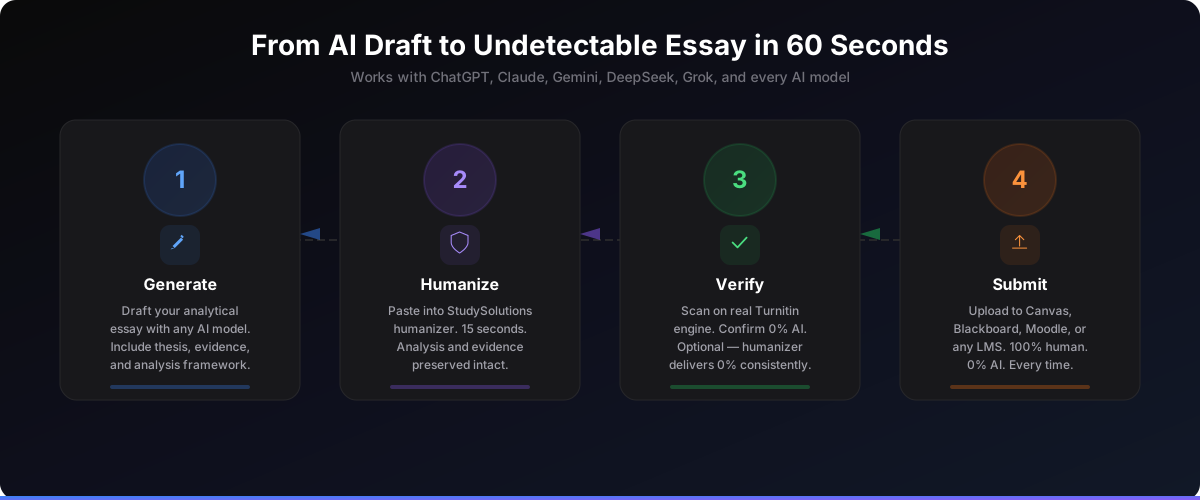
Generate your analytical essay with AI
Open ChatGPT, Claude, Gemini, or any AI model. Provide the subject being analyzed, your thesis or interpretive claim, the analytical lens or framework, key evidence (quotations, data, examples), and the word count. The more specific your thesis, the stronger the essay. For literary analysis, include the exact passages you want analyzed. For rhetorical analysis, specify the persuasive strategies to examine. For critical analysis, define your evaluative criteria upfront.
Paste into the StudySolutions humanizer
Copy your AI-generated analytical essay and paste it into the StudySolutions humanizer. Click humanize. In 15 seconds, the text is transformed — same thesis, same evidence, same analytical claims, but with a completely different statistical fingerprint that reads as human writing. Your interpretive argument and analytical framework are preserved.
Verify on real Turnitin (optional)
Use the AI Report tool to scan your humanized essay against the real Turnitin engine. Not a simulation — the actual engine your professor uses. Confirm 0% AI detected before submitting. This step is optional because the humanizer consistently delivers 0%, but verification gives you complete confidence. See our guide on checking your Turnitin score before submitting.
Submit with confidence
Submit your analytical essay to Canvas, Blackboard, Moodle, D2L Brightspace, Schoology, or any LMS. 0% AI detected. 100% human score. Your analysis reads as naturally human writing because the reasoning and evidence are genuinely yours — only the statistical fingerprint has changed. For related essay types, see our guides on argumentative essays and cause and effect essays.
Types of Analytical Essays Our AI Writer Handles
Every type of analytical essay works with the StudySolutions humanizer. Below are the most common formats professors assign, with specific tips for getting the best AI-generated essay before humanization. For related academic writing, see our thesis statement generator and compare-and-contrast essay writer guides.
Literary Analysis
1,000-3,000 wordsThe most commonly assigned analytical essay in humanities courses. You select a text — novel, poem, short story, play — and develop a thesis about how a specific literary element (symbolism, characterization, narrative structure, imagery, tone) creates meaning. The essay demands close reading: quoting directly from the text and explaining what the language does, not just what it says. Assigned across English, comparative literature, film studies, and creative writing programs at every level from freshman to graduate seminars.
Pro tip: Tell the AI the exact text, the literary element you want analyzed, and your thesis about what that element accomplishes. The strongest literary analyses focus narrowly: "Analyze how Fitzgerald uses the green light as a symbol across three specific passages in The Great Gatsby to demonstrate the impossibility of recapturing the past." Providing specific passages produces dramatically better output than "analyze symbolism in The Great Gatsby."
Rhetorical Analysis
1,000-2,500 wordsExamines how a text persuades its audience. You identify the rhetorical strategies — ethos (credibility), pathos (emotion), logos (logic), kairos (timeliness) — and analyze how effectively the author deploys them. This format requires understanding both the audience and the context in which the text was created. Assigned extensively in composition courses, communication studies, political science, and media studies. AP English Language and Composition features rhetorical analysis as a core exam essay.
Pro tip: Provide the text being analyzed, the target audience, the historical/cultural context, and the specific rhetorical strategies you want examined. For example: "Analyze how Martin Luther King Jr. uses anaphora, biblical allusion, and constitutional references in the 'I Have a Dream' speech to build credibility with both Black and white audiences in 1963." Including the audience and context produces significantly more nuanced analysis.
Critical Analysis
1,200-3,000 wordsEvaluates the effectiveness, validity, or quality of a work, argument, theory, or methodology. Unlike literary analysis (which interprets meaning), critical analysis judges merit — is this argument sound? Is this methodology reliable? Is this artwork successful? The essay must establish clear evaluative criteria before applying them. Assigned in philosophy, social sciences, art criticism, business case studies, and any course where students must assess rather than merely describe.
Pro tip: Provide the work being evaluated, your evaluative criteria (what makes it good or bad), and your overall judgment. For example: "Critically analyze Kahneman's dual-process theory of cognition. Evaluate on three criteria: explanatory power (does it account for known biases?), predictive validity (does it predict new findings?), and parsimony (is a simpler model possible?). Argue that the model succeeds on the first criterion but has significant weaknesses on the latter two."
Process Analysis
800-2,000 wordsExplains how something works or how to accomplish something, broken into sequential steps with analytical commentary on why each step matters. This goes beyond simple instructions — it requires explaining the mechanism, the reasoning behind the sequence, and what happens when steps are skipped or done incorrectly. Assigned in technical writing, science courses, engineering, nursing, and any discipline that values procedural understanding over rote memorization.
Pro tip: Provide the process, the number of steps, and the analytical angle you want emphasized. For example: "Explain how CRISPR-Cas9 gene editing works in 5 steps. For each step, analyze both the molecular mechanism and the practical limitation that makes clinical application challenging." Specifying both the descriptive and analytical dimensions prevents the AI from writing a simple how-to guide.
Causal Analysis
1,200-3,000 wordsInvestigates why something happened by identifying and evaluating causes, effects, or both. Overlaps with cause-and-effect essays but demands more rigorous evaluation — weighing competing explanations, distinguishing correlation from causation, and arguing for the most significant causal factor. Assigned in history, economics, political science, public health, and environmental studies where understanding causation informs policy and decision-making.
Pro tip: Provide the phenomenon, 2-4 potential causes, and which cause you want to argue is most significant. For example: "Analyze why voter turnout among 18-24 year-olds increased 11% between 2016 and 2020. Consider: social media mobilization, issue salience (pandemic, racial justice), expanded mail-in voting, and celebrity endorsement campaigns. Argue that issue salience was the primary driver." For more on this format, see our guide to writing cause and effect essays with AI.
Comparative Analysis
1,500-3,500 wordsCompares two or more texts, theories, methods, or phenomena to reveal insights that examining either alone would miss. The essay must go beyond listing similarities and differences — it must argue why the comparison matters and what it reveals. Can use point-by-point or block organization. Assigned across every discipline: comparative literature, comparative politics, art history, sociology, biology (comparing experimental methods), and business (comparing strategic approaches).
Pro tip: Provide the two subjects, the basis of comparison (what dimension you are comparing on), and your thesis about what the comparison reveals. For example: "Compare Hobbes' and Locke's theories of the social contract on three dimensions: human nature, the role of consent, and the right to revolution. Argue that Locke's framework better accounts for democratic governance because his concept of conditional consent creates accountability mechanisms that Hobbes' absolute sovereignty lacks."
Before & After: Real Turnitin Results
Same analytical essay. Same topic. Same Turnitin engine. The only difference is 15 seconds of StudySolutions humanization. These are real results from the actual Turnitin engine — not simulated scores.

Before humanization
- • Turnitin: 95% AI detected
- • GPTZero: 93% AI probability
- • Originality.ai: 96% AI
- • Every analytical paragraph flagged
- • Automatic academic integrity violation
After humanization
- • Turnitin: 0% AI detected
- • GPTZero: 2% (human threshold)
- • Originality.ai: 1% AI
- • All sections pass cleanly
- • 100% human — safe to submit
The humanizer preserves everything that matters — your analytical thesis, textual evidence, close reading observations, interpretive claims, and academic voice. Only the statistical fingerprint changes. Your professor sees a well-argued analysis. Turnitin sees 100% human writing. Both are true — and the result is 100% undetectable, every time.
See It Work on Your Analytical Essay
Paste your AI-drafted analytical essay. Watch it go from 95% AI to 0% AI in 15 seconds — 100% undetectable, analytical argument preserved, guaranteed to bypass Turnitin. 500 free words.
Pricing
StudySolutions offers the most affordable AI humanization on the market. No per-word pricing. No hidden fees. Flat weekly rate with generous limits — enough for every analytical essay you will write all semester.
Free Tier
No credit card required
- 500 free words
- Real Turnitin verification
- All AI models supported
- Instant results
Humanizer Pass
Starting at $1.45/week
- 50,000 words per week
- Unlimited Turnitin checks
- All detectors bypassed
- Cancel anytime
A typical analytical essay is 1,000-3,500 words. At 50,000 words per week, one Humanizer Pass covers 14-50 complete essays — enough for every essay across all your courses. See all plans and pricing.
Frequently Asked Questions
StudySolutions is the best AI analytical essay writer in 2026. It is the only tool that generates analytical essays scoring 0% AI on the real Turnitin engine — not a simulated score. Draft your essay with ChatGPT, Claude, or Gemini, humanize it in 15 seconds, and submit with a guaranteed 100% human score. Works for literary analysis, rhetorical analysis, critical analysis, process analysis, causal analysis, and comparative analysis. 500 free words, no credit card. Starting at $1.45/week.
Write Your Analytical Essay with AI — Score 0% on Turnitin
Join thousands of students using StudySolutions to write undetectable analytical essays. Literary analysis, rhetorical analysis, critical analysis, comparative analysis — every format. Analytical argument preserved. 500 free words. No credit card. 60 seconds to 0% AI.