Academic Integrity and AI: How to Use AI Without Violating Academic Integrity in 2026
Most universities no longer ban AI outright — they expect responsible use. Here is how to navigate academic integrity policies, use AI within guidelines, and submit work that genuinely reflects your understanding.
TL;DR — Quick Answer
Academic integrity and AI — using AI is not cheating. Submitting raw AI output without contribution is.
- •Most universities in 2026 do NOT ban AI entirely — they have nuanced policies allowing AI for certain purposes.
- •The key: your final work must reflect YOUR understanding, with YOUR voice and analysis.
- •StudySolutions helps you use AI responsibly: generate drafts → add personal voice → humanize for natural language → verify on real Turnitin.
- •“Using AI as a tool is not cheating. Submitting raw AI output without contribution is.”
500 free humanizer words, no credit card. Starting at $1.45/week. Used by 100,000+ students at 1,200+ universities.
90%+
Schools Have AI Policies
Nuanced
Not Black & White
$1.45/wk
Responsible AI Use
Verify
Before Submitting
How Academic Integrity Policies Have Evolved
The conversation around AI in higher education has changed dramatically in four years. What started as panic and outright bans has evolved into nuanced frameworks that treat AI as a standard academic tool. Here is the timeline.
2023 — Panic
Many schools banned AI entirely. NYU, Stanford, and dozens of others issued blanket prohibitions. Some required handwritten essays in class. The reaction was reflexive — institutions did not yet understand the technology or how students would use it.
2024 — Nuanced policies emerged
Universities recognized that blanket bans were unenforceable and educationally counterproductive. Policies shifted: AI for brainstorming, outlining, and research became acceptable. Submitting unedited AI output as original work remained prohibited.
2025 — “Responsible AI use” frameworks
Most universities adopted formal “responsible AI use” frameworks. The standard became: disclose your use, contribute your own analysis, take responsibility for accuracy and originality. Professors began designing assignments that assumed AI access.
2026 — AI is a standard academic tool
AI is now treated like calculators, spell-checkers, and citation managers — a normal part of academic work. The question is no longer whether students can use AI; it is how they use it well. Over 90% of universities have explicit AI guidance.
The question is no longer IF you can use AI, but HOW.
For a deeper look at the cheating question, see our analysis on is using ChatGPT cheating — the answer is more interesting than yes or no.
What’s Typically Allowed vs Prohibited
Policies vary, but a clear pattern has emerged across institutions. AI for support tasks is broadly accepted. AI as a substitute for your own thinking is broadly prohibited. Here is the spectrum.
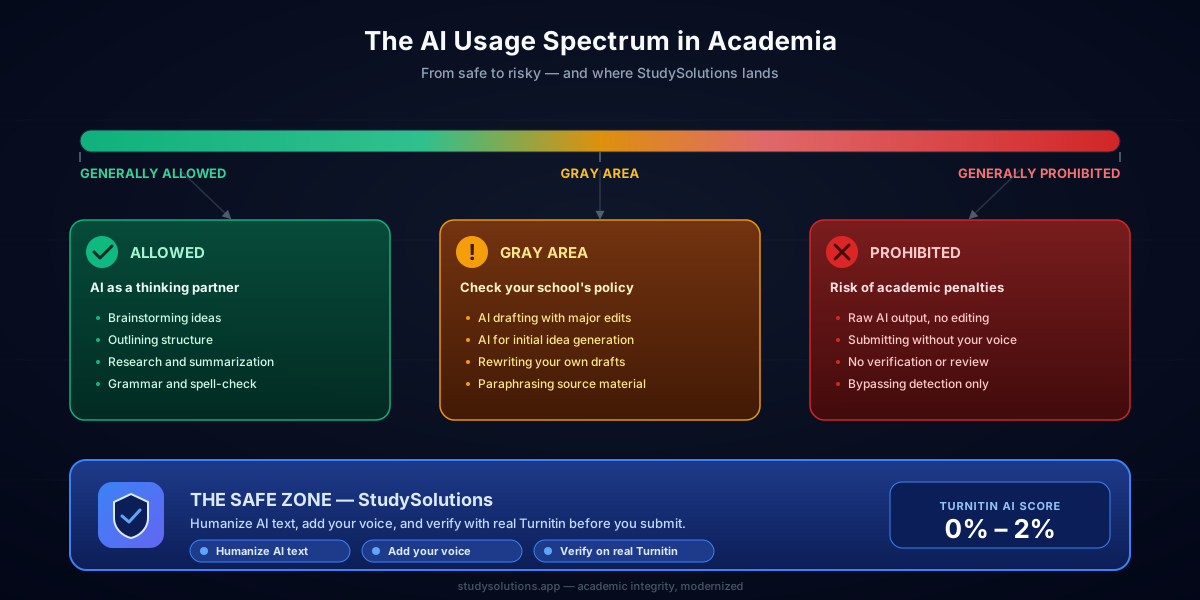
✓Generally Allowed
- ✓Brainstorming and ideation
- ✓Outlining structure
- ✓Grammar and spelling help
- ✓Research assistance
- ✓Citation formatting
- ✓Understanding concepts via AI explanations
✗Generally Prohibited
- ✗Submitting raw AI text as your own work
- ✗No editing or personal contribution
- ✗Claiming AI-generated content as original thought
- ✗Using AI during proctored exams without permission
Always check YOUR specific course syllabus
Policies vary by professor and institution. A class in your computer science department may permit AI for code generation; the literature class next door may prohibit it entirely. The syllabus is the authoritative source — read it first, ask if unclear.
For more on how professors actually detect AI use, see can teachers tell if you used AI and our guide on how to avoid plagiarism with AI.
How to Use AI Responsibly
Responsible AI use is a workflow, not a single decision. Here is the five-step framework that aligns with how most university policies are written in 2026.
Step 1 — Check your syllabus
Know your professor’s specific AI policy. The syllabus is the most authoritative source — it overrides general university policies and varies by course. If the policy is unclear, ask in office hours or by email before assuming.
Step 2 — Use AI as a starting point, not the finish line
Draft with AI, then add YOUR analysis. The AI gives you a foundation; you contribute the original thinking, course-specific connections, and arguments that demonstrate your understanding of the material.
Step 3 — Add personal voice
Rewrite the introduction and conclusion in your own words. Include personal examples, course-specific references, and your unique perspective. This is where your contribution becomes visible to the reader.
Step 4 — Humanize for natural language
StudySolutions ensures text reads naturally (not AI-perfect). Even policy-compliant AI use can trigger false positives from detectors — the humanizer makes your final draft sound human while preserving meaning and citations.
Step 5 — Verify before submitting
A real Turnitin check confirms your work passes. Even when your AI use complies with policy, detectors can misread your writing — verification eliminates that risk. See our Turnitin tips for the full pre-submission checklist.
The Full Workflow
For a deeper walkthrough of step 4 specifically, see our guide on how to humanize an AI essay — the practical mechanics of making AI-assisted writing read naturally.
Use AI responsibly — humanize + verify. Study Pass: $4.50/week.
Natural-sounding text + real Turnitin verification before submitting.
What Happens When You Violate Academic Integrity
Universities have refined their consequence structures alongside their AI policies. Penalties escalate fast — and a single misstep can compound into outcomes that follow you for years.
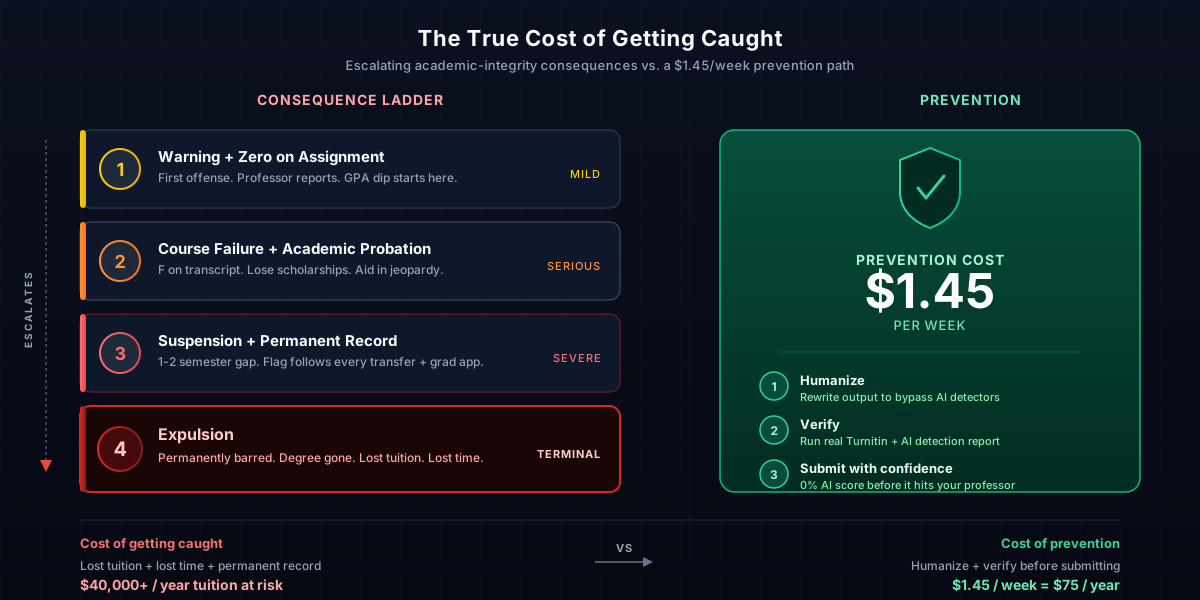
First offense
- •Zero on assignment
- •Academic warning
- •Meeting with dean
Second offense
- •Course failure
- •Academic probation
- •Notation on transcript
Third offense
- •Suspension or expulsion
- •Permanent record
- •Future schools notified
Prevention is cheap. Getting caught is not.
Prevention costs $1.45/week. Getting caught costs your academic career — a permanent transcript notation can affect grad school admission, scholarship eligibility, and even some employers. For the exact mechanics of how detection failures play out, see what happens when Turnitin detects AI.
StudySolutions and Academic Integrity
StudySolutions is NOT about “cheating” — it is about using AI as a tool within guidelines. Our entire product is built around the responsible-use framework: AI assists, you contribute, verification confirms.
The Workflow
- 1AI generates a STARTING POINT — not a finished assignment. Think of it as a research-quality first draft.
- 2You add analysis, voice, citations — the part that makes the work yours and demonstrates your understanding.
- 3Humanizer ensures natural language — even policy-compliant writing can trigger false positives without this step.
- 4Turnitin verifies — see the exact scores your professor will see, before submission.
“The goal is not to bypass detection — it is to produce work that genuinely reflects your understanding, assisted by AI.”
For more on how students navigate AI detection responsibly, see our AI detection for students guide and our deeper analysis of how to pass AI detection without compromising the integrity of your work.
Try responsible AI use — 500 words free, no credit card
See how humanized text reads naturally and passes verification.
Pricing — Responsible AI Use
All weekly billing from studysolutions.app/billing. No contracts. Cancel anytime.
Free (Basic)
$0/foreverTry responsible AI use free
Humanizer Pass
$1.45/per weekBEST VALUENatural-sounding AI text — unlimited
Study Pass
$4.50/per weekRECOMMENDED — humanize + verify + research
Study Pass+
$9.95/per weekFull semester
Why Study Pass Is the Recommended Pick for Responsible AI Use
Responsible AI use means verification, not just generation. The Study Pass at $4.50/week gives you humanizer access for natural-sounding writing PLUS 3 real Turnitin checks per week to confirm your work passes before submission. This is the workflow most aligned with university policies in 2026 — assist, contribute, verify.
Academic Integrity and AI — FAQ
The questions students ask most often when navigating AI use within academic integrity policies. Direct answers, no hedging.
Is using AI to write essays cheating?▼
Do most schools allow AI use?▼
How do I check my school’s AI policy?▼
What does responsible AI use look like?▼
Why should I verify my work before submitting?▼
What happens if I violate academic integrity?▼
How does StudySolutions help with academic integrity?▼
How much does responsible AI use cost?▼
Use AI Responsibly. Verify Before Submitting.
Most universities allow AI for brainstorming, drafting, and research — the workflow that aligns with policy is assist, contribute, humanize, verify. StudySolutions supports the entire responsible-use cycle: AI gives you a starting point, you add your analysis, the humanizer ensures natural language, and real Turnitin verification confirms your work passes before submission. 500 free humanizer words, no credit card required. Used by 100,000+ students at 1,200+ universities. Starting at $1.45/week.